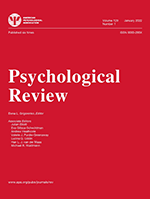
Psychological Review®
Psychological Review® publishes articles that make important theoretical contributions to any area of scientific psychology, including systematic evaluation of alternative theories. Papers mainly focused on surveys of the literature, problems of method and design, or reports of empirical findings are not appropriate.
There is no upper bound on the length of Psychological Review articles. However, authors who submit papers with texts longer than 25,000 words will be asked to justify the need for their length.
Psychological Review also publishes, as Theoretical Notes, commentary that contributes to progress in a given subfield of scientific psychology. Such notes include, but are not limited to, discussions of previously published articles, comments that apply to a class of theoretical models in a given domain, critiques and discussions of alternative theoretical approaches, and meta-theoretical commentary on theory testing and related topics.

Editor
John R. Anderson
Carnegie Mellon University
Associate Editors
Jerome R. Busemeyer
Indiana University Bloomington
Charles S. Carver
University of Miami
Susan T. Fiske
Princeton University
Harlene Hayne
University of Otago, Dunedin, New Zealand
Zhong-Lin Lu
The Ohio State University
John T. Wixted
University of California, San Diego
Consulting Editors
Aaron S. Benjamin
University of Illinois at Urbana-Champaign
David A. Balota
Washington University in St. Louis
Marlene Behrmann
Carnegie Mellon University
Marilynn B. Brewer
University of New South Wales, Sydney, Australia
Claus Bundesen
University of Copenhagen
Neil Burgess
University College London, London, United Kingdom
Linnda Caporael
Rensselaer Polytechnic Institute
Patrick Cavanagh
Université Paris Descartes, Paris, France
Kyle R. Cave
University of Massachusetts at Amherst
Nick Chater
University of Warwick, Coventry, United Kingdom
Charles Clifton, Jr.
University of Massachusetts at Amherst
Max Coltheart
Macquarie University, Sydney, New South Wales, Australia
M. Lynne Cooper
University of Missouri
Jennifer Crocker
Ohio State University
Gary S. Dell
University of Illinois at Urbana-Champaign
Jonathan St. B T Evans
University of Plymouth, Plymouth, United Kingdom
Lisa Feldman Barrett
Northeastern University
Wayne Gray
Rensselaer Polytechnic Institute
Tom Griffiths
University of California, Berkeley
Zenzi Griffin
University of Texas at Austin
Alice F. Healy
University of Colorado Boulder
Andrew Heathcote
University of Newcastle, Callaghan, New South Wales, Australia
Steve Heine
University of British Columbia, Vancouver, British Columbia, Canada
Lori L. Holt
Carnegie Mellon University
Peter R Killeen
Arizona State University
Roberta L. Klatzky
Carnegie Mellon University
Eileen Kowler
Rutgers University
Arie W. Kruglanski
University of Maryland at College Park
John K. Kruschke
Indiana University
Mark R. Leary
Duke University
Michael D. Lee
University of California, Irvine
Stephan Lewandowsky
University of Western Australia, Perth, Australia
Richard L. Lewis
University of Michigan
Gordon D. Logan
Vanderbilt University
Denis Mareschal
Birkbeck College
Brenda Major
University of California, Santa Barbara
Larry Maloney
New York University
Gail A. McKoon
Ohio State University
Timothy P. McNamara
Vanderbilt University
Janet Metcalfe
Columbia University
Scott M. Monroe
University of Notre Dame
Robert M. Nosofsky
Indiana University
Mike Oaksford
Birkbeck College, University of London, London, United Kingdom
David C. Plaut
Carnegie Mellon University
Roger Ratcliff
The Ohio State University
Keith Rayner
University of California, San Diego
Lynne Reder
Carnegie Mellon University
Erik D. Reichle
University of Pittsburgh
Joerg Rieskamp
University of Basel, Basel, Switzerland
Caren M. Rotello
University of Massachusetts
Dario D. Salvucci
Drexel University
Lael J. Schooler
Max Planck Institute for Human Development, Berlin, Germany
Suzanne C. Segerstrom
University of Kentucky
David R. Shanks
University College London, London, United Kingdom
Neil Stewart
University of Warwick, Coventry, United Kingdom
Niels Taatgen
University of Groningen, Groningen, The Netherlands
James T. Townsend
Indiana University
Marius Usher
Tel-Aviv University, Tel-Aviv, Israel
Eric-Jan Wagenmakers
University of Amsterdam, Amsterdam, Netherlands
Thomas S. Wallsten
University of Maryland
Elke U. Weber
Columbia University
Thomas Widiger
University of Kentucky
Wendy Wood
University of Southern California
Manuscript Coordinator
Abraham Anderson
Abstracting and indexing services providing coverage of Psychological Review®
- Academic Abstracts FullTEXT Ultra
- Academic ASAP
- Academic OneFile
- Academic Search Alumni Edition
- Academic Search Complete
- Academic Search Elite
- Academic Search Premier
- Academic Source Premier
- Addiction Abstracts
- AgeLine
- Book Review Digest Plus
- Business & Company Profile ASAP
- Business & Company Resource Center
- Business ASAP
- Current Abstracts
- Current Contents
- Current Index to Statistics
- Dietrich's Index Philosophicus
- E R I C (Education Resource Information Center)
- EBSCOhost MegaFILE
- Education Research Complete
- Education Research Index
- Educators Reference Complete
- Ergonomics Abstracts Online
- F R A N C I S
- Family Index
- Health & Wellness Resource Center
- Health Reference Center Academic
- I B Z - Internationale Bibliographie der Geistes- und Sozialwissenschaftlichen Zeitschriftenliteratur
- Index to Scientific Reviews
- InfoTrac Custom
- InfoTrac OneFile
- International Bibliography of the Social Sciences
- Internationale Bibliographie der Rezensionen Geistes- und Sozialwissenschaftlicher Literatur
- Journals@Ovid
- Linguistics and Language Behavior Abstracts
- M L A International Bibliography (Modern Language Association of America)
- MasterFILE Elite
- MasterFILE Premier
- MasterFILE Select
- MEDLINE
- Philosopher's Index
- ProQuest Central
- PsycINFO
- PubMed
- R I L M Abstracts of Music Literature (Repertoire International de Litterature Musicale)
- Reactions Weekly
- Russian Academy of Sciences Bibliographies
- Science Citation Index
- SCOPUS
- Social Sciences Citation Index
- Social Sciences Index/Abstracts
- Student Resource Center College
- Studies on Women and Gender Abstracts
- TOC Premier
- Wilson OmniFile Full Text Mega Edition
Prior to submission, please carefully read and follow the submission guidelines detailed below. Manuscripts that do not conform to the submission guidelines may be returned without review.
Submission
Submit manuscripts electronically (.doc or .pdf format) to:
John R. Anderson, PhD
Baker Hall 345D
Carnegie Mellon University
Pittsburgh, PA 15213
General correspondence may be directed to the Editor's office.
Do not submit manuscripts to the Editor's email address.
All submissions should be clear and readable. An unusual typeface is acceptable only if it is clear and legible.
In addition to addresses and phone numbers, please supply electronic mail addresses and fax numbers, if available, for potential use by the editorial office and later by the production office.
Keep a copy of the manuscript to guard against loss.
Masked Review Policy
Masked review is optional for this journal. Include authors' names and affiliations only in the cover letter for the manuscript. Authors who desire masked review should make every effort to see that the manuscript itself contains no clues to their identities.
Length
There is no upper bound on the length of Psychological Review articles. However, authors who submit papers with texts longer than 25,000 words will be asked to justify the need for their length.
Submissions must be under 5 MB in total size.
Manuscript Preparation
Prepare manuscripts according to the Publication Manual of the American Psychological Association (6th edition). Manuscripts may be copyedited for bias-free language (see Chapter 3 of the Publication Manual).
Review APA's Checklist for Manuscript Submission before submitting your article.
If your manuscript was mask reviewed, please ensure that the final version for production includes a byline and full author note for typesetting.
Double-space all copy. Other formatting instructions, as well as instructions on preparing tables, figures, references, metrics, and abstracts, appear in the Manual.
Below are additional instructions regarding the preparation of display equations and tables.
Display Equations
We strongly encourage you to use MathType (third-party software) or Equation Editor 3.0 (built into pre-2007 versions of Word) to construct your equations, rather than the equation support that is built into Word 2007 and Word 2010. Equations composed with the built-in Word 2007/Word 2010 equation support are converted to low resolution graphics when they enter the production process and must be rekeyed by the typesetter, which may introduce errors.
To construct your equations with MathType or Equation Editor 3.0:
- Go to the Text section of the Insert tab and select Object.
- Select MathType or Equation Editor 3.0 in the drop-down menu.
If you have an equation that has already been produced using Microsoft Word 2007 or 2010 and you have access to the full version of MathType 6.5 or later, you can convert this equation to MathType by clicking on MathType Insert Equation. Copy the equation from Microsoft Word and paste it into the MathType box. Verify that your equation is correct, click File, and then click Update. Your equation has now been inserted into your Word file as a MathType Equation.
Use Equation Editor 3.0 or MathType only for equations or for formulas that cannot be produced as Word text using the Times or Symbol font.
Tables
Use Word's Insert Table function when you create tables. Using spaces or tabs in your table will create problems when the table is typeset and may result in errors.
Submitting Supplemental Materials
APA can now place supplementary materials online, available via the published article in the PsycARTICLES® database. Please see Supplementing Your Article With Online Material for more details.
Abstract and Keywords
All manuscripts must include an abstract containing a maximum of 250 words typed on a separate page. After the abstract, please supply up to five keywords or brief phrases.
References
List references in alphabetical order. Each listed reference should be cited in text, and each text citation should be listed in the References section.
Examples of basic reference formats:
Journal Article:
Herbst-Damm, K. L., & Kulik, J. A. (2005). Volunteer support, marital status, and the survival times of terminally ill patients. Health Psychology, 24, 225–229. doi: 10.1037/0278-6133.24.2.225
Authored Book:
Mitchell, T. R., & Larson, J. R., Jr. (1987). People in organizations: An introduction to organizational behavior (3rd ed.). New York, NY: McGraw-Hill.
Chapter in an Edited Book:
Bjork, R. A. (1989). Retrieval inhibition as an adaptive mechanism in human memory. In H. L. Roediger III & F. I. M. Craik (Eds.), Varieties of memory & consciousness (pp. 309–330). Hillsdale, NJ: Erlbaum.
Figures
Graphics files are welcome if supplied as Tiff, EPS, or PowerPoint files. The minimum line weight for line art is 0.5 point for optimal printing.
When possible, please place symbol legends below the figure instead of to the side.
Original color figures can be printed in color at the editor's and publisher's discretion provided the author agrees to pay
- $255 for one figure
- $425 for two figures
- $575 for three figures
- $675 for four figures
- $55 for each additional figure
Permissions
Authors of accepted papers must obtain and provide to the editor on final acceptance all necessary permissions to reproduce in print and electronic form any copyrighted work, including, for example, test materials (or portions thereof) and photographs of people.
Download Permissions Alert Form (PDF, 47KB)
Publication Policies
APA policy prohibits an author from submitting the same manuscript for concurrent consideration by two or more publications.
See also APA Journals® Internet Posting Guidelines.
APA requires authors to reveal any possible conflict of interest in the conduct and reporting of research (e.g., financial interests in a test or procedure, funding by pharmaceutical companies for drug research).
Download Disclosure of Interests Form (PDF, 38KB)
Authors of accepted manuscripts are required to transfer the copyright to APA.
Download Publication Rights (Copyright Transfer) Form (PDF, 83KB)
Ethical Principles
It is a violation of APA Ethical Principles to publish "as original data, data that have been previously published" (Standard 8.13).
In addition, APA Ethical Principles specify that "after research results are published, psychologists do not withhold the data on which their conclusions are based from other competent professionals who seek to verify the substantive claims through reanalysis and who intend to use such data only for that purpose, provided that the confidentiality of the participants can be protected and unless legal rights concerning proprietary data preclude their release" (Standard 8.14).
APA expects authors to adhere to these standards. Specifically, APA expects authors to have their data available throughout the editorial review process and for at least 5 years after the date of publication.
Authors are required to state in writing that they have complied with APA ethical standards in the treatment of their sample, human or animal, or to describe the details of treatment.
Download Certification of Compliance With APA Ethical Principles Form (PDF, 26KB)
The APA Ethics Office provides the full Ethical Principles of Psychologists and Code of Conduct electronically on their website in HTML, PDF, and Word format. You may also request a copy by emailing or calling the APA Ethics Office (202-336-5930). You may also read "Ethical Principles," December 1992, American Psychologist, Vol. 47, pp. 1597–1611.
Other Information
- Psychological Review, The Centennial Issue
Special Isue of the journal Psychological Review, Vol. 101, No. 2, April 1994.