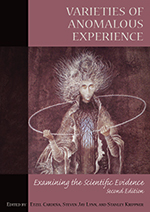
 Editors: Etzel Cardeña, PhD, Steven Jay Lynn, PhD, and Stanley Krippner, PhD
Publisher: American Psychological Association
Copyright year: 2014
ISBN: 978-1-4338-1529-4
Number of pages: 452
Price: $69.95 or $49.95 for members
Finally, a scientific book that provides a refreshing and healthy perspective about anomalous experiences that — to the general population of the Western culture in which many of us live — may not seem so normal. “Varieties of Anomalous Experience: Examining the Scientific Evidence, Second Edition” is a compelling book that explains to its readers in an objective and scientific manner what these experiences are and how they affect the psychological world.
An anomalous experience (AE) is explained as “an uncommon experience (e.g., synesthesia) or one that, although it may be experienced by a significant number of persons (e.g., psi experiences), is believed to deviate from ordinary experience or from the usually accepted explanations of reality according to Western mainstream science” (p. 4). In this second-edition book, edited by Etzel Cardeña, Steven Jay Lynn and Stanley Krippner, these experiences extend within the realm of various psychological occurrences. The book has chapters on hallucinations, lucid dreaming, alien abduction, anomalous healing, past life experiences, among others.
Cardeña, Lynn and Krippner start the book with a series of chapters from a research-based perspective, introducing the significance of differences between the individual and cultural aspects of AEs, historical concepts and understandings of theorists and why these experiences may be relevant. After reviewing the research methodology in comprehending AEs and the possible technical approaches a researcher might employ, they continue on to familiarize the reader with definitions of psychopathology, peculiarity and their relationship to AEs, social acceptability and the individual differences that contribute to AEs. Admittedly, the first few chapters seem to pass a bit slowly, as they are rather technical. However, the subsequent chapters provide an engaging, thought-provoking analysis of AEs, one that overcomes the inherent difficulty of describing and studying subjective experiences by supplementing the instances themselves with new neuroscience research and comprehensive scientific coverage of each experience discussed in the book.
One of the most remarkable concepts the editors convey is that across time and especially across cultures, people view and understand AEs differently. Hallucinatory experiences are acknowledged as acceptable and even normal, for example, in the Netherlands and Ancient Greece in the same way Western culture recognizes lucid dreaming as more or less normal for many people.
“The notion that each one of us represents a discrete, self-determining individual has been proposed to be a recent Western development” (p. 193). This book takes us outside our comfort zone and perspective, a perspective which we may believe to be accurate or definitive, and takes us into the minds of those millions of people who don’t base their every belief on “scientific fact.” Anomalous experiences are habitually ostracized and under-recognized in the Western world — and perhaps oftentimes associated with those who require psychological care. However, the editors report in the “Anomalous Self and Identity Experiences” chapter that there are many cases in which there is no evidence of a dissociative identity disorder when the experients (those who experience AEs) do report to have been possessed by a spirit. Psychics and mental mediums have been established to be psychologically healthy. In the chapter on abduction experiences, the editors make clear that experients of this type of AE are, scientifically, no less competent than their non-experiencing counterparts.
In the chapter on anomalous healing experiences, which the editors define as “recoveries from serious illnesses that defy explanations through conventional biomedical frameworks” (p. 273), again our perceptions are breeched as we are persuaded to consider that science does not have all the answers. Our perspective is broadened to read about resolved past life experiences, where experients have knowledge through no feasible means or had no previous exposure or belief in reincarnation, about proven factual information about other human beings concurrently living distantly from the experient. When reading about near-death experiences, when individuals “who had been pronounced clinically dead but were then resuscitated, who actually died but were able to describe their experiences in their final moments (‘deathbed visions’) or who, in the course of accidents or illnesses, feared that they were near death” (p. 334), science, psychological or otherwise, can literally not explain the why or the how. Maybe the most engaging part of this book is that it is all supported by verifiable facts and scientific explanations.
Furthermore, the reader learns about the subjectivity of concepts like mysticism and “the parameters that separate the normal from paranormal, the physical from the nonphysical, the nonmiraculous from the miraculous” (p. 278) and how these concepts have been construed or even perhaps negatively connoted in the Western-thinking mind.
“Varieties of Anomalous Experience” provides the reader with many references to the importance of the context and culture in which anomalous experiences take place. Many cultures do not believe AEs to be anomalous; they accept them as parts of the natural world. The book allows the Western mind to be open to a new perspective and learn from a scientific point of view about experiences that may in many ways persist to be unexplainable. It is an academic read, a comprehensive view into many so called “oddities” of the human experience. In discussing the possible natural causes as extremely viable roots for these experiences, as well as the importance of our thoughts and emotions, it shows us how these occurrences could happen to nearly any person. “Varieties of Anomalous Experiences” downplays, in a positive way, the “otherness” of AEs; it demonstrates to the reader a way to regard AEs as acceptable or even normal. Perhaps anomalous experiences are not so anomalous after all.