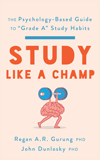
Regan A.R. Gurung, PhD, is a professor of psychology at the University of Wisconsin-Green Bay and the most recent winner of the Charles L. Brewer Distinguished Teacher of Psychology Award. Gurung writes about teaching pedagogy and psychology on his blogopens in new window.
Where, what and how you came to teach psychology
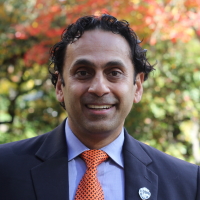 I teach at the University of Wisconsin Green Bayopens in new window. I teach intro psych; a first year seminar — "Gods, Ghosts, and Goblins: Why we believe; research methods; health psychology; and culture development and health."
I came to teach after doing a guest lecture (on relationships in a social psychology class) in graduate school, and then a TA. I got hooked. I taught my first class — health psychology, while I was a postdoc at UCLA, and my second class there as well (research methods). After that, I knew I wanted a teaching position.
Favorite aspects of the leadership roles you hold in the psychology world
There are three: meeting enthusiastic teachers who work hard for students and care about student well-being; sharing the wide world of pedagogy with those who may not have been as exposed to it; and the fact that it makes me reflect on my own teaching.
Philosophy of education
To deliver quality instruction and optimize student learning, I believe that as a good teacher I should:
- Have flexibility in my pedagogy.
- Focus on developing quality student-teacher interactions.
- Be excited about my material and the craft of teaching.
I am a passionate, organized and approachable instructor who works hard to be knowledgeable in my field and dynamic in my pedagogy. I believe that learning rarely happens automatically. The learner has to work hard. The teacher has to work hard. To some, learning comes more naturally. Similarly, some are natural teachers. I hold these assumptions to be true and the way I approach teaching and my students is driven by the basic belief that if I want learning to take place, I have to work hard at it and help my students to work hard at it as well. This is a somewhat basic teaching philosophy but if forms the foundation of a robust edifice.
Most important issue facing teachers of psychology
Knowing what evidence-based pedagogies are best to use in your class. Do not be oppressed by a need to cover content, but go beyond content to teaching skills and teaching students how to best learn.
Favorite “plug and play” strategy from your blog
A formative evaluation I give all my students after the first exam. I have them tell me four things:
- How I helped them learn.
- What I could do that could help them learn better.
- What they did to help them learn/do well.
- What they could do to learn better.
I then go back to the next class and go over each category and we all make changes based on their self-reflections.
Number one tool you want all teachers to utilize
Effective metacognition.
Favorite psychology books or websites
I like "Tools for Teachingopens in new window" by Barbara Gross Davis, which has great short pragmatic tips, and I enjoyed Gretchen Rubin’s book "Better Than Beforeopens in new window" on changing habits as I am working hard to help students make studying a habit. This sounds crazy but writing a book on model teaching with Aaron Richmond and Guy Boysen was also a great experience. I actually look at it often to remind myself of things that make model teachers.
How to promote critical thinking in our communities
Teachers should spread research methods knowledge. I love teaching the class, as I want my students to be good consumers of research and critical thinkers about the world. The tools in a research methods class can do this.
Favorite day(s) of class
First days are great for the chance to set the tone in general. I also really enjoy helping students design research studies. Pulling off a great closing day, tying things together well is very satisfying.
Funniest teaching moment
There are two memorable ones: The day I went to intro psych with 250 people and a full slideshow and the computer did not work. On the fly, I decided to go old school and write on the board and the overhead transparency projector. A fun day.
The funniest was after teaching about waist to hip ratios (Waist-hip ratio [WHR]; how women with .7 are perceived to be attractive) a student raised a hand and said, my roomie and I both have a .7 WHR but she is a hottie and I am not. Why? We all had a good time explaining that.
Favorite topic to teach
Gosh, too many. I love many aspects of my Gods, Ghosts and Goblins class (using experiments to test paranormal ideas); and love teaching evolutionary psychology, stress and coping and about different cultural approaches to health.
Least favorite topic to teach
I organize my content so that everything I teach I enjoy (ah, academic freedom).