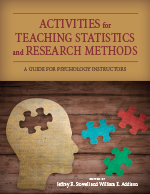
 Edited by Jeffrey R. Stowell, PhD , and William E. Addison, PhD
Pages : 192
Item # : 4316177
ISBN : 978-1-4338-2714-3
Publication date : March 2017
Format : Softcover
In this collection, co-editors Jeff Stowell and Bill Addison bring together a diverse and interesting set of classroom activities designed to enliven research methods and statistics courses. The book is divided into two parts, with the first 13 activities focused on statistics, and the latter 12 focused on research design. The book has something for everyone in that the activities range from the basic material covered in any high school psychology course that touches on research methods or statistics up to more complex topics more likely to be addressed in a college class focusing on statistics or research design.
In the sections on statistics and research design, the book is generally organized from the simpler or more basic concepts to the more complicated ones. For instance, some of the early activities in the statistics section focus on concepts like central tendency and variability while later ones get into significance testing, power and effect size.
The statistics section opens with an activity by Tamarah Smith about how to reduce student anxiety regarding statistics, an exercise that may help instructors make a potentially intimidating topic seem more welcoming. One of my favorite activities in this section, “How to Lie With the Y-Axis” by Thomas Heinzen, is helpful for illustrating how the manner in which numbers and graphs are presented can impact people’s perception of them. Given the plethora of software students can use to create visual representations of their data, it seems critical to educate students about making responsible and purposeful choices. Likewise, in “A Low-Anxiety Introduction to the Standard Normal Distribution and Measures of Relative Standing,” Laura Brandt and William Addison provide several activities that seem likely to help students translate the theoretical concepts of z scores and percentiles into something that actually impacts their lives.
The research design portion of the book includes activities that introduce most of the key aspects of research design such as experimenter and participant bias, random assignment, confounding variables and ethics. However, the section also includes exercises dealing with topics less uniformly covered in similar resources such as the coding of qualitative data and reliability in a naturalistic observation setting.
In “Everything is Awesome: Building Operational Definitions with Play-doh and Legos,” Stephanie Afful and Karen Wilson harness these omnipresent toys in an engaging exercise to show students the importance of clear operational definitions. In “The Most Unethical Researcher: An Activity for Demonstrating Research Ethics in Psychology,” Sue Frantz turns the more common approach of asking students to identify what researchers should do on its head by asking them to imagine an extreme example of ethical incompetence. Janie Wilson and Shauna Joye’s “Demonstrating Interobserver Reliability in Naturalistic Settings” sends pairs of students out to observe others in a public environment and gauge the creativity of the people they observe. After comparing an initial set of ratings, the exercise has students discuss their definitions of creativity and collect a new set of data in an effort to improve their reliability.
The audience for the book is clearly psychology and/or statistics instructors who are looking for ways to enrich their lessons. Some of the activities are straightforward and simple to set up, while others will require more of an investment of preparation time. The time spent will likely prove worthwhile in bringing some of the more elusive concepts to life.
About the reviewer
Allyson J. Weseley has been teaching for over 25 years at Roslyn High School in New York where she runs the Science Research Program, mentors students on in-house psychology projects, and founded the AP Psychology course. Allyson is one of the authors of the "Barron’s How to Prepare for the AP Psychology Exam" review book. She has also served as a reader and table leader for the AP Psychology exam and as the member-at-large of the APA Committee on Teachers of Psychology in the Secondary Schools. Allyson collaborated on an APA-sponsored guide for teachers interested in involving their students in science fairs and has published numerous empirical articles with her students. Allyson majored in psychology at Princeton University, received a master’s degree in teaching, curriculum and learning environments from the Harvard Graduate School of Education, and earned a doctorate in curriculum and teaching from Teachers College, Columbia University. She is one of the founders of the Long Island High School Psychology Fair and has served on the boards of a number of organizations dedicated to encouraging high school student research.