It was an honor to be able to participate in the first national summit on high school psychology education. However, I wasn’t sure that I was qualified to be working to create “the best future for psychology education.” It seemed like a tall order for someone who had only been teaching psychology for six years, so I was nervous to arrive at Weber State University.
As I waited to board my plane at O’Hare, my fears were allayed as Steve Jones and Brad Wray said hello and introduced themselves. These were two educators whose videos, lesson plans and blogs have provided me a roadmap over the past few years. I was overwhelmed by their kindness, inclusivity and humility. Educator after educator I met over the course of the summit treated me and all the newer teachers with professionalism and respect. I was so grateful for the opportunity to learn alongside high school psychology’s giants — men and women like Charlie Blair-Broeker, Randy Ernst, Amy Fineburg, Rob McEntarffer and Kristin Whitlock. After the initial shock that some of these colleagues cared what I had to say, I started reflecting. Why was I here? What was the mission of Strand 7: Diversity and Access? What unique contributions could I make?
 I teach African-American and Latino students on the southside of Chicago. My students are curious and analytical, college bound and incredibly hard-working. Many also happen to be from low-income families, some are undocumented and others will be the first in their families to attend college. As I reflected on that responsibility I realized I was there to ensure that the future of high school psychology considered students like mine as well as their experiences.
For the past six or seven years, I have had the privilege of attending National Council for the Social Studies (NCSS) conferences and the APA/Clark Workshop for High School Teachers. I have learned from #psychat and various teachers’ blogs about how to develop a psychology class that both challenges and supports my students. However, as I’ve benefited from these wonderful professional development opportunities, I often thought to myself, “I wish some of these examples had students of color” or “Why are there so few people of color among the psychologists featured in the psychology curriculum?"
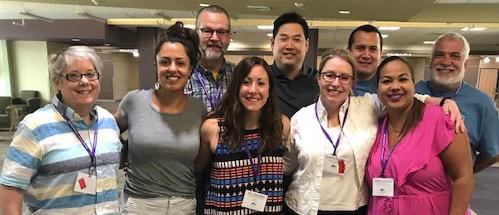
As I got to know my colleagues in Strand 7, at first over the phone and then in person, I quickly learned that these questions were plaguing them as well. Yadira, Carlos, Nikki, Steve, Sylvan, Wayne and I are each in classrooms with high school students who, in some ways, have been forgotten by traditional textbooks or traditional professional development experiences. Linda and Tammy are both teaching at the college level, but they also serve students who are considered diverse in a number of ways. We were all there to ensure that high school psychology education asks teachers to consider diversity issues when designing their courses.
At first, I was thinking about “diversity” as an umbrella term used to describe students of color; however, as we dove deeper into the material, it was clear that diversity is much broader. Every single classroom is diverse. Our work was not just for the nine of us to bring back to our schools; I realized that it was imperative to share our work with the rest of our colleagues at the summit and beyond. Although each classroom might not have students of color, classrooms are diverse along socioeconomic lines, ability/disability status, sexual orientation, gender identity, religions, etc. Also, while some classrooms may only have some segment of diversity, it is important for psychology’s materials to reflect the diversity of the world outside of an individual classroom, particularly if a class looks homogenous. Psychology is uniquely positioned to broaden students’ horizons and open their minds to new ways of understanding. We were charged with the task of trying to ensure that psychology considers the diversity of both students and the world.
Resources are important, but it's not just about sharing resources. We in Strand 7 realized that if we wanted to achieve the mission that the APA had empowered us to pursue, we had to think about the teachers who would be using those resources. Resources are not substitutes for a teacher who is truly committed to diversity. We decided that before we could expect teachers to use our resources, we had to give teachers the tools to be self-reflective on how well they understand issues surrounding diversity within themselves, their students, their classrooms and their school communities. Once teachers could see a need to be inclusive in their curriculum and instruction, we wanted to provide a list of resources that could be easily swapped with older, more traditional examples that might have been less inclusive of diverse populations. Next, our group brainstormed how to develop marketing materials and other professional development opportunities to ensure that psychology continues to attract more diverse students and teachers. Knowing the APA is concerned with pipeline issues, we thought attracting more diverse students into psychology classrooms was a solid first step.
While there is still much work to be done, my experience at the summit has already shaped me in profound ways. Since the summit, I have re-examined my course and am actively seeking ways to improve, particularly in consideration of the diversity in my students. I also led a school-wide professional development session during our in-service week to bring to light many of the issues we discussed this summer. If high school psychology’s giants continue to reflect, re-tool, ask questions and improve their practice, then so can I. I look forward to being part of the team that crafts what comes next.
Read additional participant reflections from the other seven summit strands in the fall 2017 NCSS-Psychology Community newsletteropens in new window.
About the author
 Nora Berdelle is a National Board Certified social science educator at Lindblom Math and Science Academy, a selective-enrollment high school on the South Side of Chicago. She received her master of science in education from Northwestern University in 2009. She is in her ninth year of teaching, and for the past six years, she has loved teaching AP psychology and introducing the rich and relatable content to her students. She also participated in the Hollyhock Fellowship at Stanford University where she worked to deepen her content knowledge, improve her pedagogy and work for greater equity in her school community. This summer, she enjoyed working with her colleagues on issues related to diversity and access at the APA Summit on High School Psychology Education.