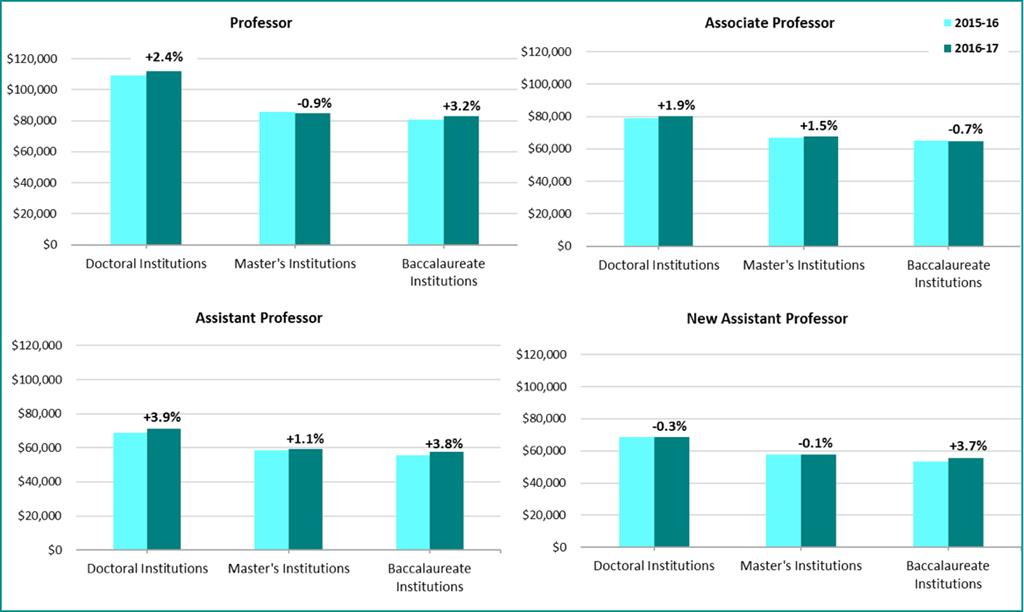
A new report from APA’s Center for Workforce Studies examines salaries for psychology faculty employed full-time at four-year colleges and universities during the 2016-17 academic year. Among its findings are that, when adjusted for inflation, faculty salaries between 2015-16 and 2016-17 increased slightly. However, salaries in some categories remained stable across these academic years and, in some cases, decreased somewhat (see figure).
Key findings include:
- Tenured/tenure-track psychology faculty employed at private independent institutions earned the highest salaries — more than faculty at public and private religious institutions — across all academic ranks. Psychology faculty employed at private religious institutions had the lowest median salaries.
- Tenured/tenure-track psychology faculty working in the Pacific division of the United States (i.e., Alaska, California, Hawaii, Oregon and Washington) earned the highest median salaries. Faculty in the East South Central division (i.e., Alabama, Kentucky, Mississippi and Tennessee) earned the lowest salaries.
- For psychology tenured/tenure-track positions, the majority of faculty in the academic ranks of new assistant professor, assistant professor and associate professor were female. However, there were more male faculty than female faculty in the position of professor.
- Psychology faculty working at public institutions with collective bargaining units earned more than psychology faculty who worked at public institutions without collective bargaining units.
- In general, psychology faculty earned less than faculty working in other social science disciplines, as well as faculty in science, technology, engineering and mathematics (STEM) or STEM-related disciplines.
The report presents information on salaries by academic rank, tenure status, institution type, presence or absence of collective bargaining units, geographic division, and gender and race/ethnicity of faculty. The report analyzed data from the College and Universities Professional Association for Human Resources annual compensation survey for faculty in higher education.
Visit the APA CWS Center for Workforce Studies for additional reports on psychologists and psychology students.
About the author
 Peggy Christidis received her PhD in cognitive psychology from the Claremont Graduate University. She is currently a senior research officer for the Center for Workforce Studies at the American Psychological Association. Prior to coming to APA, she conducted functional magnetic resonance imaging research at the National Institute of Mental Health.