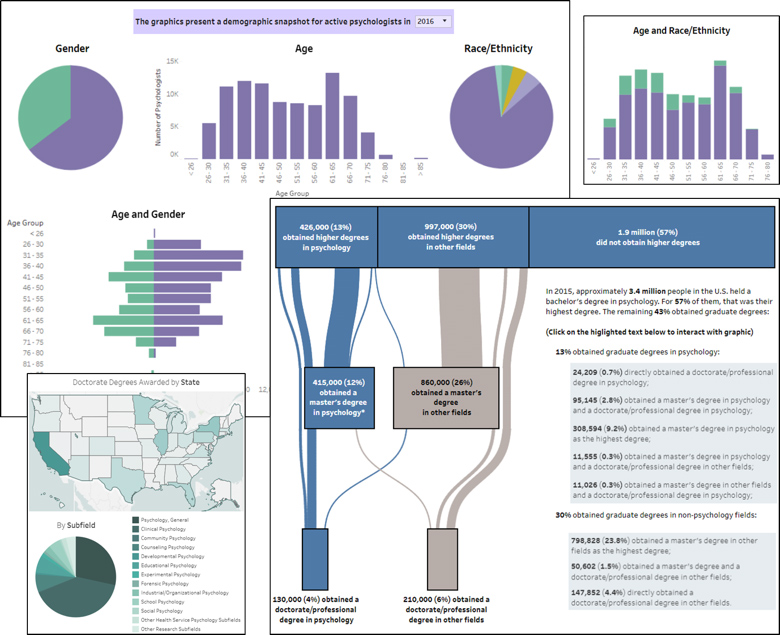
Did you know that an estimated 3.4 million individuals in the United States hold a bachelor’s degree in psychology? Or did you know that younger psychologists are more racially/ethnically diverse than older ones? The APA Center for Workforce Studies recently launched a series of interactive data tools to answer questions about the psychology workforce and education pipeline. Hold your mouse over the graphs and figures, and a box pops up with additional information.
Among other topics, the data tools cover:
- Degrees in psychology. Four dashboards display bachelor’s, master’s, and doctorate degrees in psychology and an overview of degrees awarded in psychology. By default, the separate dashboards show data for all years. Filters can show a single year or range of years. The master’s and doctorate degree dashboards can be filtered by health service psychology or research subfields.
- Workforce demographics. This tool shows trends in gender, age, race/ethnicity, disability status and select combinations of these characteristics. The workforce demographics tool can show individual years 2000-2016.
- Degree pathways in psychology. This data tool contains one dashboard showing pathways from bachelor’s degrees in psychology and another dashboard showing pathways to doctorates in psychology.
- Careers in psychology. This data tool displays an occupation word cloud and employment characteristics by level of highest degree in psychology.
The Center for Workforce Studies receives frequent requests for these types of information. We are trying to move away from dense, static reports to more user-friendly data visualizations. Through the data tools, people will be able to find the workforce and education information they need.
At the bottom, each data tool has additional technical details and a recommended citation. Icons at the bottom right corner allow users to share the data tools, download PDF versions or view the dashboard full screen.
About the author
 Karen Stamm, PhD, is the director of the American Psychological Association’s Center for Workforce Studies. Her research has focused on women in science, health behaviors in older adults, and the psychology workforce and education pipeline. She received her MA and PhD in psychology (with a focus on quantitative methods and research methodology) from the University of Rhode Island and BA in psychology and English from Boston College.