Authors: Thomas Gilovich and Lee Ross
Pages: 307
ISBN: 978-1-4516-7754-6
Publication date: 2016 (Free Press, an imprint of Simon and Schuster)
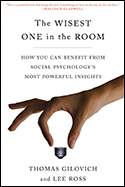 "The Wisest One in the Room" covers many aspects of social psychology. In its first five chapters, it explains various principles, such as the subjective nature of reality, how the circumstances one is in influence behavior, the plasticity of emotions and personal beliefs, and how prior held beliefs and ideologies affect how information is perceived and interpreted. The authors go through these principles of social psychology by explaining various experiments and theories, such as naive realism, explaining how people misinterpret their own biases as enlightenments, or how cognitive dissonance causes radical change in personal beliefs, as was evidenced by a thorough analysis of the Festinger study.
In the second half of the book, the authors make use of the principles and theories that they described earlier to apply to the reader’s life. They discuss one’s perception of happiness and some of the controversial science behind the biases that plague negotiating. In the final two chapters, Gilovich and Ross tackle two pressing issues of American policy: the problems facing minorities in school (due to self-fulfilling prophecy and stereotype bias) and attempting to tackle climate change (using framing and social influence as mechanisms to bring about change). In those last two chapters, they explain some of the psychological mechanisms that can be used to mitigate such problems.
Overall though, the main message that Gilovich and Ross convey is that if one learns about the psychological phenomena that shape how people perceive the world and interact with it and others, they can develop a sense of wisdom. Wisdom is defined by Gilovich and Ross as having insight into others, having a good sense of judgement, and being able to understand other peoples' perspectives and motives. Both Gilovich and Ross are well qualified to write this book and possess expertise in social psychology. Gilovich is a professor of psychology at Cornell University specializing in behavioral economics and decision-making, and his work on the relation between happiness and purchases has been widely cited. Ross, a professor of psychology at Stanford University, is noted for his work in developing the notion of the fundamental attribution error. The book is well written and full of examples that make the theories and ideas being described more understandable to the interested reader. The organization of the book also contributed to its strength, as it began by introducing some of the ideas of social psychology in the first half and applying them in the second.
One of the most useful parts of the book is covered in chapter 4, “The Primacy of Behavior,” concerning the relationship between one’s cognitions and emotions with one’s behavior. More specifically, this chapter describes the influence of one’s individual perception on shaping how he or she encodes stimuli and events; their cognitive evaluation of the stimuli and events causes them to behave in a certain way. It is fascinating when the authors describe how easy it is to change emotion by changing behavior (based on Schachter's theory of emotion) or how a misallocation of emotions can be responsible for an experience on a bridge making men more aroused (Dutton and Aron Bridge Study). One of the best points in the book is their contrast of Bem’s self-perception theory with Festinger’s cognitive dissonance theory to explain that behavior is often indicative more of attitudes than attitudes are of behavior. Additionally, regarding cognitive dissonance, the authors make an interesting point regarding the relationship between dissonance reduction and rationalization. Rationalization is the process by which an individual justifies controversial behavior to themselves. The point the authors put forward is that dissonance reduction is just one type of rationalization. As Gilovich stated in an email in response to a question I wrote him, “According to Festinger, dissonance processes kick in to deal with the psychological discomfort that results from the recognition that one of our cognitions is inconsistent with another. So, dissonance reduction is one type of rationalization, or one family of rationalizations, and one can rationalize in other ways and for other reasons as well.” (T. Gilovich, personal communication, Oct. 2, 2017).
The book is designed to educate readers about how other people think, how they themselves think, and how many factors are simultaneously at play affecting how individuals interact with others and their environments.
For a psychology teacher, "The Wisest One in the Room" would be valuable as a classroom supplement for a social psychology unit or a summer reading assignment, especially as a resource for students as it covers the majority of the key elements of social psychology: the fundamental attribution error; cognitive dissonance; stereotype threat; the false consensus effect; Bem’s self-perception theory; and confirmation bias and pluralistic ignorance. It supports all of these principles with examples based in practice, along with brief descriptions of the studies that originated them, which often involves some of the most important experiments in all of social psychology, like Festinger’s study of dissonance reduction and Asch’s study on conformity. The book can give students the basic knowledge of social psychology they would need to meet most course expectations.