APA’s Online Psychology Laboratory (OPL) can bring psychological experience to students more easily than ever. OPL has been renovated to enhance students’ experience in learning psychology whether they use desktop or laptop computers, tablets or other mobile devices. Changes in OPL are meant to streamline student and teacher use of OPL in the classroom, the lab or anywhere a student chooses to access it. And, as before, OPL is available for use without charge.
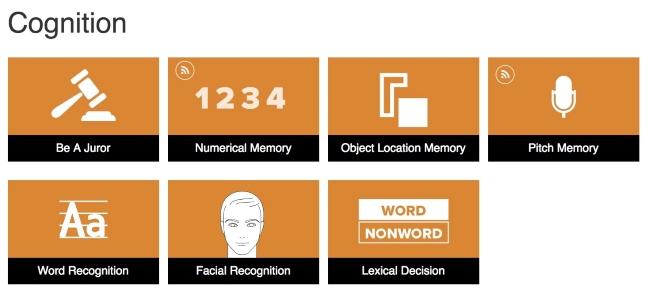
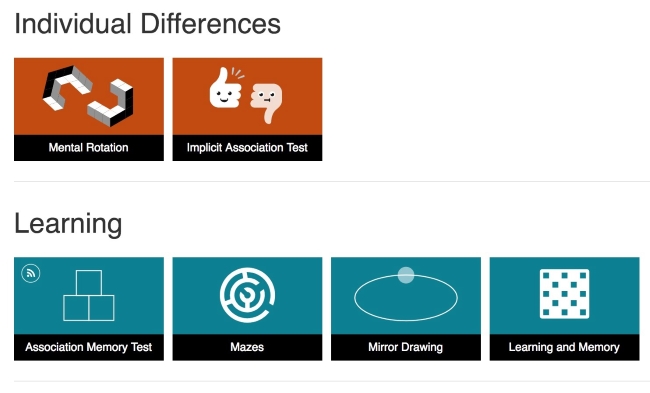
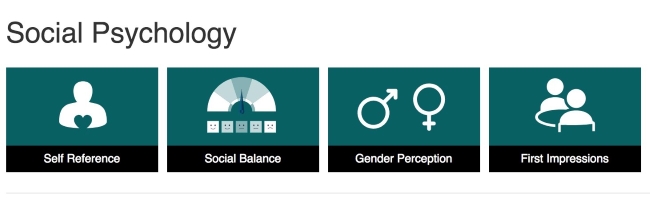
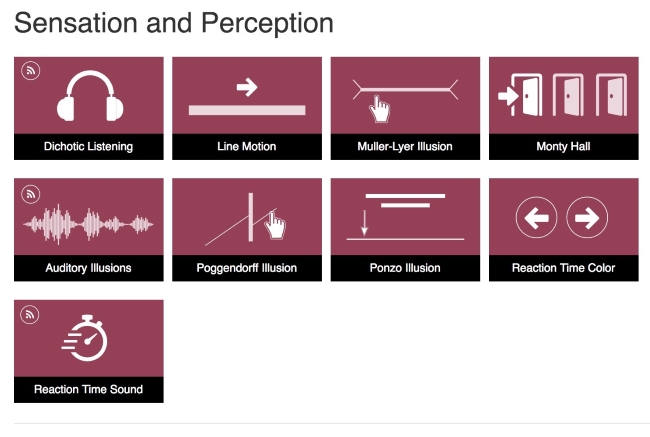
The new version of OPL will be recognized by previous users as having 26 different data collection exercises in cognition, individual differences, social psychology, learning and sensation and perception. In addition, students can explore wide realms of psychology in the areas of biological basis of behavior, developmental psychology, memory and others. The images below show the different data-collection modules that are available.
The exercises are appropriate for students at all levels. For instance, beginning students can learn basic concepts of psychology with interactive modules. Teachers could introduce students to psychology via the "Demonstrations" component. Most introductory-level textbooks present biological aspects of behavior very early in the course.
As such, classes using OPL could access the demonstration for the action potential that demonstrates the movement of ions across a cell membrane or students could view the sensory homunculus showing the relative amount of brain tissue devoted to sensation of different body parts. Students can also see a simulated view of ion movement as it is affected by different kinds of drugs.
When students move to the next section of the class, they can engage in interactive exercises related to sensation and perception. For example, students can see the effect of different hues and saturation in additive color mixing. The OPL demonstrations also feature some of the standard illusions that fascinate students, like the Ponzo and Poggendorf illusions, size illusions and others. There is also a data-collection exercise for the Ponzo illusion that students could complete after being exposed to the demonstrational module.
As students advance, they can engage in data collection exercise. In the two minute "Be a Juror" experiment, students in different groups evaluate a simple trial scenario and provide a judgment of guilt. After the data collection, which can be done in class or individually outside of class, teachers can compile the data to see how participants in the different groups responded. For students who have completed a statistics class, the data can be downloaded for statistical analysis. An added benefit is that teachers who have small classes can merge their class data with the data from students at other schools in order to generate a meaningful sample size.
At a more advanced level, students can complete studies like "Mirror Drawing" and "Mental Rotation." These particular modules closely mimic the procedures of classic research studies. The data are amenable to simple descriptive statistics but can also be used for more sophisticated statistical treatment for advanced students.
One of the advantages of the newly renovated OPL activities is that they are generally accessible through a wide range of devices. The initial version of OPL was limited to desktop or laptop computers. The new version allows users to interact with the experiments and demonstrations on virtually any device. Some activities aren’t available on cell phones because of display issues, but the majority will work well regardless of the platform.
Teachers who already have an OPL account will need to register again in the updated version of OPL. There is no need to be a member or affiliate of APA. Teachers (and students) can create their accounts independent of membership. This has not changed.
As noted above, there is no cost to use OPL. One addition, though, is that APA has created an app for accessing OPL material on mobile devices. The app sells for $1.99 although students do not need it for desktops or laptops. In fact, many (but not all) modules function on a mobile phone.
In summary, OPL can foster learning through the presentation of psychological concepts in static and in interactive modes. This material can supplement student use of textbooks. In addition, students can learn how psychologists conduct experiments, acting as research participants. At an upper level, students can also conduct data analysis. So, OPL can be useful as students move through different educational levels.
About the author
 Barney Beins is professor of psychology at Ithaca College, where he has taught since 1986. His scholarship includes humor studies and the scholarship of teaching and learning. Over the course of his career, he has authored or edited over 30 books, instructors’ manuals and encyclopedias, and over 130 refereed articles, book chapters, encyclopedia entries, and reviews and commentaries.
His books include "The Worth Expert Guide to Scientific Literacy: Thinking Like a Psychological Scientist" (with Ken Keith; Worth Publishing), "Research Methods: A Tool for Life" (Cambridge University Press, 4th ed.), "Research Methods and Statistics" (with Maureen McCarthy; Cambridge, 2nd ed.), "APA Style Simplified" (Wiley-Blackwell), "Effective Writing in Psychology" (with Agatha Beins; Wiley-Blackwell, 2nd ed.), "Successful Research Projects" (Sage). He also served as general editor for the seven-volume "Student Handbook of Psychology" (Facts on File), for which he wrote one volume (Methods and Measurements) and co-wrote a second (Learning and Cognition).
He was the 2010 recipient of the Charles L. Brewer Distinguished Teaching Award from the American Psychological Foundation. He is a fellow of the Association for Psychological Science; APA Divs. 1 (Society for General Psychology and Interdisciplinary Inquiry), 2 (Society for the Teaching of Psychology, STP), 3 (Society for Experimental Psychology) and 52 (Society for International Psychology), the Eastern Psychological Association, and the New England Psychological Association.