Author: Sarah-Jayne Blakemore
Publisher: Public Affairs Books 2018
ISBN number: 978-1-61039-731-5
Pages: 240
Price: $27 hardcover
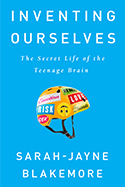 Sarah-Jayne Blakemore takes on the confusing and turmoil-filled time of adolescence in her new book, "Inventing Ourselves: The Secret Life of the Teenage Brain." Rather than taking the common view of vilifying teenagers for their nature, she attempts to understand and explain teenagers to her readers while avoiding demonization of teens. Blakemore’s background includes a professorship in cognitive neuroscience at University College London. She is an accomplished, award-winning scientist who has been recognized as one of only four scientists in the Sunday Times 100 Makers of the 21st Century in 2014. As a researcher on adolescents, she has a greater understanding and ability to communicate to the lay person.
Blakemore lays out the argument for adolescence in the first chapter called, “Adolescence isn’t an aberration.” One highlight within her examination of development is discussion of a cross-cultural study by Laurence Steinberg at Temple University. The study examined sensation-seeking (increasing from age 10-19 and decreasing in the 20s) and self-regulation (increased during the teens and 20's and leveling out during the 20s). Adolescence is not just an American phenomenon. Blakemore also examines the brain imaging studies that have been done on teens. While teachers of psychology will probably enjoy the research descriptions (and possibly use them for class), the lay reader may come away frustrated at the level of neuroscience in the book.
Chapter 2 explains how our sense of self and the tastes we develop in our teenage years can shape and influence attitudes and preferences about music, fashion, politics and morality for our entire lives. Blakemore also uses several cross-cultural examples and research. The complexity of our decision-making increases as our frontal lobe develops and creates connections with the limbic system. In the early chapters, Blakemore explains the various developmental and social processes teens experience in a sort of primer for adults and a reminder for teachers.
Chapter 3 examines how teens feel the need to fit in with peers and offers several stories to illustrate the risky choices teens can make. Blakemore posits a see-saw model of the social influence teens face to respond to drive and text. The importance of peer opinions outweighs the other side of the see-saw with opposing social, legal and health factors telling the teen not to text and drive. The author asserts that while all people can succumb to social pressures, teens are more likely to do so. She cites examples and research to support the claim.
Chapter 4 delves into the brain, literally. Here the author examines brain structure and function, with both text and diagrams — again, teachers will enjoy the review while many lay readers will find it onerous. Phineas Gage makes an appearance as does synaptic pruning and HM. Chapter 5 contains lots of research and stories related to brain imaging techniques.
Brain plasticity and neural/structural brain changes during a lifetime are examined in depth. Few general psychology texts go into the detail that is presented here. Teachers will find answers to challenging class questions including how the brain is impacted by experience as well as damage. Descriptions of research on specific brain functions and development are a joy to read.
Additional issues and topics that Blakemore covers include the following:
- The social mind, the theory of mind, the autism spectrum, facial recognition and studies designed to examine these concepts.
- The use of brain scans in attempting to ascertain how one learns to understand other people (including facial expressions).
- The impact of sleep and sleep deprivation on the brains of teens.
- Potential changes in the educational system that could be made with the increased knowledge we have about the brain and learning.
- Risk-taking and the relation between rates of development and size of the amygdala, the prefrontal cortex and the nucleus accumbens (possible hypersensitivity of the limbic system during adolescence leading to increased risk-taking).
- How marketing messages are received and interpreted differently by teens.
- How experiences can have negative impact on the brain and lead to later life challenges.
In sum, this book is an excellent read for psychology teachers desiring a stronger background in neuroscience and research. The book is written at a high level, leaving many lay readers not familiar with neuroscience or research to perhaps struggle through reading it. For those in the psychology field, it is a refreshing read explicating how modern neuroscience researchers pose questions and creatively research them. This is a high-quality book for any teacher who wants to review research on the adolescent brain. This book is also a nice addition to any library collection.