Have you used any of the assessments available through APA’s Project Assessment?
Project Assessment is a digital repository spearheaded by APA’s Committee on Associate and Baccalaureate Education (CABE). The repository contains peer-reviewed assessment tools and resources freely available for use by undergraduate faculty and high school teachers. The repository is searchable by topic and type, and the assessments are aligned with the "APA Guidelines for the Undergraduate Psychology Majoropens in new window" and with the "National Standards for High School Psychology Curricula." While the repository does require a registration, there is no cost to use the exemplars contained within the database.
 The range of exemplars in Project Assessment includes some that are suited for use as formative assessments, some as summative assessments, some as course level, topic level or program level assessments. Some exemplars may be single use and still others can be used as pre-post assessments. Topics in Project Assessment include development, ethics, workforce psychology, cognition, biopsychology, sociocultural, research methods and social psychology. The different types of assessments range from discussion topics to final papers, creative projects to more traditional exams, as well as some resources for program review. Each exemplar has instructions on how to use the assignment, and most include a grading rubric to accompany the assignment. While each exemplar includes information about past usage, teachers are encouraged to share their own experiences with the assessments and to be creative in their application.
For example, "APA Guidelines 2.0 Goal 5 on Professional Development" is one that tends to be more difficult to evaluate. One of the exemplars in Project Assessment is “The Value of Psychology in Professional Domains Scale” by Naufel, Bodily, Holtzman, Ryan and Steirn. The measure was designed as a single point evaluation of students’ perceptions of the impact of psychology in multiple career areas. However, it is also a valuable tool when used in a pre-post method as a program student learning outcomes measure. Specifically, using the exemplar at the beginning of a course in introductory psychology and then again at the end of their undergraduate career can provide useful data on their growth within the major.
Whether or not you have used an exemplar from Project Assessment, CABE would like to encourage teachers at the high school or undergraduate level to submit their best assessment exemplars. The process is simple; create an account, and once logged in, there is a link for you to submit an exemplar (“Become an Author”; see details below). This is beneficial not only to Psychology teachers, but to you, as an author of a peer-reviewed assessment tool.
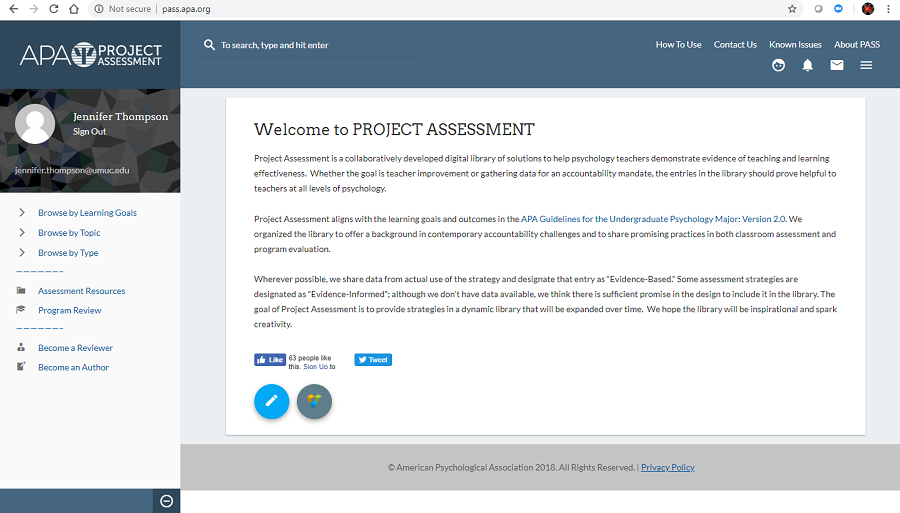
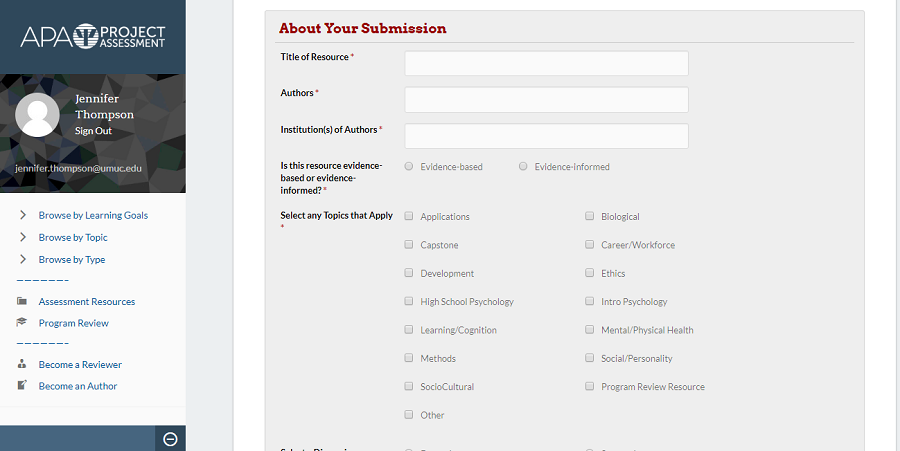
To submit, you will be asked to give your contact information and information about the assessment resource or exemplar. This information includes selecting topics that may apply, such as methods, capstone or ethics. It also includes information about the type of resource, such as a paper, creative product or presentation. In addition, we ask that you self-identify areas of alignment with the undergraduate learning goals featured in "Guidelines 2.0 or the APA National Standards."
Once you have filled in this information, prepare your assessment specifically including three areas: an overview which describes the assessment; specific instructions for use of the assessment; and targeted scoring criteria; a grading rubric or an answer key. Then simply upload your assessment or resource. A member of the editorial board will be in touch once the peer-review process is complete. There is also a link for if you are interested in becoming a reviewer.
Anyone with innovative evidence-based or evidence-informed assessments is invited to submit them for review through the Project Assessment website. Happy assessing.
About the author
 Jennifer Thompson, PhD, is program chair and collegiate professor in the department of psychology at University of Maryland University College (UMUC). Jennifer has been with UMUC for over 12 years. Prior to teaching at UMUC, she completed a postdoctoral fellowship in the voice, speech and language section of the National Institute on Deafness and Other Communication Disorders at the National Institutes of Health. Her research focused on functional imaging studies of language in patients with Parkinson's disease and patients with Cochlear Implant devices as well as studies on text comprehension. Jennifer is the past co-chair of the APA Committee on Associate and Baccalaureate Education and is currently the program chair for applied psychology for the Eastern Psychological Association. Jennifer received her BA in Psychology and American History from Vanderbilt University in Nashville, Tennessee, and received both her MA and PhD in psychology from American University in Washington, D.C. with a concentration in cognitive and experimental psychology.