The American Psychological Association convened a Summit on Introductory Psychology in Washington, D.C., on July 18-21, 2019. This meeting was the latest step in addressing a three-year charge from the APA Board of Educational Affairs (BEA) to make evidence-informed recommendations for introductory psychology.
Appointed by the APA BEA, members of four working groups, including the APA Introductory Psychology Initiative (IPI) Steering Committee, met to address the challenges inherent in teaching introductory psychology. The four APA IPI working groups are:
- Student Learning Outcomes and Assessment
- Course Models and Design
- Teacher Training and Development
- Student Success and Transformation
At the summit, the working groups made significant progress in addressing why the introductory psychology course is important, formulating guiding principles to teach the course, shaping training for instructors, and crystallizing the ways the course can enable student success and transformation. The IPI Summit participants also finalized a set of student learning outcomes for the introductory psychology course, in addition to providing valuable course design and assessment examples.

The IPI Summit participants.
At the IPI Summit, working groups collaborated on compiling materials that were made available to instructors for a Fall 2019 IPI Pilot. The Fall Pilot was launched in early August to introductory psychology instructors, giving those who were interested an opportunity to “field test” some of the recommendations proposed through the Introductory Psychology Initiative. An invitation to participate in the Fall Pilot was sent out to instructors who already had indicated an interest in the activities of the IPI. The steering committee is planning for a spring 2020 IPI pilot. Instructors who are interested in participating in the next IPI pilot should contact IPI via email by Jan. 30, 2020.
Recommended introductory psychology student learning outcomes (SLOs)
The IPI Summit participants’ list of expected student learning outcomes articulate what introductory psychology students should know and be able to do by completing the course. Closely aligning with APA’s new Strategic Initiatives, the outcomes emphasize essential concepts and themes, skills that promote scientific thinking about behavior and mental processes, and ethical reasoning in psychology. These learning outcomes are recommendations from the IPI Steering Committee and IPI working groups and do not represent APA policy.
In an introductory psychology course, students are expected to:
- Identify basic concepts and research findings, and give examples of psychology's integrative themes:
○ Psychological science relies on empirical evidence adapting as new data develop.
○ Psychology explains general principles that govern behavior, while recognizing individual differences.
○ Psychological, biological, social, and cultural factors influence mental processes and behavior.
○ Our perceptions filter experience of the world through an imperfect personal lens.
○ Applying psychological principles can change our lives in positive ways.
- Apply psychological principles to everyday life.
- Draw appropriate, logical, and objective conclusions about behavior and mental processes from empirical evidence.
- Evaluate misconceptions or erroneous behavioral claims based on evidence from psychological science.
- Design, conduct or evaluate basic psychological research.
- Describe ethical principles that guide psychologists in research and therapy.
In addition to developing these SLOs for the course, the APA IPI team is also working to analyze responses from the first ever Introductory Psychology Census. Prior to the 2019 IPI Summit, the IPI Steering Committee identified a critical need to examine how introductory psychology is being taught. This goal led to the construction and distribution of an Introductory Psychology Census which garnered approximately 750 instructor responses and a large amount of descriptive data related to the four areas of the IPI. The committee also developed the Census Plus, a follow up survey, which asked instructors and their students for more detail about what was being done in their introductory psychology course(s) and what impact these practices had on student learning. Armed with this data, IPI working groups used their time together at the summit to begin making evidence-informed recommendations.
Next steps for the APA Introductory Psychology Initiative include continued data collection, presenting at teaching conferences and regional meetings, gathering feedback on the IPI recommendations, and submitting a final book manuscript to APA in December 2020. Opportunities to participate in course design institutes are being planned for the latter half of 2020 and in 2021.
Stay tuned for announcements about the roll-out of the IPI recommendations at APA 2020 in Washington, D.C., and the 2020 STP Annual Conference on Teaching in Pittsburgh. To join the mailing list for IPI, contact IPI via email.
About the Author
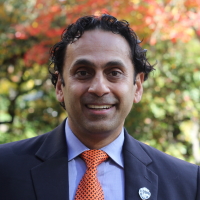 Regan A. R. Gurung, PhD, is professor of Psychological Science, director of the General Psychology Program, and interim executive director of the Center for Teaching and Learning at Oregon State University.
A social psychologist by training, his research encompasses social, health and pedagogical psychology. After an undergraduate education at Carleton College, he earned his PhD at the University of Washington in Seattle, was a National Institute of Mental Health postdoctoral fellow at University of California Los Angeles, and spent 20 years at the University of Wisconsin-Green Bay. He has published articles in a variety of scholarly journals including the American Psychologist, Psychological Review and Personality and Social Psychology Bulletin, and Teaching of Psychology, and is also the co-author/co-editor of 15 books. His textbook "Health Psychology: Well-Being in a Diverse World" is now in its 4th edition (SAGE). He recently published the "Handbook of Health Psychology" (2019, co-edited with Tracey Revenson) and is currently working on a "Field Guide to Research Methods: Creating Savvy Consumers of Science", and "Studying Like a Champion: Applying Cognitive Science to Everyday Life" (with John Dunlosky).
He is honored to have won numerous teaching awards such as the American Psychological Foundation’s Charles L. Brewer Award for Distinguished Career in Teaching Psychology, The National Council for the Advancement and Support of Education’s Wisconsin Professor of the Year, the University of Wisconsin System Regent’s Teaching Award, and the University of Wisconsin-Green Bay Founder’s Award for Excellence in Teaching as well as the Founder’s Award for Scholarship. He is fellow of the American Psychological Association, the Association for Psychological Science, and the Midwestern Psychological Association. A past-president of the Society for the Teaching of Psychology (APA Div. 2), he is President of Psi Chi, the International Honor Society in Psychology and is the founding co-editor of APA's journal Scholarship of Teaching and Learning in Psychology. He is currently co-chair of the APA Introductory Psychology Initiative.