


Why does the Introductory Psychology course matter?
An estimated 1.2 to 1.6 million undergraduate students take Introductory Psychology (IP) each year as an introduction to the psychology major, to fulfill a general education requirement, or to learn more about human behavior. Given the popularity and reach of this course, it has the potential to:
- Attract talented and diverse students into the discipline
- Elevate students’ understanding of psychological science as an essential tool that can be used to address complex societal challenges
- Help students to cultivate academic, career, and personal skills that can improve their quality of life and overall functioning
Explore the APA IPI webpage
Use the following links to jump to the different major sections of the page and learn more about this initiative. You can use your browser’s back button to jump back to the top of the page.
Recommendations from the IPI Working Groups
Full report and recommendations
Transforming Introductory Psychology
A full report of the process and recommendations for the future of the teaching of introductory psychology is available in the APA book entitled Transforming Introductory Psychology: Expert Advice on Teacher Training, Course Design, and Student Success.
Summary of recommendations
Student learning outcomes (SLO) and assessment
APA adopted a set of Introductory Psychology Course Student Learning Outcomes (PDF, 40KB)opens in new window that can serve as a meaningful framework for selecting and organizing course material. Instructors are encouraged to use backward design to construct their course:
- Articulate desired student learning outcomes
- Select instructional methods and course content that will promote desired learning
- Choose assignments/assessments that measure students’ achievement of selected learning outcomes
Course models and design
Instructors are encouraged to:
- Use evidence-based instructional methods to promote learning
- Diversify course content and promote inclusion
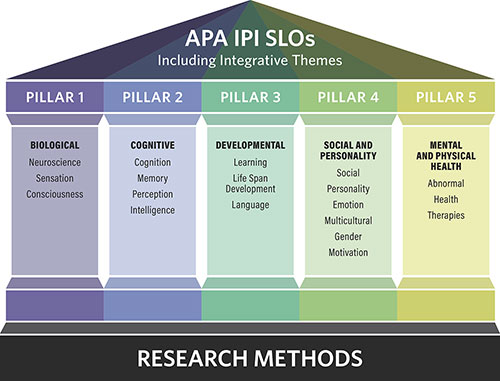
- Consider using the pillar model to guide content selection (covering at least two topics from each of the five content pillars)
- Emphasize how scientific inquiry serves as a foundation for all content
- Use the Psychology’s Integrative Themes (PDF, 43KB)opens in new window document as a coherent, defining course framework
Teacher training and development
Training opportunities should be designed and offered to help new instructors apply best practices in teaching to the content and themes of IP:
- Trainings should be modifiable to accommodate the varying needs of diverse instructors and institutional contexts.
- Collaborative networks and communities of practice are required to sustain course modifications and promote continued innovation.
Student success and transformation
IP should be taught as a transformative course that helps students begin to cultivate the skills needed for academic, career, and personal success. A well-planned course can teach students:
- Effective study skills such as retrieval practice, distributed practice, and interleaving that promote elaborative processing
- Career and work skills such as project management, critical thinking, scientific literacy, and communication
- Personal skills such as self-regulation, ethical decision-making, and stress management
Initiatives to support educator adoption
Learn more about resources and initiatives available to support educators in adopting the IPI recommendations.
Sample syllabi
Examples of how some instructors have incorporated the IPI recommendations into their courses can be found in the following syllabi:
- Jenel Cavazos, University of Oklahoma
Elements of Psychology Syllabus 2024 (PDF, 2865 KB)opens in new window - Regan A. R. Gurung, Oregon State University
General Psychology Syllabus (Winter 2024) (PDF, 96KB)opens in new window - Erin Hardin, University of Tennessee
General Psychology Syllabus (Fall 2021) (PDF, 1MB)opens in new window - Garth Neufeld, Cascadia College
General Psychology Syllabus (PDF, 277 KB)opens in new window
Assignments and lessons
The Project Assessmentopens in new window (PASS) database includes assignments and assessments that may be relevant to your course. In addition, members of the IPI working group and other educators have shared sample assignments and lessons. We also invite you to review a sample Integrative Themes assessment (PDF, 63KB)opens in new window, a lesson plan for improving study skills through psychological science (PDF, 38KB)opens in new window, an assignment asking students to consider how to apply psychological content across careersopens in new window.
Videos
Mini lecture on stress and health in the introductory psychology class
In this mini lecture, Danae Hudson, PhD, of Missouri State University weaves integrative themes through instruction on stress and health and includes some sample questions to assess learning.
Sample Multiple Choice Questions for Stress and Health (PDF, 96KB)opens in new window
Video: Targeting Difficult Concepts in Stress and Healthopens in new window
Assessing personality: A class learning activity
Gail Gottfried, PhD, of Claremont McKenna College, discusses ways to integrate research into introductory psychology using the Big Five personality tests.
Course Design Institute
The APA Center for Education in Psychology sponsored a free multi-session virtual Course Design Institute (CDI) to help Introductory Psychology instructors integrate recommendations from APA’s Introductory Psychology Initiative into their course. These videos from the CDI share some of the key presentations from this event.
-
Transforming Introductory Psychology: 1. IPI recap and Teaching Introductory Psychology with confidenceopens in new window
Presenters: Regan A. R. Gurung, PhD, Oregon State University; Garth Neufeld, MA, Cascadia College -
Transforming Introductory Psychology: 2. Embracing transforming outcomesopens in new window
Presenter: Jane S. Halonen, PhD, University of West Florida -
Transforming Introductory Psychology: 3. Moving From outcomes to teaching strategiesopens in new window
Presenter: Jane S. Halonen, PhD, University of West Florida -
Transforming Introductory Psychology: 4. Forecasting student performanceopens in new window
Presenter: Jane S. Halonen, PhD, University of West Florida -
Transforming Introductory Psychology: 5. Drafting your transformation planopens in new window
Presenter: Jane S. Halonen, PhD, University of West Florida -
Transforming Introductory Psychology: 6. Authentic assessmentsopens in new window
Presenters: Karen Brakke, PhD, Spelman College; Jenel T. Cavazos, PhD, University of Oklahoma; Carolyn Brown-Kramer, PhD, University of Nebraska, Lincoln
- Transforming Introductory Psychology: 7. Instructional methodsopens in new window
Presenters: Jennifer McCabe, PhD, Goucher College; Erin E. Hardin, PhD, University of Raechel Soicher, PhD, Oregon State University - Transforming Introductory Psychology: 8. Infusing diversity into Introductory Psychology (Part 1)opens in new window
Presenters: Shawn C.T. Jones, PhD, Virginia Commonwealth University - Transforming Introductory Psychology: 9. Infusing diversity into Introductory Psychology (Part II)opens in new window
Presenter: Shawn C.T. Jones, PhD, Virginia Commonwealth University - Transforming Introductory Psychology: 10. Psychology can change the world; Integrating diversity, equity, and inclusion in Introductory Psychologyopens in new window
Presenter: Catherine A. Sanderson, PhD, Amherst College - Transforming Introductory Psychology: 11. Strategies to enhance engagement and belonging in Introductory Psychology
opens in new window Presenter: Bridgette M. Hard, PhD, Duke University
Early IPI Adopters Conference
APA convened early adopters of IPI to learn more about their experiences and needs
Conference Report

Stay informed about new opportunities and resources
Join an APA Intro Psych Community listserv with periodic updates about the APA Introductory Psychology Initiative (IPI). For additional resources on undergraduate teaching, see our Associate and Baccalaureate Education webpage.

Other conference presentations on IPI
This content is disabled due to your privacy settings. To re-enable, please adjust your cookie preferences.
Psychology One Conference
Workshop: Now what? A process for starting to adopt the APA’s IPI recommendations in your class.
Presenter: Melissa Beers, PhD, The Ohio State University
This content is disabled due to your privacy settings. To re-enable, please adjust your cookie preferences.
Teaching Introductory Psychology Northwest Conference
Help students see the bigger picture: An integrative “themes” approach to teaching introductory psychology
Presenter: Bridgette Martin Hard, PhD, Duke University
TIP Northwest 2021 Teaching Activitiesopens in new window
Access 31 complete activities, organized according to Theme # and Pillar. The activities have a description, directions for implementation, notes to the instructor, and additional resources. These activities are released with a CC-BY-SA license. You may download, share, and modify these activities with attribution to the original team.

Introductory Psychology Initiative Co-Chairs
- Regan A. R. Gurung, PhD
Oregon State University - Garth Neufeld, MA
Cascadia College
SLOs and Assessment
- Jennifer Thompson, PhD, co-chair
University of Maryland University College - Kristin Whitlock, MEd, co-chair
Davis HS/Weber State University - Jane Simmons Halonen, PhD
University of West Florida - R. Eric Landrum, PhD
Boise State University - Sue Frantz, MA
Highline College
Course Models and Design
- Bridgette Hard, PhD, co-chair
Duke University - Dana S. Dunn, PhD, co-chair
Moravian College - Danae Lisa Hudson, PhD
Missouri State University - Robin Musselman, EdD
Lehigh Carbon Community College - Aaron Richmond PhD
Metropolitan State University of Denver
Teacher Training and Development
- Bill Altman, PhD, co-chair
SUNY Broome Community College - Melissa Beers, PhD, co-chair
The Ohio State University - Erin E. Hardin, PhD
University of Tennessee - Jordan D. Troisi, PhD
Colby College - Elizabeth Yost Hammer, PhD
Xavier University of Louisiana
Student Success and Transformation
- Katherine Wickes, PhD, co-chair
Blinn College - Stephen L. Chew, PhD, co-chair
Samford University - Jerald L. Rudmann, PhD
Irvine Valley College - Karen Naufel, PhD
Georgia Southern University - Guy A. Boysen, PhD
McKendree University
APA Staff
- Martha Boenau, MS, Robin Hailstorks, PhD, and Sue Orsillo, PhD
Precollege and Undergraduate Education, Education Directorate
Historical background for the initiative
The call for a focus on Introductory Psychology has its origins in the 2008 APA National Conference on Undergraduate Education in Psychology (Undergraduate Education in Psychology: A Blueprint for the Future of the Discipline, Halpern, 2010).
In the years since the 2008 conference, the APA Board of Educational Affairs (BEA) appointed two working groups focused on introductory psychology who produced the following reports: the BEA Working Group Report on Strengthening the Common Core of the Introductory Psychology Course and the BEA Working Group on Assessing Introductory Psychology. These initiatives resulted in a set of key recommendations for future work on introductory psychology (Gurung et al., 2016). In 2016, APA sponsored the Summit on National Assessment of Psychology. This summit brought together 45 experts in educational assessment to develop an online, searchable database of assessment tools.
Project Assessment (PASS)opens in new window is an online library that features assessment tools that are aligned with the learning goals and outcomes described in the APA Guidelines for the Undergraduate Major (PDF, 1MB)opens in new window, including assessments for the Introductory Psychology course.