



Between her health and her schoolwork, something had to give. Michelle Manno, who is studying for a master's degree in educational psychology at Hunter College, was facing a spate of all-nighters and gulping down four large cups of coffee each day to stay alert. Within a few weeks, she came to need the coffee for another reason: If she didn't drink it, she became irritable and had migraines. Manno didn't like having a caffeine dependency, but "the benefits of helping me with my schoolwork outweighed its negative implications for my health," she says.
Caffeine is the most widely used drug in the world, consumed by some 80 percent of American adults every day. It's probably safe to say that caffeine's most popular vehicle, coffee, is a mainstay for many psychology grad students. A 2012 surveyopens in new window conducted on behalf of Dunkin' Donuts and CareerBuilder showed that scientists drink more coffee than any other professional group except food workers.
But while its cultural pervasiveness suggests caffeine is benign, it's actually a powerful psychoactive compound. Caffeine does have its cognitive perks — including boosting alertness, energy and feelings of well-being — but overuse can cause a range of unpleasant side effects, including troubled sleep, jitters, irritability and gastric distress. Further, caffeine dependence can become a hard-to-shake habit, leading to a full-blown substance use disorder, research has shown.
"I wouldn't deny anybody their coffee, but people might benefit from becoming aware that caffeine use has the potential to become a problem and impact their physical or mental health," says Alan Budney, PhD, a professor of psychiatry at Dartmouth Medical School. "Caffeine is similar to most other drugs that are reinforcing, which caffeine is. People desire the effect and repeat the behavior over and over again. When reinforcers like that are easily accessible and inexpensive, their use may get out of control."
The brain boost
Caffeine is chemically similar to the neuromodulator adenosine, which accumulates through the day and induces drowsiness for sleeping at night. When we consume caffeine, it binds to adenosine receptors in the brain, blocking the effects of adenosine, with the side benefit of allowing dopamine to flow more freely. That can bring on feelings of well-being, energy and alertness.
A number of studies suggest that caffeine measurably boosts cognitive performance, helping to speed up reactions and sustain attention, though as Simone Cappelletti, MD, of Sapienza University in Rome, and colleagues suggested, those benefits may be helpful only to those who need caffeine to avoid withdrawal from a habit of consuming it in the first place (Current Neuropharmacologyopens in new window, 2015).
Caffeine may also have mental health benefits over time. For one, it has been associated with a lessened risk of depression. Michael Lucas, PhD, of the Harvard T.H. Chan School of Public Health, and colleagues followed more than 50,730 women in the Nurses' Health Study for almost 25 years, finding that those who drank at least four cups of coffee a day had a 20 percent reduced risk of depression compared with those who drank little or no coffee (Archives of Internal Medicineopens in new window, 2011). Another study from Lucas of nearly 43,600 men found that drinking two to three cups of coffee a day was correlated with a 50 percent reduced risk of suicide (The World Journal of Biological Psychiatryopens in new window, 2013).
A cup of coffee might even help consolidate learning. Michael Yassa, PhD, an experimental psychologist at the University of California, Irvine, led a team of researchers who discovered that nonhabitual caffeine users who took 200 milligrams (roughly the amount in a 12-ounce cup of coffee) of the substance were better able to remember differences among sets of pictures, though it's not clear yet how the caffeine helped (Nature Neuroscienceopens in new window, 2014).
Caffeine has also been associated with reducing the risk of cognitive decline. A review by Lenore Arab, PhD, an epidemiologist at the University of California, Los Angeles, and colleagues concluded that caffeine consumers overall had less cognitive decline than people who didn't use caffeine (Advances in Nutritionopens in new window, 2013). The protective effect is stronger in women than in men, suggests a cohort study of 309 women in the Journal of Alzheimer's Diseaseopens in new window (2010) by Catarina Santos, PhD, and colleagues at the University of Porto in Portugal.
Epidemiological studies suggest that caffeine may inhibit memory disorders, too. Research in animals suggests it slows the production of the protein beta-amyloid, which has been linked to Alzheimer's progression. Another mechanism may be how caffeine interacts with adenosine receptors; research with humans and animals is building the case that these receptors play an important role in Alzheimer's disease, Parkinson's disease and schizophrenia, according to a review by Jiang-Fan Chen, MD, PhD, a neurologist at Boston University (International Review of Neurobiologyopens in new window, 2014).
Disordered drinking
But some people experience drawbacks to using caffeine. A daily dose of 400 milligrams or less — about three to four cups of home-brewed coffee — is generally considered safe by the Food and Drug Administration, but smaller amounts can trigger side effects, such as restlessness, insomnia and a rapid heartbeat in people who are particularly sensitive to caffeine's effects. Pregnant women are advised to limit intake to 200 milligrams a day at most.
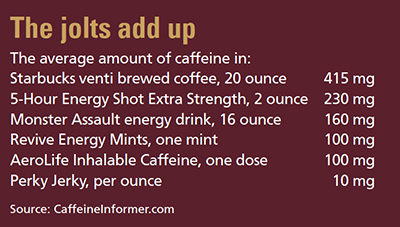 Five cups of coffee and more may bring on worsening symptoms, including anxiety, agitation, headache, rambling speech and excitement, what the DSM-5 calls "coffee intoxication." It's a line casual users may occasionally cross, as many people build up a tolerance for caffeine that leads them to consume more of it over time, says Laura Juliano, PhD, a professor of psychology at American University and a leading researcher on the topic.
Caffeine does help us stay up later, delaying the onset of melatonin, the hormone that helps us sleep; a dose equivalent to a what's in a double espresso taken three hours before bed led participants to go to sleep 40 minutes later on average, according to a 2015 study in Science Translational Medicineopens in new window by Tina Burke, PhD, of the University of Colorado Boulder. However, the caffeine pushed participants' entire circadian rhythm back, meaning they got up later, too — an effect perhaps unwelcome for those with 8 a.m. classes.
Then there is caffeine's addictive factor. If you think you can't possibly give up your coffee habit, you may be right. Many users can't stay away from caffeine, even though it might intensify their related health problems. That's a primary criterion of "caffeine use disorder," a condition the DSM-5 deems worthy of more research. Other potential symptoms include trying to quit but being unable to, craving, suffering withdrawal after stopping, using more than intended and spending a great deal of time with the drug. Sound familiar? Yet here, too, caffeine's ubiquity may help us turn a blind eye to our dependency.
"The world doesn't broadcast that caffeine can be an addictive drug that might cause problems," Budney says. "Certainly its overuse might not be as scary as other drugs; the consequences aren't so dramatic. Such less severe consequences, however, may reduce awareness or concern about a potential problem that could prompt taking action."
According to the DSM-5, caffeine withdrawal syndrome occurs when people skip a dose of caffeine and experience headaches, fatigue, depression and trouble concentrating. These are clinically well-documented symptoms that can be severe. In fact, research suggests many people use caffeine just to avoid these symptoms — though others, especially children and adolescents, may not understand why they feel sluggish and have a raging headache.
"Many people don't realize they are dependent on caffeine until they skip it for a day and experience caffeine withdrawal," Juliano says.
The drug is notorious for causing the jitters and anxiety, particularly at higher doses. People with underlying mental health issues may be more susceptible: a review of eight studies found that caffeine aggravated symptoms of anxiety and panic disorder (Expert Review of Neurotherapeutics, 2011).
Wise use
Want to try to limit your caffeine intake? Try these research-based tips:
- Delay having coffee for at least an hour after you wake in the morning since that is when your body doesn't actually need a caffeinated pick-me-up: Soon after waking, your body produces cortisol, a natural energy booster, so save your coffee breaks for mid-morning or the early afternoon, when cortisol levels dip, advises Dartmouth University neuroscientist Steven Miller, PhD.
- Similarly, if you don't habitually drink caffeine, consider drinking it only when you really need a functional boost, such as before a long drive or particularly long seminar, Juliano suggests.
- Caffeine can interfere with sleep when consumed as long as six hours before bedtime, reducing sleep by an hour and interfering with sleep efficiency and REM patterns, according to a study by Christopher Drake, PhD, of the Henry Ford Hospital in the Journal of Clinical Sleep Medicineopens in new window (2013). So time your intake accordingly.
- There are no formal guidelines to help people get off caffeine, but strategies that are effective in stopping other problem behaviors such as smoking, drinking alcohol or overeating may help, psychologists say. They include stimulus control, such as learning to watch out for triggers that spur caffeine use and asking friends to help you reach your goal, Budney suggests. Juliano has been developing and testing manualized treatment to help people reduce caffeine use. An early test, in press in the Journal of Consulting and Clinical Psychology, suggests that keeping a daily diary of consumption is effective. Also, gradually cutting back on caffeine may help you avoid withdrawal symptoms.