


While student debt has grown in recent years, starting salaries appear to be remaining static, according to a survey of 1,283 graduate students and early career psychologists in Training and Education in Professional Psychology®, 2016.
According to the survey, the median first-year salary of a psychologist with any graduate degree is $60,000 — a number that hasn't risen in about a decade. However, the cost of graduate-level tuition has risen 250 percent over the past few decades, as the TEPP study cites. Students and new psychologists have a median anticipated debt load of $110,000 — PhDs are looking at $75,000 and PsyDs $160,000 — upon finishing doctoral studies, excluding undergraduate debt, the authors found. That can lead to monthly payments of hundreds of dollars.
"I think the reality is that many individuals, once in the [training] pipeline, experience moments of ‘If I knew then what I know now, would I do it again?'" says lead study author Jennifer Doran, a doctoral student at The New School for Social Research in New York City.
Starting salaries vary according to field of work, though. According to the TEPP study, the highest paying subfields are clinical neuropsychology ($72,500), industrial/organizational ($65,000) and social psychology ($63,000). That reflects a higher demand for psychologists with expertise in a niche area.
Meanwhile, when adjusted for inflation, psychology salaries for new doctorates have declined from a median of $64,000 in 2009, based on data that APA's Center for Workforce Studies (CWS) reported that year. That may reflect lingering effects of the Great Recession of 2007-09 and a general salary trend in the United States. Faculty salaries have also not increased much since 2002, according to CWS data (see box below).
"Psychology faculty often make less than faculty working in other STEM departments such as physical sciences, biological sciences, computer science and engineering," says Peggy Christidis, PhD, senior research officer at CWS.
What can new graduates expect to earn?
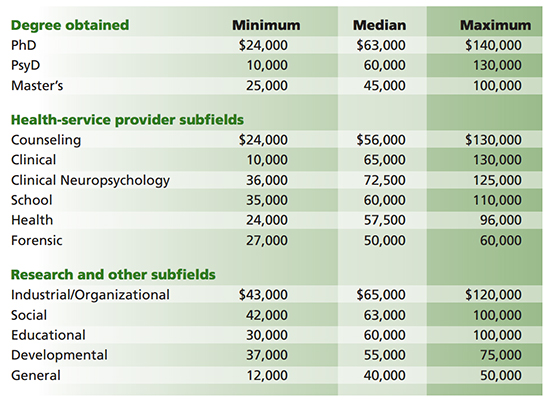
Of course, most people don't go into psychology for the money, she adds. Other factors contribute to job satisfaction. "Flexibility of work hours, pace and lifestyle in general may be appealing to many who enter academia," she says.
Having a doctoral degree does make it more likely you'll be paid more than those who graduate with a master's degree. A 2015 reportopens in new window from Anthony Carnevale, PhD, of the Georgetown University Center for Education and the Workforce, and colleagues says that psychology majors can expect to have a 33 percent higher median wage when they earn a graduate degree. However, that premium is much higher for fields like biology and life sciences (64.3 percent) and physical sciences (49.2 percent).
The good news is that psychologists shouldn't have a hard time finding jobs. According to unpublished data from the Doran study, 72 percent of recent graduates (classes of 2013 and 2014) were employed within three months of graduation, up 4 percent from CWS data in 2009.
And job growth for psychologists is projected to be 19 percent by 2024 to 206,400 from 173,900 in 2014. That's much higher than the average of 7 percent for all occupations, according to the Department of Labor, which cites greater demand for services in schools, hospitals, mental health centers, and social services, and to help people dealing with issues related to autism, aging and trauma.
In 2013, only 1 percent of psychology research doctorates reported being unemployed, according to the National Science Foundation.