Mike Feyh spent years in uniform fighting in Iraq, but he faced his biggest mental health challenge in 2010 after he returned home to California and went to work as a firefighter.
“I had a little incident when I got blown up in an explosion, and I had PTSD,” he said.
Feyh, a fire captain who now serves on the two-man behavioral health unit of the Sacramento Fire Department, opened the front door of a house that exploded. An arsonist had lit a candle and cut the gas line, and four firefighters were injured. Feyh was burned, and three other members of the crew were injured.
“One of the guys was having flashbacks in the hospital,” he said. At the time, his department — along with many others throughout the United States — held its crews to a mandate that first responders attend post-incident mental health debriefing.
“We did a formal debriefing,” Feyh said, “and it did not go very well at all. People were struggling with what happened. But they did not want to come in and talk about it.”
That strategy — mandatory debriefing — is being revisited as departments throughout the country embrace peer support programs as a bridge to treatment for firefighters who need it. The clinicians and peer support counselors who staff behavioral health units talk about the hidden side of the fire service: the PTSD, depression and substance abuse that firefighters will suffer in silence.
“First responders have significantly higher rates of anxiety and depression,” said Alyssa Lanza, a clinical psychologist in Bethesda, Maryland, who is a disaster response mental health practitioner. “Substance abuse is a more socially acceptable way to cope. There's an overall decrease of quality of life and less ability to keep doing the job.”
But the fear of losing that job because of lack of mental fitness or the fear of being perceived as weak can prevent firefighters from seeking treatment. Also, Lanza said, immediate follow-up doesn't help everyone after an incident.
“If you do it too soon, it's retraumatizing,” she said. “Every approach has pros and cons...There's a variety of people who need a variety of different types of treatment.”
Behavioral health units — once the province of big-city departments like New York and Boston — are becoming more common in small and midsized fire departments. As these units become more common, fire departments are embracing new treatment models to break the stigma.
In the last five years, the International Association of Fire Fighters has rolled out programs that have trained thousands of firefighters in peer support techniques. Separately, in California, a new lawopens in new window will extend confidentiality laws to peer supporters and bolster training for peer support programs at all levels of the fire service.
The IAFF recognized the need to take a larger role to support behavioral health in 2015 following strong reaction to an articleopens in new window on PTSD in Fire Fighter Quarterly. The story pointed out that “symptoms include recurrent or persistent recollections or dreams about the event, intense distress when reminded of the trauma by another event and difficulty functioning and performing day-to-day tasks.”
“The phone started ringing off the hook,” said Sarah Bernes, a licensed master social worker and behavioral health specialist for the association. “Our members started calling and saying, ‘I didn't know what this [feeling] was.'"
In a partnership with Advanced Recovery Systems, the organization opened a 64-bed treatment facilityopens in new window for firefighters and paramedics in Upper Marlboro, Maryland. Since 2017, more than 1,000 members have received treatment for substance abuse and accompanying issues such as PTSD, depression and anxiety.
The organization also started offering a peer support training program on a large scale. The two-day, in-person program emphasizes individual skills, such as confidentiality and active listening, as well as organizational skills, such as how to start and enhance a peer support program.
Since March 2016, more than 5,400 people have completed the program. The courses are standardized. They maintain a 15:1 student-to-instructor ratio, and each class has two master instructors, which include a firefighter and a clinician. Another 7,800 fire personnel have completed IAFF's online behavioral health training program.
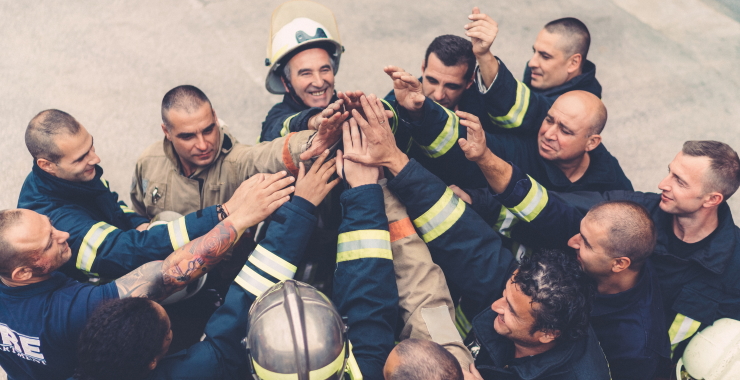
The emphasis on peer support speaks to the culture of the fire service.
“Because the fire service is such a brotherhood and sisterhood, firefighters prefer to lean on each other,” said Doug Stern, director of media relations for the IAFF. “We talk about peer support as a bridge to other treatment.”