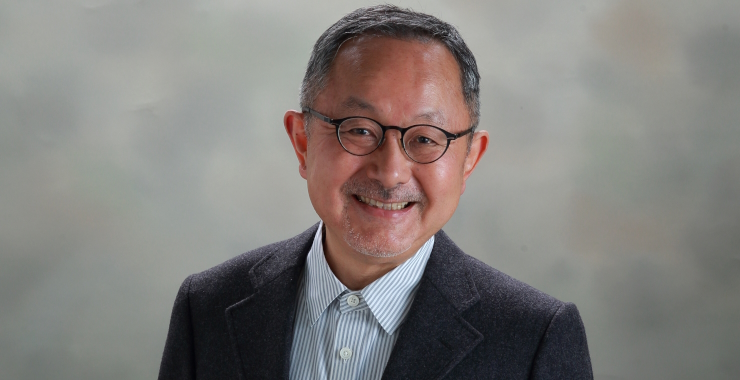
Shinobu Kitayama, PhDopens in new window, the Robert B. Zajonc collegiate professor of psychology at the University of Michigan (UM) in Ann Arbor, is working to expand the theory and practice of psychology to make it more reflective of, and useful for, societies other than Western, Eurocentric ones. Kitayama has been a pioneer in cultural psychology, which explores the relationship between culture—a society’s way of life—and the mind. He is one of the most-cited scientistsopens in new window in the world, recipient of the The American Psychological Foundation's 2024 Gold Medal Award for Impact in Psychology, and in 2022 received the APA’s Distinguished Scientific Contribution Award. He is also an elected fellowopens in new window of the American Academy of Arts and Sciences.
Powerful historical, geographic, and economic forces shape all societies, and culture in turn informs our personalities, thinking, and behavior from the moment we’re born. Kitayama notes that every one of us has the potential to change our culture, because it’s alive and dynamic, but we live within its values. However, he says, the current literature of general psychology presently focuses on behaviors and motivations that are particular to the West.
“It’s important to expand the scope” of psychology to encompass the globe, he says. “When you look at a map of the world, the West is here, the rest is everywhere else.”
At UM’s Culture and Cognition Labopens in new window, which he directs, Kitayama and his team have shown that only people in Western societies value their independence more than their place in their group. Other humans, all over the worldopens in new window, are much more likely to be “interdependent,” or reliant on other people for support. They are primed by their culture to do what it takes to maintain relations with their significant others—family members, friends, colleagues, tribes—and their place within the group. However, Kitayama has found that interdependent behavior takes different forms across the globe.
Using genetics and brain imaging
The idea that culture plays a role in the development of the mind is not newopens in new window. Kitayama and his colleagues have tapped a wealth of existing scholarship from around the world to take a deeper look at the ways in which different cultural imperatives shape a person’s thoughts, emotions, and motivation.
Kitayama has employed genetics and brain imagingopens in new window to demonstrate that some people’s brain structures show the effects of cultural influencesopens in new window. One often-cited example of this is a brain studyopens in new window from 2001 (not Kitayama’s), which revealed that London taxi drivers’ posterior hippocampi, the brain area that maintains a spatial representation of one’s environment, were considerably larger than those of control subjects.
Kitayama has found similar evidence in at least some people’s brains he has studied. Some people, across the cultures tested, are more genetically disposed to be receptive to cultural influencesopens in new window. For these individuals, brain regions in charge of characteristic “cultural tasks,” or routines performed to achieve goals that are important to the society—driving a cab in London is a good example—“show volume differences that are sometimes massive,” he says.
An epiphany in Ann Arbor
The son of a Buddhist priest, raised in Yaizu, a commercial fishing town in Shizuoka Prefecture in Japan, Kitayama obtained his bachelor’s and master’s degrees from Kyoto University. There, he learned well-established psychological explanations for why people behave the way they do, like attribution theory and cognitive dissonance, but he couldn’t relate to them personally. He didn’t see them in action in himself, or in his friends. Nor did he see many non-Western researchers at work in the field.
Then he came to Ann Arbor on a Fulbright scholarship, to work on his PhD in social psychology. At UM, he encountered Americans “who lived attribution theoryopens in new window,” he recalls in “Seeking the Middle Way: An Exploration of Culture, Mind and the Brainopens in new window,” a chapter he wrote recently for Pillars of Social Psychology. These were the people who had informed the textbooks he read in Japan—American college students. He was thunderstruck. Psychology, a scientific study of human behavior practiced worldwide, had been drawing critical inferences from only a sliver of humanity.
At Michigan, Kitayama struck up a friendship and fruitful collaboration with Hazel Markus, PhDopens in new window. “Nothing is more important than excellent collaborators,” he says. Their 1991 review, “Culture and the selfopens in new window,” is one of the most-cited papers in the behavioral sciences, with more than 33,410 citations to date. Markus and Kitayama referenced dozens of studies, including a number by Asian researchers and writers, to compare Western culture with Asian cultures that exhibit “the fundamental relatedness of individuals.”
One of these reference works was Takeo Doi’s 1973 essayopens in new window on the concept of amae, a core principle of Japanese culture, the understanding that one will be “accepted and cared for by othersopens in new window with few strings attached.” Amae obviates the need to go it alone in life and suggests why Japanese people would avoid conflict in their interactions, to protect vital relationships. Until recently, Kitayama’s work has focused primarily on Western and East Asian cultures like Japan to demonstrate how culture shapes the mind.
Different construals of the self
Kitayama and Markus concluded that “people in different cultures have strikingly different construals of the self, of others, and of the interdependence of the two...[which] can influence, and in many cases determine, the very nature of individual experience....”
Later, during a decade-long stint as an associate professor at Kyoto University, Kitayama noticed Japanese students getting sulky or indignant, which in Michigan he might have construed as dissonance—anxious feelings that arise in the wake of choices that haven’t panned out as expected. In Japan, he says, that discontent is called iji. Curious about the context for this behavior, he conducted an experiment that showed that Japanese people are likely to experience iji only in the face of others’ disapproval of choices they have made.
Back at Michigan in 2004, Kitayama and colleagues compared Japanese and American participantsopens in new window’ stance on ambivalent choices, and found that while Americans resolved the conflict they felt after such a choice by doubling down on their decisions, even in the absence of external criticism—a “normal” response to dissonance—Japanese people only justified their choices when someone whose opinion they valued questioned them.
Around the same time, looking at fundamental attribution error, also known as correspondence biasopens in new window, several researchers, including Kitayama, found that Americans, but not Japanese or other East Asian subjects, were likely to credit good or bad actionsopens in new window they saw another person do to that person’s (good or bad) character, even when those actions were heavily influenced by the situation. These experiments proved out Kitayama’s early instincts that some fundamental psychological tenets don’t apply to Asians in the same way they do to Westerners.
Different types of interdependence
Lately, Kitayama has been looking beyond East Asian societies. In a 2022 paper, his team identified three other distinct forms of interdependenceopens in new window in various sectors of the world. Generally speaking, as discussed above, Japanese people and other East Asians maintain interdependence by avoiding conflict.
However, Kitayama’s team contends that people in Arab societies express “disengaging” emotions like pride and anger to assert their value to the group they identify with, historically the tribe, which was essential to their survival in a barren landscape. So, someone might tout a distinctive skill, or react angrily to a threat to his honor, or to the reputation of his family, to show the group that he is resourceful, respectable, and reliable.
Latin Americans use overt expression of emotions to be “amicable” and fit in, Kitayama’s studies have found. People from a few different Latin American societies were found to value their own and others’ ability to be simpático, that is, to do their part to maintain a personable and accepting environmentopens in new window with the people they depend on, both at home and out in the world.
Debating is the most popular nonsports activity for students in India and Pakistan (PDF, 7.5MB)opens in new window, and arguing can help people there succeed as leaders and in commerce. But Kitayama’s teamopens in new window found that people from the Indian subcontinent accept as “uncontestable” the need to “modulate and adjust” their argumentative behavior in deference to others, especially authority figures, in order to get along in their groups.
Kitayama’s team has recently begun exploring the cultures of sub-Saharan Africa. He says early evidence indicates that residents of this area of the world exhibit yet another distinctive form of interdependence.
Kitayama says he has always tried to “see what it means to be human in its diverse manifestations,” and only hopes his work will “provide some interesting insights into psychological theory.” During the Covid-19 pandemic, he collaborated on studies of various societal responses to that rare global event, and says he intends to continue those studies, along with his project to effectively globalize psychology.