Field of research findings
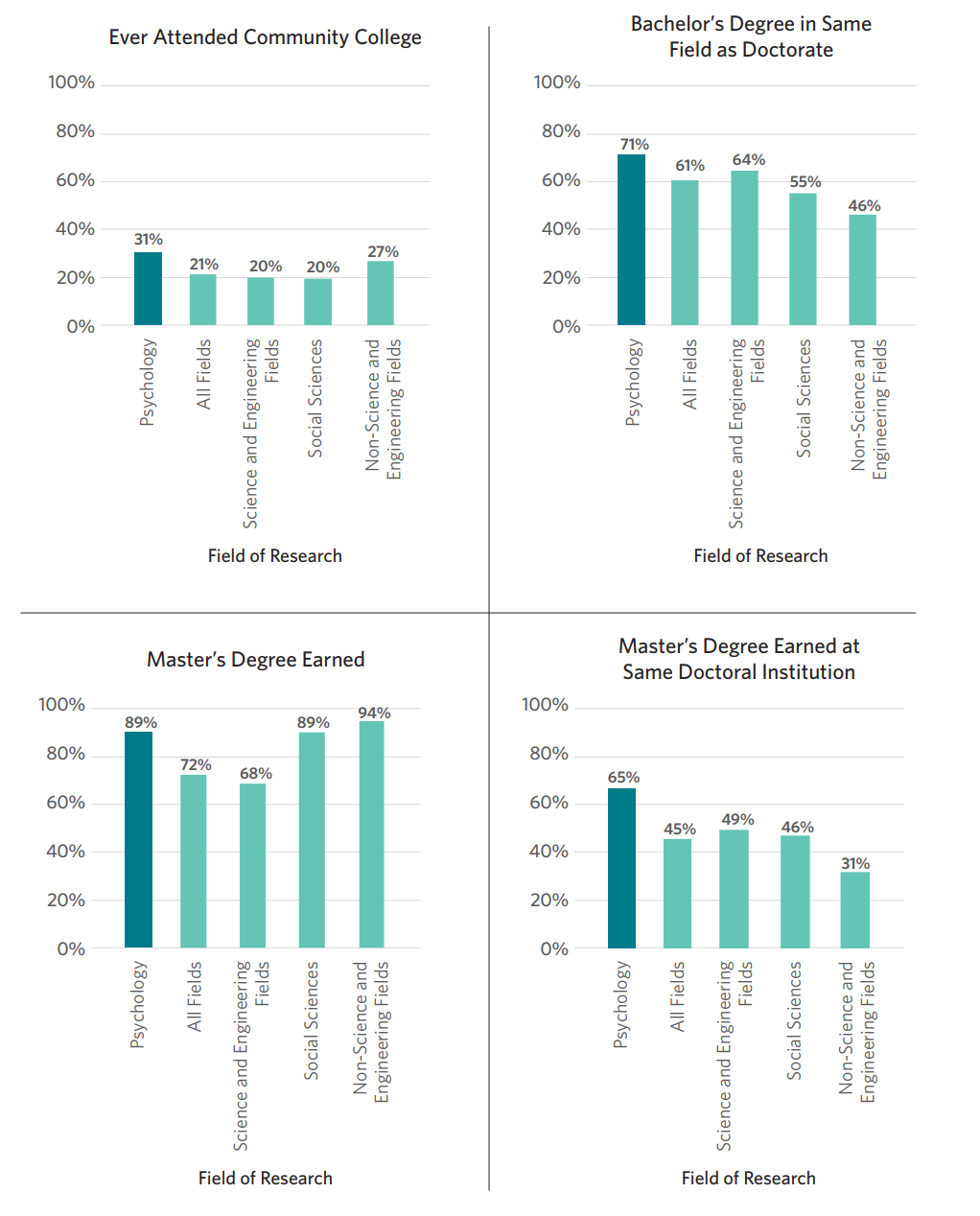
Ever attended community college
The first bar graph illustrates the percentage of doctoral holders who attended community college across various fields of research. Psychology stands out at 31%, notably higher than the overall average of 21%. Attendance is lower in science and engineering fields (20%) and social sciences (20%), while non-science and engineering fields (27%) fall between psychology and the broader averages. This suggests psychology students are more likely than peers in other disciplines to begin their academic journeys at community colleges.
Bachelor’s degree in the same field as a doctorate
The second graph highlights the continuity between undergraduate and doctoral studies. Seventy-one percent of psychology doctorate holders earned their bachelor’s degree in psychology, exceeding the overall average of 61%. In comparison, 64% of science and engineering doctorates, 55% of social science doctorates, and only 46% of doctorates in non-science and engineering fields followed the same pathway. This indicates a stronger alignment in psychology between early academic focus and ultimate doctoral specialization.
Master’s degree earned
The third graph examines whether doctoral holders completed a master’s degree before their doctorate. Psychology doctorate holders report an 89% rate, tied with social sciences and surpassed only slightly by non-science and engineering fields at 94%. In contrast, science and engineering fields report 68%, and the overall average is 72%. These findings reflect that psychology and related fields often require or expect master’s-level preparation as part of the doctoral pipeline.
Master’s degree earned at the same doctoral institution
The fourth graph looks at whether doctoral holders earned their master’s degree at the same institution where they pursued their doctorate. Psychology again stands out, with 65% completing both degrees at the same institution, compared to an overall rate of 45%. Rates are lower in science and engineering (49%), social sciences (46%), and non-science and engineering fields (31%). This suggests that psychology doctoral students are more likely to progress through an integrated master’s-to-doctorate pathway within the same university.