

April 2005 | Monitor on Psychology
Vol. 36 No. 4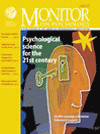
On the Cover: Psychological science for the 21st century
-
Psychological science for the 21st century
A new APA Science Directorate initiative will promote sound, responsible psychological science, supported by a strong infrastructure.
-
Responsible conduct of research
What are the risks in research?
-
Culture of service
Scientists who serve
-
Infrastructure for the science of psychology
Getting psychologists in the grid

SCIENCE WATCH
New studies hint depressed people may not factor context into judgments as much as the nondepressed--putting a new twist on the 'real' part of depressive realism.

IN BRIEF
- IOM calls for more complementary and alternative medicine research
- Older consumers factor more positives, specifics into product choices
- People's performance slows, falters when switching to a new task
- Tomes to retire from APA public interest post
- Board and Council address psychologists' involvement in military and security concerns and call for comprehensive sex-education programs, among other actions
- People in poor health are happier than others think
- Psychologist introduces mixed-age crowd to mysteries of the mind
- Department of Education renews APA's accreditation
- APA hosts session to inform recommendations of White House aging conference
- Students require tailored interventions for their different drinking styles
- Aging lessens tendency to take others' perspectives
- Harkin receives Integrity Award
- Researchers question validity of dieting measures
- Survey finds professional benefits to Psi Chi membership
- Soy's health benefits may not extend to reduced anxiety
- College students with psychological impairments need more services
- Free experimental psychology archive launched
- Social exclusion reduces people's willingness to self-regulate
- Happy employees make happy families, study finds

ETHICS ROUNDS
Disclosing confidential information involves psychology's core values. Psychologists therefore consider the nature, purpose and manner of the disclosure when sharing confidential information outside the treatment relationship.

Features
Research shows that first instincts can stink, but we trust them anyway. Why?
New research suggests that people can glean emotional content from an unfamiliar culture's music.
Is it more chemotherapy or the body's response to cancer that could sometimes affect the brain?
Two psychologists founded the first university-based chapter of a group that taps volunteers to befriend people with mental illnesses.
With thousands of returning troops who may need help battling trauma, civilian and military psychologists alike are finding new ways to help.
APA staff took its resilience message to military children by teaching them how to 'bounce back' from stress.
Changes to the disabilities education law mean psychologists might need to learn and support different assessment methods.
Psychologist Neil Lutsky has made quantitative reasoning a priority at Carleton College.
Psychologist and former track star Nicki Moore helps the University of Oklahoma athletics department better serve its student-athletes.
Arlo Guthrie reflects on bringing 'Alice's Restaurant' out of retirement for his upcoming tour, which stops at this year's APA convention.
A small but growing pack of psychologists works to improve animal-human interactions as certified applied animal behaviorists.
Meet three psychologists tapping into federal dollars by making the bench-to-bedside bridge.
A decision many questioned led Kathleen McDermott to win the $25,000 F.J. McGuigan Early Career Investigator Research Grant for her research on memory flaws.

A CLOSER LOOK
APA's Div. 44 has its sights set on boosting science on lesbian, gay and bisexual (LGB) couples and families, and delivering key research findings to the public and policy-makers.

PUBLIC POLICY UPDATE
The administration's budget presents challenges for psychology.

CORRECTIONS
COLUMNS
From the CEO
In the Public Interest
Judicial Notebook
President's Column
Science Directions