

November 2001 | Monitor on Psychology
Vol. 32 No. 10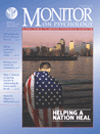
On the Cover: Helping a nation heal
-
APA'S Disaster Response Network: help on the scene
Just after the second plane hit the World Trade Center, APA's Practice Directorate and the Red Cross activated the Disaster Response Network.
- Helping a nation heal: CALIFORNIA
- Helping a nation heal: NEW YORK CITY
- Helping a nation heal: PENNSYLVANIA
- Helping a nation heal: THE PENTAGON
-
Reaching out to schools and communities
Psychologists have been working to help students and families cope with the Sept. 11 tragedies.
-
Behavioral science gears up to combat terrorism
The terrorist attacks cover from research on risk assessment, human factors in aviation and indoctrination into fanatical groups to psychological approaches to conflict resolution, cross-cultural differences and preventing hate crime.
SCIENCE WATCH
Research indicates that during anxiety, people find it difficult to pull their attention away from threatening stimuli, challenging long-held assumptions about the link between anxiety and attention.
ETHICS ROUNDS
A prize for graduate students

Features
Robert V. Guthrie, one of the most influential and multifaceted African-American scholars of the century, wants to be remembered only as 'an American psychologist.' In an interview with the Monitor, he recollects the barriers he overcame to claim that title.
Tuesday, Sept. 11
State associations mobilized members after the Sept. 11 attacks.
For every suicide, there are as many as six to 10 family members who are immediately affected by the death--about 186,000 new survivors each year, according to statistics. Working with the family members of a patient who is suicidal or has completed suicide is a role more psychologists are embracing.
Military psychologists are educating troops about stress, developing new ways to train military personnel in the fight against terrorism and offering support to families.
Norma Lang Steuerle, PhD, is remembered for her energy, zest for life and sense of humor.
After the attacks, international trauma relief expert and New York City psychologist Nina Thomas put her skills to work in her hometown.
In the weeks after the attacks, APA psychologist Daniel Dodgen counseled rescuers, Department of Defense and airline workers, and families of victims at the Pentagon.
Psychologist June Feder overcame clogged communication channels and mass confusion to respond to the disaster in New York.
Laura Barbanel has seen mental health care emerge as a priority in ways it hasn't before.
In response to the tragedies, a New York psychologist expands the focus of her practice.
APA President Norine G. Johnson discusses psychology's role in the aftermath of the attacks and shares some of her related clinical experiences.
Practitioners shouldn't consider themselves invulnerable at this time and are encouraged to address their own needs so they can help their clients.
APA develops public service announcements aimed at adults and children.
Psychologists across the country offer support in the wake of a national tragedy.
A former State Department and FAA psychologist talks frankly about America's response to the recent terrorist attacks.
APA's president-elect on why the efforts to prevent future terrorist acts must begin with understanding the root causes of the hatred against America.
APA Past-president Martin E.P. Seligman talks about optimism in the aftermath of the Sept. 11 attacks.
Psychologists' research offers new insights on the emotions that lead to hate crimes and how to prevent them.
Support from other psychologists, especially for trainees, is an integral part of recovery for 'clinician-survivors.'
Questions remain on what motivates people to take their lives.
Psychology's introductory textbooks need to better integrate issues of aging, disability, gender, sexual orientation and ethnicity, argue experts.
A new medical school curriculum, the first of its kind, will prepare physicians to take advantage of advances in the behavioral sciences.
Under the new rule, payment for telehealth services will equal what Medicare would pay for the service without the use of a telecommunications system.
'Creating a New Vision for Health Promotion' conference will be held Feb. 25-March 1 in Lake Tahoe, Nev.
PUBLIC POLICY UPDATE
APA's Public Policy Office is responding to the national tragedy through a range of policy initiatives involving psychological science, education and public interest.
COLUMNS
In the Public Interest
President's Column
Running Commentary
Science Directions
Shared Perspectives