Wizdom Powell, PhD, is a trauma psychologist who has spent her career conducting community-based research on the impact of modern racism and gender norms on African American male health outcomes and inequities. Her contributions have ranged from serving on an APA task force to co-chairing the Health Committee for President Obama’s My Brother’s Keeper Initiative. She’s also a member of the Aspen Institute’s Global Leadership Network.
 Now, as president of APA Div. 51 (Society for the Psychology of Men and Masculinities), she is leading an initiative examining the role of masculinity and health inequities for boys and men of color during the COVID-19 pandemic. “This is a watershed moment where tremendous clarity is needed if we are to advance health equity for Black men and boys who are being impacted both by the pandemic and gendered racism.”
Shortly after the protests against police brutality began in May, APA asked Powell about the division’s initiative and what she sees as psychology’s role during this historic time.
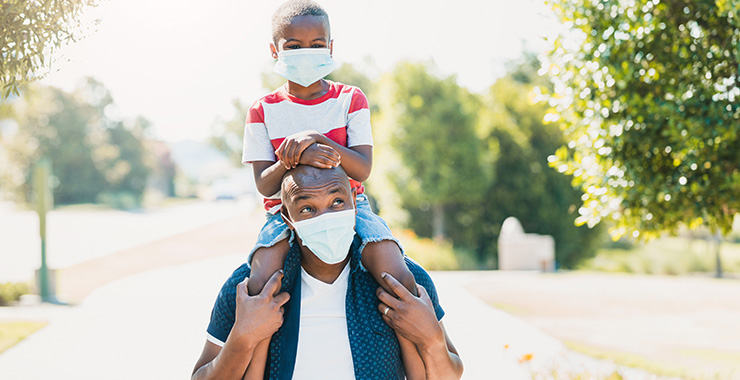
What do today’s crises—COVID-19, the recession and nationwide protests against racist policing—reveal about the inequities that Black men and boys face?
We all knew that health inequities among Black men and boys existed. They live the shortest lives in U.S. society. We have data from Nancy Krieger, PhD, and her colleaguesopens in new window at Harvard suggesting that over the past 50 years, Black men have faced significantly higher risk of being killed by police than whites. These are data we had pre-COVID-19.
If we can learn anything from the simultaneous crises, it is that we need to center health equity and social justice, particularly racial justice, in all policies, practices, and procedures. When the storms converge, the folks who feel the full tailwind are almost always operating at the margins of society, a place where Black men and boys find themselves.
What are the goals of the Div. 51 initiative that you recently launched?
Our initiative, “Holding Space for Boys and Men of Color: Reimagining Masculinities, Transforming Systems, and Advancing Health Equityopens in new window,” seeks to create therapeutic landscapes for boys and men of color where they live, work, play, are educated, confined, and get health care in: We aim to shift processes of care so that they address racialized and gendered barriers to health care.
Boys and men of color have tremendous and untapped potential to contribute to our nation and economy. Their potential is undermined by structural disadvantage and systematic dehumanization. Masculinity norms play a role in health behaviors that are rooted in and driven by social inequity. We’re not just teaching boys and men how to cope better with their environments. Rather, we are focused on changing structures and programs to be more equitable. [Working with national experts and leaders on health equity of boys and men of color], we’re holding webinars, creating issue briefs, providing professional development for school [personnel], developing a public syllabus project and launching a podcast series. We are translating the evidence into policy action. We want to expand the public’s understanding of these issues by ensuring they receive evidence-based messages about this population—not just from the traditional scientific knowledge that we generate, but knowledge we draw from the communities that we serve.
We are working to provide decision-makers with information they can put into practice. For example, we are sharing what we know about suicide among Black boys and how racial trauma manifests in both noninstitutionalized and incarcerated populations so they can prevent these tragedies and create more equitable policies.
For more on the Div. 51 initiative, go to the Div. 51 Society for the Psychology of Men and Masculinitiesopens in new window webpage.
What can our society, parents and caring adults do to build resilience in Black boys?
We have done a lot to build the self-esteem of Black girls through positive racial and ethnic socialization and positive representations in our media through things like #BlackGirlsRock and #BlackGirlMagic. We could similarly be creating resources for boys to impact how they see themselves in the world. The challenge is that we often treat boys, particularly boys of color, as if they are "problems to be solved rather than wonders to behold." We can shift towards praising healthy masculinity in Black boys and men without feeling as if we are feeding broader systems of patriarchy. Parents, along with a surrounding caring community, can affirm their identities by praising the contributions they make as sons, brothers, partners in healthy relationships with others.
What is the one thing every psychologist can do now to help Black men and boys at this time?
We can create safe and equitable space for Black men and boys to express the full range of their emotions. We need to be prepared and ready for their grief, the rational rage, and the disappointment that may show up at clinical encounters. We need to listen with deep empathy, without questioning and without re-examining the therapeutic process, but just holding space for those rational emotions that are likely stemming from lots of places but most immediately from bearing witness to recent killings of Black men and boys.
We psychologists also need to work on ourselves. We would like to believe that psychologists are immune from the racial biases that permeate society—after all, we talk about the need to be self-aware and reflective. But we also are human [and] the same implicit and explicit biases that have driven us to the current moment are the same ones that psychologists breathe in every day. We must be willing to work on ourselves so that we can better receive Black men and boys when they come.