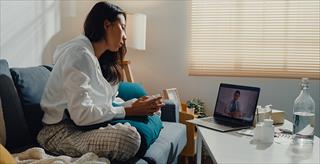
Patricia Perez, PhD, has a front-row view of how the shift from in-person school to distance learning is affecting many youth, and she sees a disturbing trend: Many children are struggling and parents are unsure how to help. Perez, a child development specialist who consults with children and families in the Chicago area, recently worked with a mother whose 16-year-old son was losing interest in going to college after graduating high school. Before the pandemic, he was passionate about math and science and participated in his school’s robotics and Model United Nations clubs, but his mood started changing after states began closing schools in the spring. As he logged on to his computer for Zoom school week after week, he started sleeping more during the day and became more isolated from friends and family members.
“He’s not motivated anymore,” says Perez, who is also an associate professor of international psychology at The Chicago School of Professional Psychology. “Young people like to make plans for the future, and it’s difficult to do that when they don’t know how long this new way of life will last.”
Although U.S. school districts that chose a remote learning model had more time to prepare for online school this fall than in the spring, psychologists who specialize in education research are concerned about how kids will cope psychologically with the ongoing loss of access to the friends, teachers, and routines associated with going to a physical campus. Research shows that the school environment is critical for fostering academic motivation and social development, and many students rely on schools for mental health care. Among adolescents who received mental health services between 2012 and 2015, 35% received these services exclusively from school settings, according to data from the National Survey on Drug Use and Health (Ali, M. M., et al., Journal of School Health, Vol. 89, No. 5, 2019).
“We have to be careful and acknowledge just how big a change this has been for kids and families,” says Beth Doll, PhD, a professor of educational psychology at the University of Nebraska–Lincoln. “We have taken away the context that supports their engagement in school and their overall well-being, plus they are dealing with the tremendous uncertainty about the future.”