

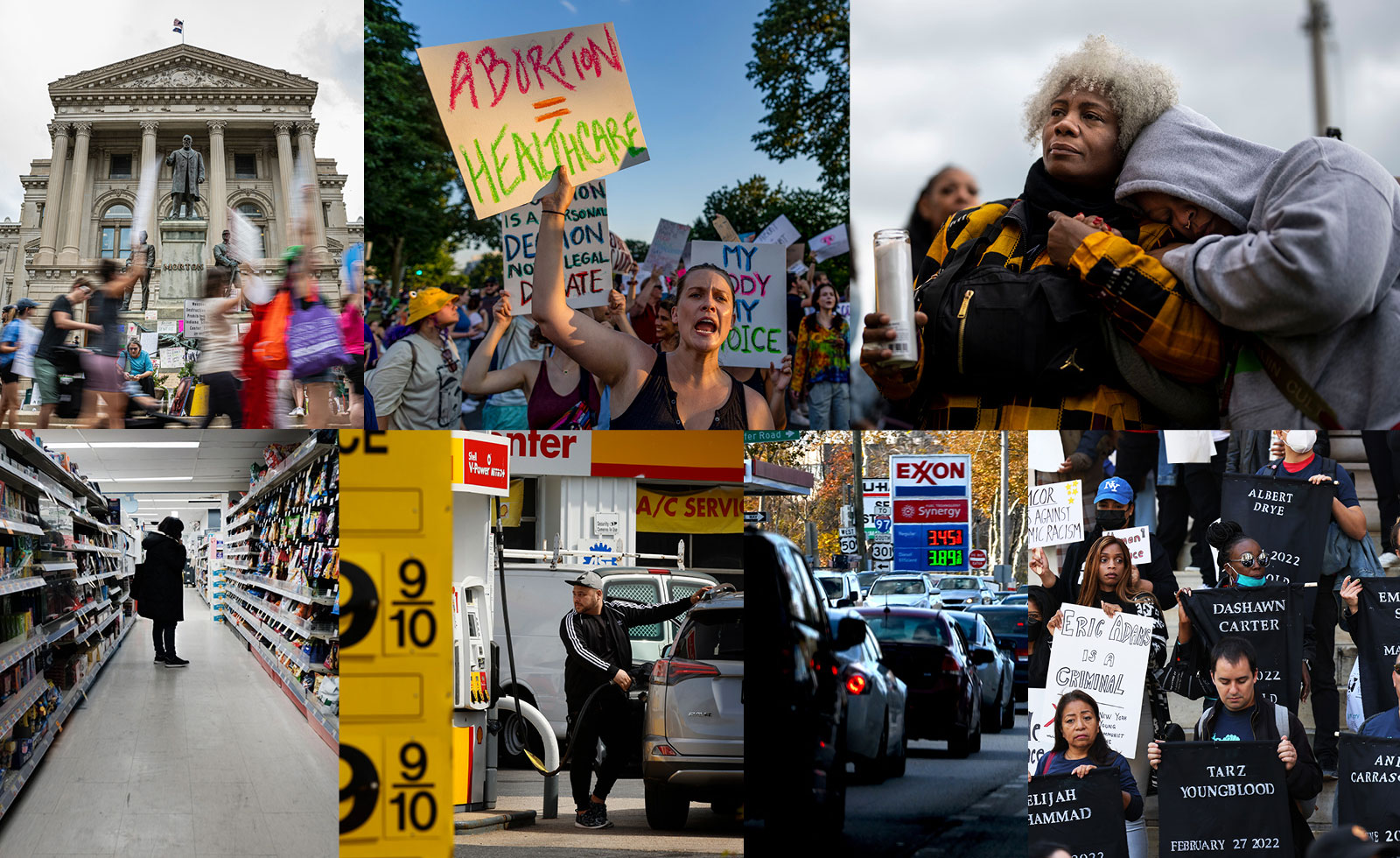
The U.S. population has experienced an intense range of stressors over the past few years, as the Covid-19 pandemic, racial injustice, and political divisiveness have dominated news cycles and social media. A new survey, conducted by The Harris Poll on behalf of APA, tells a story of uncertainty and dissolution.
Stress in America 2022: Concerned for the Future, Beset by Inflation, shows a battered American psyche, facing a barrage of external stressors that are mostly out of personal control. The survey found a majority of adults are disheartened by government and political divisiveness, daunted by historic inflation levels, and dismayed by widespread violence.
The report summarizes findings on current reported stress levels, sources, and consequences. Our psychologists also offer advice and strategies to help the nation navigate the fear of the unknown and the pervasive threats to the well-being of all Americans. APA is committed to empowering people to find ways to take back control and to find peace and calm in the chaos.
Pessimistic views on government and civil liberties pervade
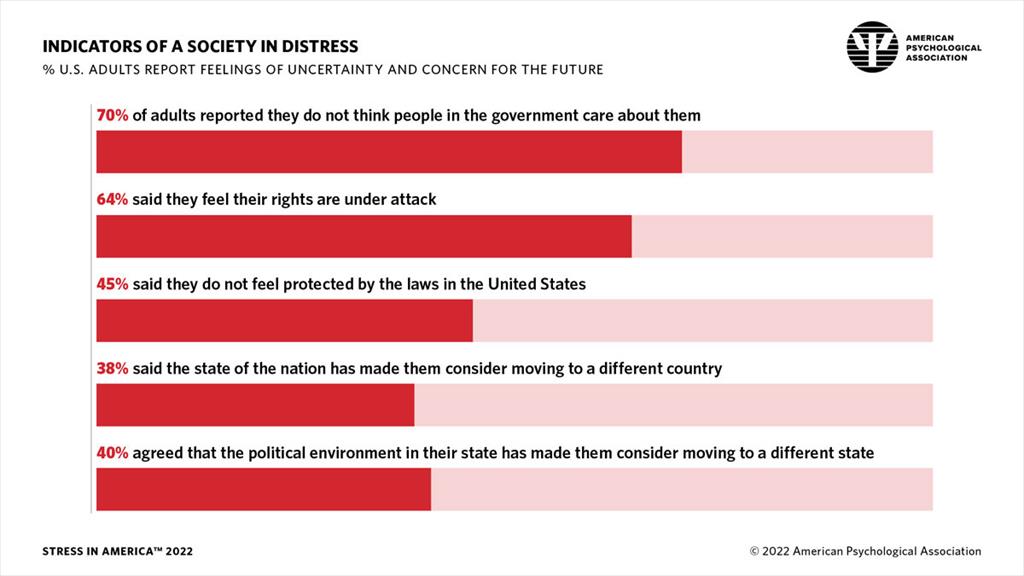
Seventy percent of adults reported they do not think people in the government care about them and 64% said they feel their rights are under attack. Further, nearly half of adults (45%) said they do not feel protected by the laws in the United States.
Nearly two in five adults (38%) said the state of the nation has made them consider moving to a different country, and a similar proportion of adults (40%) agreed that the political environment in their state has made them consider moving to a different state.
Civil liberty distress by population
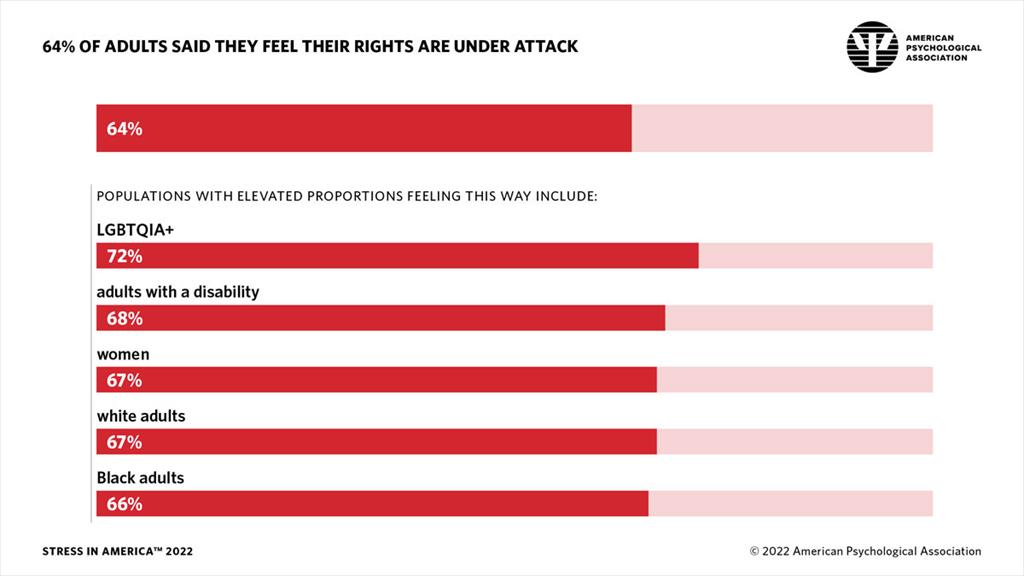
Women were more likely than men to report feeling that their rights are under attack (67% vs. 61%). Specifically, women under 35 (ages 18 to 34) were more likely than men under 35 to report feeling this way (68% vs. 54%). White and Black adults were more likely than Latino/a and Asian adults to report feeling this way (67% and 66% vs. 49% and 58%, respectively). In addition, adults with a disability were more likely than those who do not have a disability to report feeling that their rights are under attack (68% vs. 62%). A slightly larger proportion of members of the LGBTQIA+ community reported feeling that their rights are under attack compared with their non-LGBTQIA+ counterparts (72% vs. 64%), but the difference was not statistically significant.
Views on legal protection by population
Women were more likely than men to say they do not feel protected by the laws in the U.S. (49% vs. 40%). Members of the LGBTQIA+ community also were more likely than their non-LGBTQIA+ counterparts to say that they do not feel protected by the laws in the U.S. (60% vs. 44%). Also, Black adults were more likely than Latino/a and Asian adults to say they do not feel protected by the laws in the U.S. (48% vs. 39% each, respectively). Further, 54% of Black women said they do not feel protected by U.S. laws, and 49% of all people ages 18 to 35 said they do not feel protected by U.S. laws.
Considering leaving a state or the nation, by population
A significant proportion of younger and middle-aged adults reported that the state of the nation has led them to consider moving to a different country. Specifically, adults ages 18 to 34 and 35 to 44 were more likely than their older counterparts (those ages 45 to 64 and 65+) to say the state of the nation has made them consider moving to a different country (53% and 51% vs. 29% and 19%). Fifty-nine percent of LGBTQIA+ respondents said the state of the nation has made them consider moving to a different country compared with 36% of their non-LGBTQIA+ counterparts.
Around half of adults ages 18 to 34 (51%) reported that the political environment of the state they live in has made them consider moving to a different state. Specifically, adults ages 18 to 34 and 35 to 44 were more likely than their older counterparts (those ages 45 to 64 and 65+) to consider this (51% and 53% vs. 36% and 21%).
Majority of U.S. adults agree the nation’s future looks bleak
A majority of adults (62%) disagreed with the statement, “our children are going to inherit a better world than we did,” and 63% disagreed with the statement, “I feel our country is on the path to being stronger than ever.”
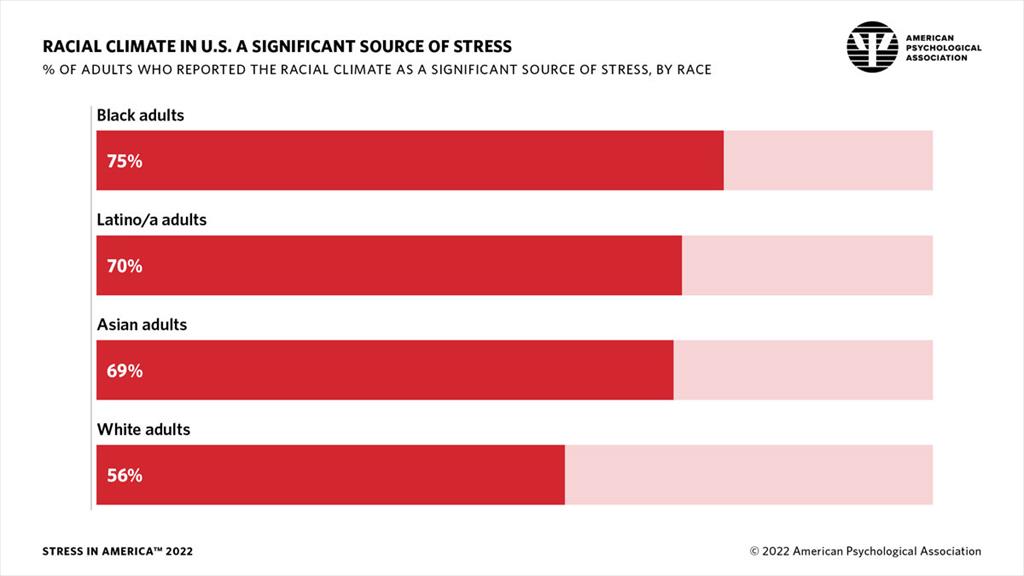
More than three-quarters of adults (76%) said that the future of our nation is a significant source of stress in their lives, while 68% said this is the lowest point in our nation’s history that they can remember. Two in three adults (66%) said the current political climate is a significant source of stress in their lives. Further, three in five adults (60%) said that the current social divisiveness in the nation causes them stress. Slightly more than three in five adults (62%) reported that the racial climate in the U.S. is a significant source of stress in their lives.
A sizeable proportion of adults said race relations (41%), women’s rights (38%), and LGBTQIA+ rights (30%) are getting worse in America. Slightly more than two in five adults reported feeling race relations are either about the same (42%) or getting worse (41%) in America—while less than a fifth reported feeling that they are getting better (17%). Similarly, around two in five adults reported feeling women’s rights are either about the same (40%) or getting worse (38%). Slightly more than one in five (22%) adults reported feeling that women’s rights are getting better in the U.S.; men were more likely than women to report feeling this way (27% vs. 17%). Two in five adults (43%) reported feeling that LGBTQIA+ rights are about the same in the U.S., in general. But around three in 10 reported feeling that they are either getting worse (30%) or better (27%).
Nearly three in five (57%) adults reported feeling that religious freedom is about the same in America. Nearly three in 10 adults reported feeling that it is worse (27%), and 16% that it is better.
Varying perspectives reveal disparate concerns
One trend that emerged in the 2022 survey results was evidence to support disparities in stressors. While some concerns, such as inflation, were high across all respondents, others varied widely by population subgroups. Elevated figures among varying populations when compared with the general population included:
- White adults were less likely than Black, Latino/a, and Asian adults to agree that our children are going to inherit a better world (33% vs. 50%, 46% and 49%, respectively).
- The racial climate in the U.S. was reported as a significant source of stress at highest levels among Black adults ages 65+ (81%) compared with the general population at just 62%.
- Women were more likely than men to disagree that our country is on the path to being stronger than ever (68% vs. 58%).
- Older White adults were more likely than those under 35 to say this is the lowest point in our nation’s history (78% for ages 44 to 65 and 76% for ages 65+ vs. 64% for ages 18 to 34).
Inflation leads to increased tension
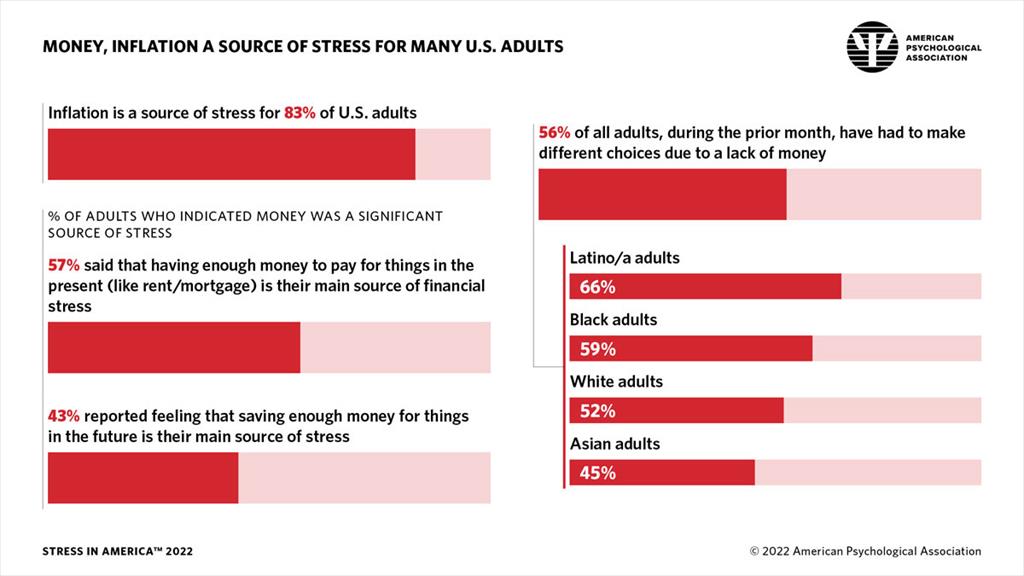
Inflation was reported as a source of stress for the vast majority of adults (83%), and the majority of all adults also said the economy (69%) and money (66%) are a significant source of stress. Of those who said money is a source of stress, most said that stress is about having enough money to pay for basic needs. Slightly more than half of adults who reported money is a significant source of stress (55%) said money is a cause of fights or tension in their family compared with 41% of the general population who said the same. This may be partially due to having to make different choices due to lack of money.
Nearly three in five adults (57%) who indicated money was a source of stress said that having enough money to pay for things in the present—like food or rent/mortgage—is their main source of stress regarding money, while more than two in five adults (43%) reported feeling that saving enough money for things in the future is their main source of stress.
Among those who reported that money is a significant source of stress, adults with an annual household income of less than $50K were more likely than those with an annual household income of $50K or more to say the main source of their stress is having enough money to pay for things in the present (72% vs. 48%). Among those who reported that money is a significant source of stress, those at or below the poverty level were more likely than those above the poverty level to say having enough money to pay for things in the present is their main source of stress regarding money (77% vs. 48%).
More than half of all adults (56%) agreed that they and/or their family have had to make different choices due to lack of money in the past month, with Latino/a and Black adults reporting this at a higher level than White and Asian adults (66% and 59% vs. 52% and 45%, respectively).
Concerns over violence, crime, and safety leave most feeling unprotected
Violence was reported as another issue that is a significant source of stress for the majority of adults in the U.S. This is true for violence and crime in general, but also mass shootings and gun violence.
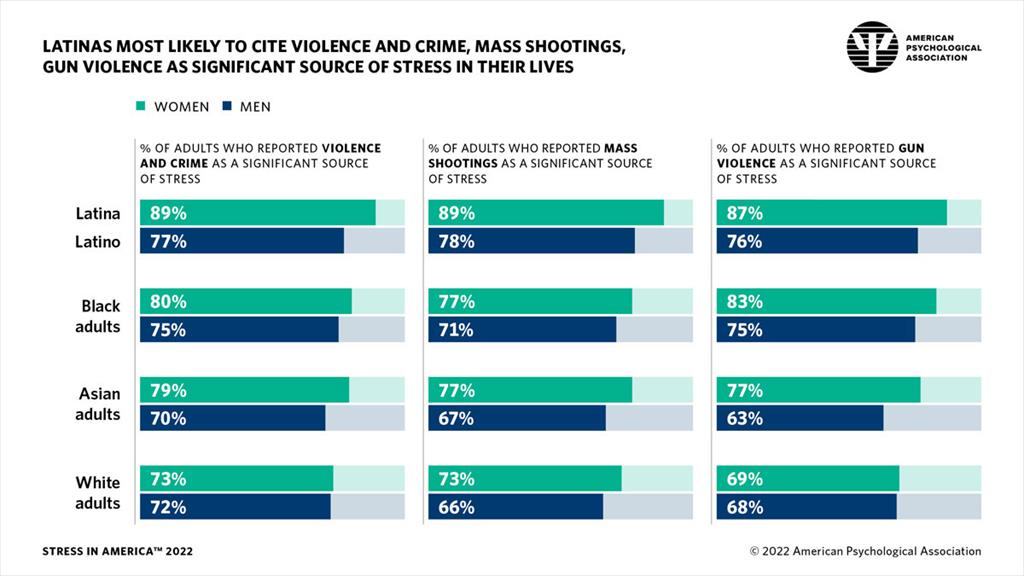
Three-quarters of adults (75%) agreed that violence and crime are a significant source of stress in their lives. Latino/a adults were more likely than White and Asian adults to report this (83% vs. 73% and 75%, respectively). In particular, Latinas were more likely than White, Black, and Asian women (89% vs. 73%, 80% and 79%) and White, Black, Latino, and Asian men (89% vs. 72%, 75%, 77% and 70%) to say that violence and crime are a significant source of stress.
Mass shootings were reported as another significant source of stress, as nearly three-fourths of adults (73%) agreed. Women were more likely than men to cite mass shootings as a significant source of stress in their lives (78% vs. 69%). Following closely behind violence, crime, and mass shootings, more than seven in 10 adults (72%) cited gun violence in general as a significant source of stress.
As with mass shootings, women were more likely than men to say that gun violence in general is a significant source of stress in their lives (75% vs. 69%). Latino/a and Black adults were more likely than White and Asian adults to agree that gun violence in general is a significant source of stress in their lives (81% and 79% vs. 69% and 71%). Black women and Latinas were more likely than White men and women to cite this (83% and 87% vs. 68% and 69%, respectively). Latinas also were more likely than their male counterparts (87% vs. 76%) to feel this way.
The impact of stress on daily functioning and productivity
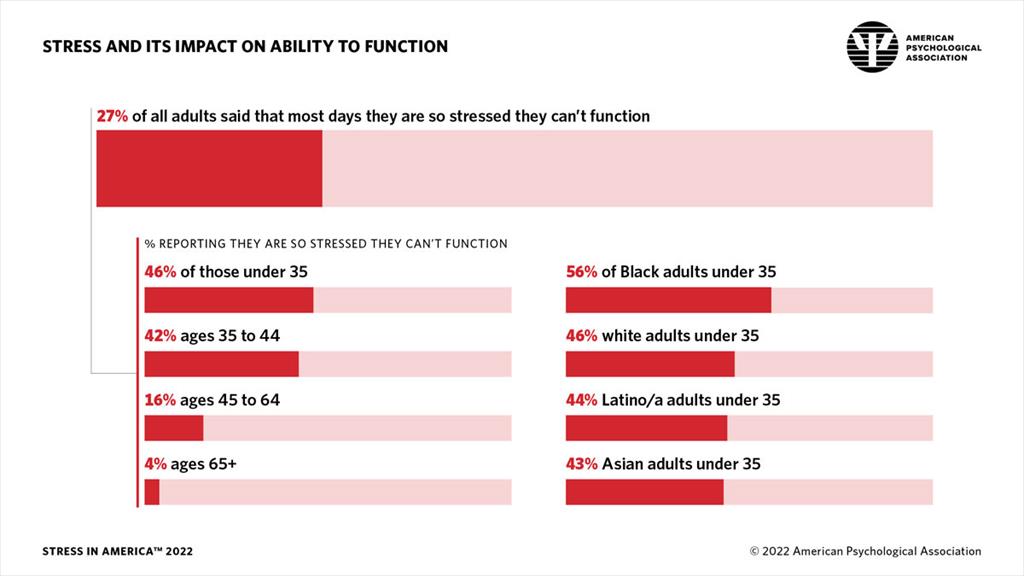
On a scale of 1 to 10, where 1 means you have “little or no stress” and 10 means you have “a great deal of stress,” the average reported level of stress during the past month among all adults was 5.0, which has held steady since 2020. Still, this level is slightly elevated from prepandemic levels (2021: 5.0, 2020: 5.0, 2019: 4.9, 2018: 4.9, 2017: 4.8, and 2016: 4.8). What’s more, an alarming proportion of adults reported that stress has an impact on their day-to-day functioning, with more than a quarter (27%) saying that most days they are so stressed they can’t function. Nearly half (46%) of those under 35 and more than half (56%) of Black adults under 35 agreed with this statement.
Nearly two in five adults (37%) reported that when they are stressed, they can’t bring themselves to do anything. Around a fifth of adults also reported experiencing forgetfulness (21%), an inability to concentrate (20%), and difficulty making decisions (17%) in the last month due to stress. Adults with a higher average stress level were more likely than those with a lower average stress level to report experiencing forgetfulness (39% vs. 7%), the inability to concentrate (38% vs. 6%), and difficulty making decisions (31% vs. 5%).
Around a third of adults (34%) reported that stress is completely overwhelming most days. Some groups were even more likely to report feeling this way. For example, adults ages 18 to 34 and 35 to 44 were more likely than their older counterparts to report feeling this way (56% and 48% vs. 24% of those 45 to 64 and 9% of those 65+). In addition, younger women (ages 18 to 34) were more likely to report feeling this way than women ages 35 to 44, 45 to 64, and 65+ (62% vs. 48%, 27% and 9%, respectively). Younger men also were more likely than older men to report feeling this way (51% of ages 18 to 34 and 48% of ages 35 to 44 vs. 21% of ages 45 to 64 and 8% of ages 65+). Black men were more likely than White men to report feeling this way (42% vs. 28%), and members of the LGBTQIA+ community also were more likely than those who are not to report that most days their stress is completely overwhelming (50% vs. 33%).

Consistent with psychological science, results from this poll revealed that when adults are feeling stressed, around three-quarters (76%) reported there are aspects of their lives that were negatively impacted. Specifically, their mental health (36%), eating habits (33%), physical health (32%), and interest in hobbies/activities (30%) were among the top aspects negatively impacted by stress. Psychological research on both humans and nonhuman animals revealed that the effects of stress on the brain, immune system, our gene expression, susceptibility to physical illness, mental illness, and subsequently on people’s ability to engage in necessary daily tasks can be long lasting, and even intergenerational.
Around a quarter of adults (25%) reported that during the prior month, they very/fairly often felt difficulties were piling up so high that they could not overcome them. Latino/a adults (27%) were the most likely to say they very/fairly often felt difficulties were piling up so high that they could not overcome them (compared with 24% of White adults, 23% of Black adults, and 18% of Asian adults). A similar proportion of adults reported they are so stressed they feel numb (30%). Latino/a adults also were more likely than White and Asian adults to report feeling this way (35% vs. 28% and 26%). And around three in 10 Black adults (31%) reported they are so stressed they feel numb.
Stress and the consequences for American health
Around three-quarters of adults (76%) said they have experienced health impacts due to stress in the prior month, including headache (38%), fatigue (35%), feeling nervous or anxious (34%), and/or feeling depressed or sad (33%).
Adults with a higher average stress level were more likely than those with a lower average stress level to report experiencing headache (59% vs. 20%), fatigue (57% vs. 15%), feeling nervous or anxious (56% vs. 12%), and feeling depressed or sad (57% vs. 10%) due to stress in the past month.
Around seven in 10 adults (72%) have experienced additional health impacts due to stress, including feeling overwhelmed (33%), experiencing changes in sleeping habits (32%), and/or worrying constantly (30%). And more than one in 10 said they have been using alcohol, cigarettes, or drugs to relax (15%). Adults with a higher average stress level were more likely than those with a lower average stress level to report experiencing feeling overwhelmed (57% vs. 11%), changes in sleeping habits (53% vs. 12%), constant worrying (53% vs. 9%), and using alcohol, cigarettes, or drugs to relax (30% vs. 5%).
Meanwhile, a majority of adults (70%) said that health care is a significant source of stress in their lives. Adults at or below poverty level were more likely than those above poverty level to say that health care is a significant source of stress in their lives (75% vs. 68%). Black, Latino/a, and Asian adults were more likely than White adults to agree that health care is a significant source of stress in their lives (74%, 77% and 74% vs. 67%).
How to take action during times of uncertainty
Despite myriad stressors weighing on adults, slightly more than seven in 10 (71%) adults reported that they feel hopeful about their future. In fact, a majority of adults (72%) said they can get things done even when they are feeling stressed, and around half of adults (51%) have very/fairly often felt confident about their ability to handle personal problems in the last month.
People react differently to uncertainty, but you can take some simple steps to build your resilience in uncertain times. Accepting that there will be uncertainty can free us to focus on what is in our control.
Disrupt negative thinking. Get out of the habit of ruminating on potential consequences. It can make you feel like the worst case is already happening. When we pregrieve about possibilities, we feel threatened and afraid before it is necessary. Take a breath when you find yourself spiraling into negative thoughts or tragic worst-case scenarios. Instead, try to imagine the best possible scenarios, and figure out a role for you in making those happen.
Do something unexpected. You can train yourself to be more comfortable with uncertainty. Stretching ourselves to try something new or go somewhere unfamiliar or go without a schedule can help us become more comfortable with the unknown and our ability to handle it.
Take control where you can. Research shows taking action over aspects of life that are within one’s personal control can feel empowering and help mitigate stress over things that are out of one’s control. For example, voting, volunteering, and community involvement can help people feel more connected and in control over their own futures. In fact, research has found people who volunteer may live longer than those who don’t.
Don’t judge yourself against others. Some people are better at dealing with uncertainties than others, so don’t beat yourself up if your tolerance for unpredictability is lower than a friend’s. Remind yourself that it might take time for the stressful situation to resolve and be patient with yourself in the meantime.
Take your own advice. Ask yourself: If a friend came to me with this worry, what would I tell them? Imagining your situation from the outside can often provide perspective and fresh ideas.
Don’t look for a rescuer. Asking someone else to solve the problem for you perpetuates the feeling that you are powerless. Rescuers are often actually enablers who keep us from taking responsibility for our own lives. Instead, seek out emotionally supportive friends and family who see you as capable and can help you focus on next steps for addressing your concerns.
Methodology
The 2022 Stress in America™ survey was conducted online within the United States by The Harris Poll on behalf of APA between August 18 and September 2, 2022, among 3,192 adults age 18+ who reside in the U.S. Interviews were conducted in English and Spanish.
Data are weighted where necessary to reflect their proportions in the population based on the 2021 Current Population Survey (CPS) by the U.S. Census Bureau. Weighting variables included age by gender, race/ethnicity, education, region, household income, and time spent online.
Latino/a adults were also weighted for acculturation, taking into account respondents’ household language as well as their ability to read and speak in English and Spanish. Country of origin (U.S./non-U.S.) was also included for Latino/a and Asian subgroups.
Weighting variables for Gen Z adults (ages 18 to 25) included education, age by gender, race/ethnicity, region, household income, and size of household, based on the 2021 CPS.
Propensity score weighting was used to adjust for respondents’ propensity to be online. A propensity score allows researchers to adjust for attitudinal and behavioral differences between those who are online versus those who are not, those who join online panels versus those who do not, and those who responded to this survey versus those who did not.
Respondents for this survey were selected from among those who have agreed to participate in Harris’s surveys. The sampling precision of Harris online polls is measured by using a Bayesian credible interval. For this study, the sample data is accurate to within + 2.9 percentage points using a 95% confidence level. This credible interval will be wider among subsets of the surveyed population of interest.
All sample surveys and polls, whether or not they use probability sampling, are subject to other multiple sources of error, which are most often not possible to quantify or estimate, including but not limited to coverage error, error associated with nonresponse, error associated with question wording and response options, and postsurvey weighting and adjustments.
Related resources
-
Survey questions for Stress in America October 2022 (PDF, 194KB)opens in new window
Questions used in APA’s October 2022 Stress in America survey: Concerned for the future, beset by inflation
-
Stress in America October 2022 Topline Data (PDF, 711KB)opens in new window
Questions, percentage of respondents, and other statistics from APA’s October 2022 Stress in America survey.
Contact
Sophie Bethune
(202) 336-6134