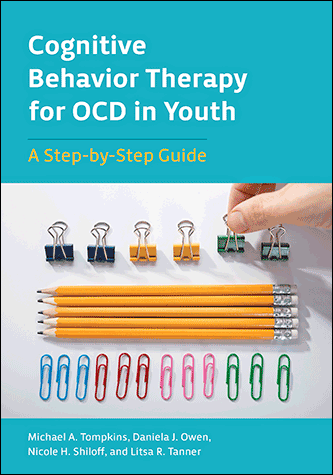
Cognitive Behavior Therapy for OCD in Youth
Available formats
Also available from
Obsessive-compulsive disorder (OCD), which can cause significant impairment in personal, social, and academic contexts, affects nearly half a million children in the United States.
This step-by-step guide provides mental health professionals with an adaptable, evidence-based model that uses cognitive behavior therapy to treat pediatric OCD. The authors present well-tested, empirically-validated strategies that encourage clinical flexibility and creativity.
Chapters describe the nuts and bolts of assessment, case conceptualization, and treatment planning, as well as psychoeducation, pharmacotherapy, strategies for relapse prevention, and involving family members in treatment. Richly described case studies illustrate how core strategies can be effectively implemented with youth between the ages of 7 and 18.
Clinicians and practitioners resources provides downloadable handouts for clinical use, including worksheets and fact sheets for parents and guardians, exercises and games, and other tools and resources.
Acknowledgments
Introduction
- Overview of Obsessive-Compulsive Disorder in Youth
- Modular CBT for Pediatric OCD
I. Assessment, Case Conceptualization, and Treatment Planning
- Gathering Information
- Developing the Case Conceptualization and Treatment Plan
II. Implementing the Core Strategies of the Treatment Approach
- Engaging Youth and Parents in the Treatment Approach
- Psychoeducation With Youth and Parents
- Working With the Family
- Implementing Graded Exposure and Response Prevention
- Developing and Implementing a Relapse Prevention Plan
III. Putting It All Together
- Structuring the Treatment
- Combining Cognitive Behavior Therapy and Pharmacotherapy
- Overcoming Obstacles
References
Index
About the Authors
Michael A. Tompkins, PhD, ABPP, is codirector of the San Francisco Bay Area Center for Cognitive Therapy, assistant clinical professor at the University of California–Berkeley, and board certified in behavioral and cognitive psychology. He is the author or coauthor of numerous articles and chapters on cognitive behavior therapy and related topics, as well as 10 books.
Dr. Tompkins serves on the advisory board of Magination Press, APA’s children’s press, and provides evidence-based treatments for adults, adolescents, and children.
Daniela J. Owen, PhD, is the assistant director of the San Francisco Bay Area Center for Cognitive Therapy, and assistant clinical professor at the University of California–Berkeley. She is the coauthor of several peer-reviewed articles and chapters.
Dr. Owen has presented locally and nationally on evidence-based treatments for pediatric disorders.
Nicole H. Shiloff, PhD, is an adjunct clinical faculty member at Stanford University School of Medicine and diplomate of the Academy of Cognitive Therapy. She has a private practice in Menlo Park where she specializes in the treatment of anxiety disorders in children, adolescents, and adults.
Litsa R. Tanner, MS, MFT, is a cofounder of the Santa Rosa Center for Cognitive Behavioral Therapy. Ms. Tanner specializes in the treatment of pediatric obsessive–compulsive disorder and obsessive–compulsive spectrum disorders.
This evidence-based guide will teach you how to conduct therapy with youth who have OCD. It provides a modular structure for individualizing treatment, based on a cognitive conceptualization.
—Judith S. Beck, PhD
President, Beck Institute for Cognitive Behavior Therapy, and Clinical Professor, University of Pennsylvania, Philadelphia
Tompkins, Owen, Shiloff, and Tanner slam a home run with this book. They cover all the CBT bases for effective treatment of pediatric OCD. Ingenious techniques, clinical dialogues, and helpful resources make this inspired reading for any practitioner treating young patients with OCD.
—Robert D. Friedberg, PhD, ABPP
Professor, Palo Alto University, Palo Alto, CA
There are still too few clinicians adequately trained in the treatment of pediatric OCD. This book provides health care professionals with techniques for implementing evidence-based treatments like exposure and response prevention. Readers will also find guidance on promoting engagement, dealing with unexpected obstacles, and reducing family accommodation. I highly recommend this book to pediatric therapists seeking to develop their skills in OCD treatment and to OCD therapists looking to expand their practice to include youth.
—C. Alec Pollard, PhD
Director, Center for OCD and Anxiety-Related Disorders, St. Louis Behavioral Medicine Institute, and Professor Emeritus of Family and Community Medicine, Saint Louis University School of Medicine, St. Louis, MO
Welcome to the clinician and practitioner resources for Cognitive Behavior Therapy for OCD in Youth: A Step-by-Step Guide. This website contains downloadable forms, worksheets, and tools to help practitioners provide therapy as described in the book. These documents are for clinical use only. If you wish to reprint or adapt them for publication, permission is required from the publisher. © 2020 American Psychological Association.
Contents
- Web Form 1.1: OCD vs. PANDAS/PANS (PDF: 39KB)opens in new window
- Web Form 1.2: Obsessive-Compulsive Cycle (PDF: 9KB)opens in new window
- Web Form 3.1: Map of My Land (PDF: 16KB)opens in new window
- Web Form 4.1: Functional Assessment and Case Conceptualization Worksheet (PDF: 52KB)opens in new window
- Web Form 6.1: Obsessive Compulsive Disorder Fact Sheet (PDF: 44KB)opens in new window
- Web Form 7.1: Family Accommodation Cycle (PDF: 38KB)opens in new window
- Web Form 7.2: Popular Rewards (PDF: 43KB)opens in new window
- Web Form 8.1: Exposure With Response Prevention Practice Form (PDF: 47KB)opens in new window
- Web Form 8.2: Self-Directed ERP Practice Form (PDF: 12KB)opens in new window
- Web Form 8.3: Lifestyle ERP Practice (PDF: 11KB)opens in new window
- Web Form 9.1: My Flight Plan (PDF: 13KB)opens in new window
- Web Form 9.2: Our Flight Plan (PDF: 13KB)opens in new window
- Web Form 9.3: My Daily Activity Schedule (PDF: 22KB)opens in new window
- Web Form 9.4: Certificate of Achievement (PDF: 9KB)opens in new window