

 Imagine you're walking down the street and you see a three-card monte game in progress. You know such games are rigged and thus both ethically and legally wrong, but you stop to watch. The mark is completely invested, watching the cards being shuffled by the dealer, who is also working to keep the mark's attention on the cards. The rest of the crowd is similarly enthralled. And then you notice that no one is watching the money in the pot. A few moments later, you're walking away, planning how you're going to be spending the ill-gained money in your pocket, with no one else the wiser.
As in the example above, when the risk of being caught is low, the temptation to commit a self-beneficial act at someone else's expense can get the best of a person. Such is one proposed unintended consequence of racial profiling called "reverse deterrence." That is, although racial profiling, when performed by law enforcement, is intended to reduce crime by concentrating attention and resources on members of a certain group thought to be more likely to commit criminal acts, it may embolden people outside of the targeted group to commit crimes because they believe they will not be caught.
To test this idea, Hackney and Glaser (Law and Human Behavior, 2013) (PDF, 82KB)opens in new window examined the effect of racial profiling on White and Black test takers who were given the opportunity to cheat. Small groups of participants were asked to complete extremely difficult anagrams.
Before the 15-minute test period started, the experimenter noted that because cheating had occurred in the past, she would be monitoring for it during this session. She then gave two confederate test takers (either two Black participants or two White participants, each pair being the only members of that race in their test group) a hard stare and asked them to move to the front of the room for the test.
The experimenter watched the two singled-out participants exclusively during the test period. The answers to the anagrams were available on the page following the test page, as the test was to be self-scored. Given that the experimenter's attention was engaged, would the other participants cheat? If so, would Black and White participants cheat or not cheat at the same rates?
Figure 1 shows that there was significantly more cheating among White participants when Black participants were profiled.
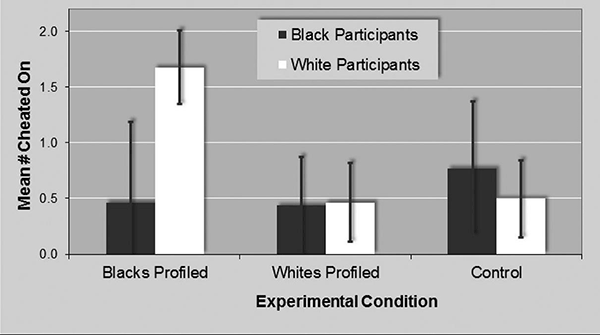
Figure 1. Average number of items cheated on out of the 12 most difficult anagrams, by condition and participant race. Error bars represent 95% confidence intervals
In addition to the usual discriminatory effect, racial profiling of a minority group in this experiment had an ironic negative consequence: White students were more likely to succumb to illicit behavior. Additional research is needed, but the possible wide-ranging implications of the unintended consequences of racial profiling are sobering.
Citation:
Hackney, A. A., & Glaser, J. (2013). Reverse deterrence in racial profiling: Increased transgressions by nonprofiled Whites. Law and Human Behavior, 37(5), 348–353. doi: 10.1037/lhb0000038
Note: This article is in the Social Psychology & Social Processes topic area. View more articles in the Social Psychology & Social Processes topic area.