 In a literature review published in International Perspectives in Psychology: Research, Practice, and Consultationopens in new window, the authors explored one way to promote access to mental health care services in low and middle income settings: through task-shifting skills in the context of the Community Based Rehabilitation (CBR) model.
At the global level there is a huge shortfall of practitioners to attend to the global mental health care needs.
Task-shifting has been used to transfer some of the tasks often performed by mental health professionals to those who live in the community themselves. This redistribution of care and support skills has the potential to increase access, decrease dependency on professionals, develop greater awareness of how professionals can be best used, and, at the same time, empower members of the community.
Rapid scale-up in access to services has been achieved when using task-shifting in other contexts, such as HIV, maternal health, and tuberculosis. Unique strengths that come from within the community itself can be harnessed to trigger effective health intervention mechanisms.
In this review, the authors explored if task-shifting mental health skills could be an effective way of providing services that might be needed to support such a model of intervention. The review examined which skills mental health workers are currently using at the community level; bringing together research previously scattered across time, continents, systems, and fields.
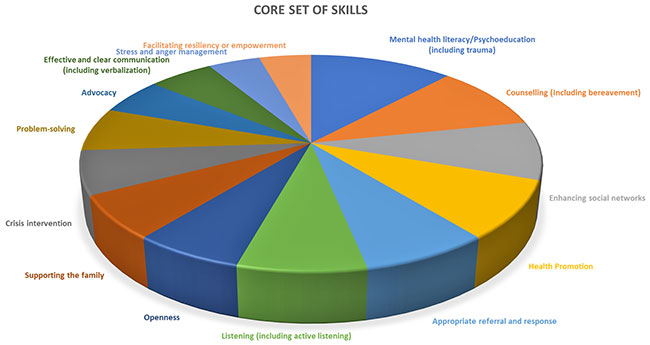
The key skills identified are shown in the pie chart (see Figures section), broken down by frequency of reported use and demonstrating the breath of skills of community mental health workers.
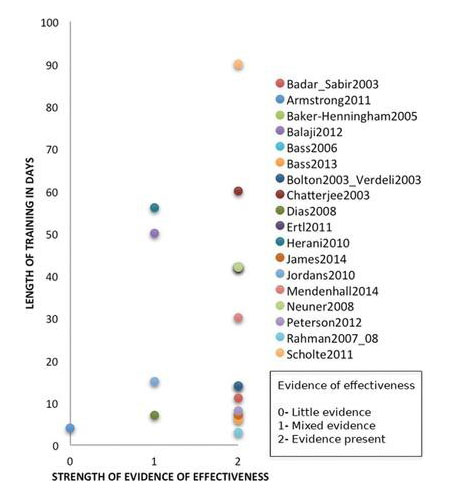
The scatterplot (see Figures section) represents the range of time community workers spent in training to deliver the interventions, and the extent to which there was evidence supporting the effectiveness of the interventions they delivered.
The results suggest that there is no straight-forward relationship between the length of time people spend in training and the strength of evidence associated with the outcome of the intervention they deliver. The context and the content of the training program may however be critical.
Through thematic analysis and realist synthesis the authors provide guidelines regarding some of the key factors that should be addressed in programs that seek to task-shift mental health interventions into the hands of community members.
The critical skills and issues included
- stigma towards mental health problems
- the current state of well-being or crisis within the community
- access routes to services
- cultural aspects of mental health and associated interventions
- a willingness to allow information to flow bi-directionally between service provider and service user
- empowerment of service users which challenges historical power structures
- engagement with local leaders
- the level of literacy in the community
- service providers learning "on-the-job"
- the development of mutual trust between service users and service providers
Significant investment is needed to increase access to quality mental health care in poorly resourced context. While task shifting alone is not intended to address this lack of resources it may be a realistic option for rapid scale-up of mental health interventions that can be effective.
Training programs that take into account the factors identified in this review are likely to be more effective in achieving this aim.
Citation
- Deimling Johns, L., Power, J., & MacLachlan, M. (2018). Community-based mental health intervention skills: Task shifting in low- and middle-income settings. International Perspectives in Psychology: Research, Practice, Consultation, 7(4), 205–230. https://dx.doi.org/10.1037/ipp0000097
Note: This article is in the Clinical Psychology topic area. View more articles in the Clinical Psychology topic area.