

 In this time of considerable economic uncertainty, organizations are struggling to identify ways to manage and respond to such uncertainty. Effective human resource (HR) management can help firms weather economic uncertainty, because enhancing the quality of employees creates strategically valuable firm resources that can be reconfigured and redeployed as the environment changes.
A considerable amount of research in industrial and organizational psychology suggests that more selective hiring and better training for employees can enhance individual job performance, but the question of whether such HR investments help firms effectively adapt to economic changes remains.
To understand the consequences of HR management for firm performance in changing economic conditions, Kim and Ployhart (2013) (PDF, 336KB)opens in new window used large, public Korean databases to examine the effects of staffing and training on firm productivity and profit growth before, during, and after the Great Recession. The Great Recession (December 2007–June 2009) provided a means to examine an extremely strong shock on the global economy, as many firms saw drastic reductions in consumer markets and profitability.
In the calendar year 2005, HR managers were asked to complete survey items about the selectivity of staffing or the amount of internal training within their firms. Kim and Ployhart also examined financial data on profit (earnings before interest and taxes) from 1999 to 2011.
On the basis of an analysis of 359 firms, they found that both selective staffing (operationalized as the selection ratio) and internal training (proportion of employees trained internally) positively contributed directly to firm productivity and indirectly to profit growth before the Great Recession (the bigger they are). However, firms that performed better because of selective staffing and internal training before the recession actually suffered the most when the recession hit (the harder they fall). Yet, these same firms usually recovered more quickly coming out of the recession, apparently because of slack resources developed pre-recession (the faster they get back up).
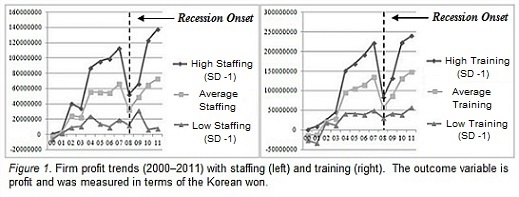
In general, training appears more important for enhancing pre-recession productivity and profit growth, whereas staffing appears more important for postrecession profit growth. Figure 1 shows how selective staffing and internal training contribute to firm profit growth under different economic conditions (pre-recession, at recession onset, and post-recession).
View larger imageopens in new window
Thus, firms that use more effective staffing and training outproduce and outperform competitors before a recession and recover more quickly after a recession, but they suffer a larger short-term drop when the recession hits. Thus, the bigger they are, the harder they fall, but the faster they get back up.
Economic uncertainty and shocks such as recessions force managers to make difficult choices, and such uncertainty is the norm for the foreseeable future. These results suggest that selectively staffing and effectively training employees can help firms prepare for and adapt to economic uncertainty.
The Great Recession forced difficult choices about the management of scarce resources, and many firms responded by implementing hiring freezes and cutting back on training. Such actions may carry unintended negative long-term consequences, as the quality of the people within the firm may, in fact, allow organizational flexibility and adaptability to whatever economic future lies ahead. Future research should investigate the generalizability of these findings and the joint relationships among employees, firms, and economic conditions.
Citation:
Kim, Y., & Ployhart, R. E. (2013). The effects of staffing and training on firm productivity and profit growth before, during, and after the Great Recession. Journal of Applied Psychology, 99, 361–389. doi: 10.1037/a0035408
Note: This article is in the I/O Psychology & Management topic area. View more articles in the I/O Psychology & Management topic area.