

 Is there any truth to the common conception that men do not remember people they have met, the location of misplaced objects, or who said what last Saturday to the extent that women do?
In their meta-analysis published in Psychological Bulletin, Martin Asperholm, Nadja Högman, Jonas Rafi, and Agneta Herlitz determined that for the most part it is correct.
The authors investigated the impact of sex on episodic memory performance by summarizing data from 617 studies conducted between 1973 and 2013 with in total 1,233,921 participants.
Because the demands on episodic memory can take many forms and require, for example, verbal (e.g., remembering a conversation or a list of words), visual (e.g., remembering an image), or spatial (e.g., remembering a route) processing to a greater or lesser degree, the researchers also investigated to what extent the magnitude of sex differences was modified by what was to be remembered.
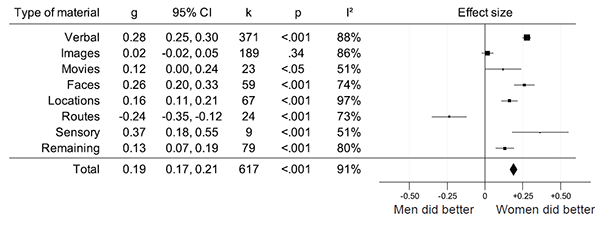
The authors found a consistent pattern, namely that females have a general advantage in episodic memory, which is modified by the material to be remembered.
Along a continuum ranging from highly verbal to highly spatial, the female advantage is found in tasks in which verbal abilities can be utilized (e.g., remembering a word list, a story, or nameable images), whereas there is a male advantage in tasks relying more fully on spatial processing (e.g., abstract images or routes).
In addition, there is a female advantage on tasks assessing memory for faces and sensory information (odor, taste, and color).
These sex differences have remained stable since 1973 and are seen across the life span. For verbal episodic memory tasks, differences seem to vary across continents, and are somewhat smaller in childhood and old age than for other ages.
Because episodic memory is known to be a sensitive system that tends to deteriorate relatively early in adulthood and is negatively affected in individuals with, for example, sleep deprivation, depression, and preclinical dementia, it is a commonly assessed cognitive ability. Oftentimes episodic memory is assessed by first presenting a wordlist, and then, after a delay, asking the person to recall the remembered words.
This meta-analysis suggests that women should be expected to have a non-negligible advantage over men on such tasks. Therefore, when episodic memory tasks are used to assess and compare individuals, the relative disadvantage of men as a group should be taken into account when evaluating performance.
Even though the female advantages in verbally based episodic memory tasks are reliable, they can still be considered small (d=0.28) — in this case, 61% of all women will be above the mean of men.
- Can such small differences in basic cognitive abilities have cumulative impact on everyday life, or are these differences unimportant?
- Can the requirement of remembering verbal information contribute to the sex differences observed in most school subjects?
- Can the relatively minor sex differences in episodic memory and other cognitive functions contribute to the observed sex segregation in educational choices?
Although there are no definite answers at present, these questions clearly merit further research attention.
Citation
- Asperholm, M., Högman, N., Rafi, J., & Herlitz, A. (2019). What did you do yesterday? A meta-analysis of sex differences in episodic memory. Psychological Bulletin, 145(8), 785–821. https://dx.doi.org/10.1037/bul0000197
Note: This article is in the Core of Psychology topic area. View more articles in the Core of Psychology topic area.