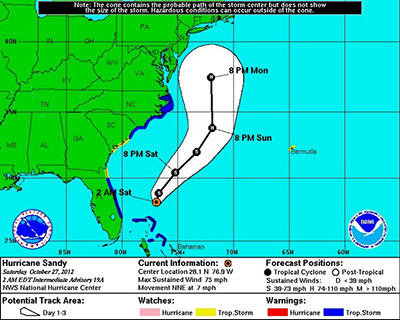
 A paper published in the September 2018 issue of Journal of Experimental Psychology: Applied by Alexander P. Boone, Peri Gunalp, and Mary Hegarty investigated the understanding of a common visualization used in communicating hurricane forecasts to the public. The so-called "cone of uncertainty" (Figure 1) is often used to disseminate vital forecast information, yet this visualization violates cognitive principles of graphical design and is often misinterpreted.
The authors focused on two misconceptions: the size misconception and the boundary misconception. The size misconception is the assumption that the width of the cone represents the size or strength of the hurricane (rather than uncertainty about the location of the hurricane track over time), while the boundary misconception is the assumption that the boundary of the cone represents the boundary of the hurricane itself when, in fact, it represents a confidence interval for the possible location of the hurricane over time.
These misconceptions reduce forecast effectiveness and, when used to inform evacuation decisions, can be the difference between life and death.
The authors examined the effects of explaining to naive viewers how to interpret the cone of uncertainty (i.e. the graphic conventions of the display). That is, they explained that a wider cone indicated more uncertainty about the possible path of the hurricane but did not provide information about the size or strength of the storm. They also explained that the boundary of the cone indicated a confidence interval, specifically the forecast of where the storm is likely to hit 67% of the time.
Two experiments examined the effects of these instructions on both agreement with explicit statements about what the cone of uncertainty shows (e.g. "the display shows the hurricane getting larger over time") and on a task that involved interpreting the graphic to estimate damage from the hurricane.
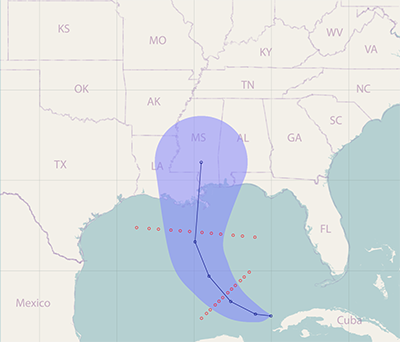
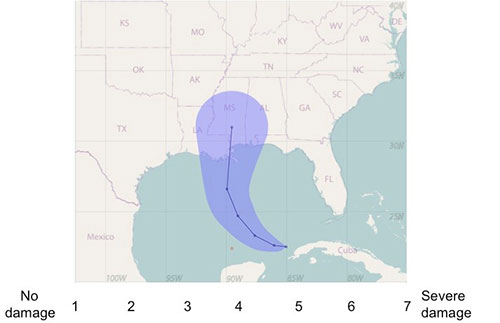
In the damage estimation task, participants interpreted the displays to estimate the relative damage from a hurricane to locations (oil rigs) at different distances from the center of the cone, including locations both inside and outside the cone (see Figure 2). However, participants only rated one oil rig per trial (Figure 3).
In the first experiment, participants made these judgments before and after they read a description of the graphic conventions. In the second experiment, three groups of participants received different instructions. One group received no information about the graphic conventions. Another group received qualitative information (e.g., "a wider cone means more uncertainty"), while the third group received quantitative information about these conventions (e.g., "the hurricane has a roughly 67% chance of being located inside the area of the cone").
More information about the graphical conventions of the display influenced explicit beliefs in both experiments.
Notably, in Experiment 1, participants who were given this information were significantly less likely to endorse the boundary and hurricane size misconceptions. In Experiment 2, participants who were provided with qualitative or quantitative instructions were less likely to endorse the size misconception. However, only those provided with quantitative information were less likely to endorse boundary misconception.
The researchers examined patterns of responses over many damage estimation trials to understand effects of the instructions on these judgments. On average, explanations of the graphic conventions of the cone of uncertainty had little effect on these estimates.
However, aggregate data masked qualitatively different patterns of responses across individuals. A minority of individuals made estimates consistent with the misconceptions; for example, they might estimate no damage to an oil rig that fell outside the cone of uncertainty, indicating a boundary effect. However, most individuals did not show evidence of the misconceptions in their damage estimates.
The results suggest that explaining the graphical conventions that indicate uncertainty in hurricane forecasts can influence individuals' explicit beliefs about what these displays show. They also indicate that many people intuitively understand that the boundary of the cone as a confidence interval rather than a physical boundary, and do not necessarily take the size of the cone to indicate the size of the hurricane itself.
Most importantly, the results indicate that others hold misconceptions that are not necessarily rectified by additional instructions about how to interpret the display. Understanding and targeting individual differences in comprehension and misconceptions may be critical in addressing communication of uncertain events to the public.
Citation
- Boone, A. P., Gunalp, P., & Hegarty, M. (2018). Explicit versus actionable knowledge: The influence of explaining graphical conventions on interpretation of hurricane forecast visualizations. Journal of Experimental Psychology: Applied, 24(3), 275–295. https://dx.doi.org/10.1037/xap0000166
Note: This article is in the Basic / Experimental Psychology topic area. View more articles in the Basic / Experimental Psychology topic area.