

 Gone are the days when psychotherapy was limited to the outpatient office. Telepsychology interventions have become increasingly common among a variety of pediatric populations, such as children with traumatic brain injury (TBI), chronic pain, obesity, cancer, or encopresis, in order to bring the “experts” in these conditions a little closer to home.
Telepsychology reduces the barriers of time and distance, as well as the challenge of bringing and keeping a dysregulated child in an office for a traditional 45-minute session.
Although telepsychology may improve access to services, its growth is accompanied with increasing questions about the suitability and efficacy of web-based interventions, particularly for children with significant physical and/or behavioral issues. Moreover, conditions that impair attention and executive function skills (e.g., attention deficit hyperactivity disorder and cognitive impairment due to TBI) may render telehealth approaches less effective than face-to-face treatment.
What do therapists who have delivered these interventions think about telepsychology?
In a study published in the August 2019 issue of Rehabilitation Psychology, Dr. Shari Wade and colleagues examined clinician perceptions regarding the experience of delivering telepsychology interventions to children recovering from moderate to severe TBI and their families. Seventeen clinicians (psychologists and advanced psychology doctoral students) who delivered both telepsychology and face-to-face interventions completed surveys and interviews.
As depicted in the figure below, telepsychology was rated as equivalent or superior to face-to-face interventions on most dimensions.
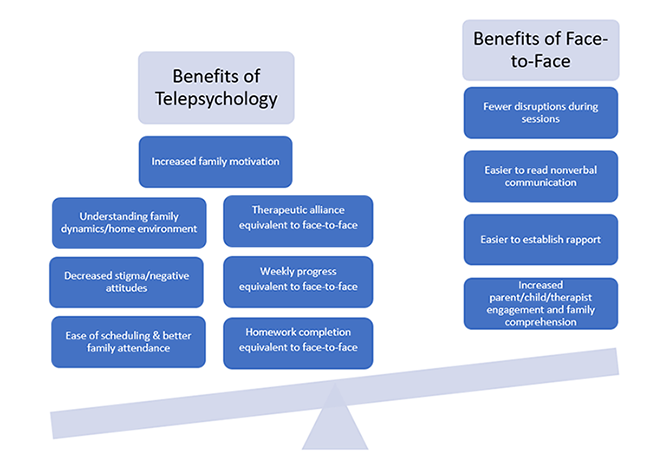
Figure: Relative Benefits of Telepsychology Versus Face to Face Treatment
Clinicians rated telepsychology as superior to face-to-face therapy in terms of scheduling/attendance, understanding the family and home environments, and reducing behavioral health stigma. Although some clinicians commented that establishing therapeutic alliance via telepsychology could be challenging and require unique clinical skills, a majority rated establishment of therapeutic alliance as equivalent between online and face-to-face sessions.
Clinicians noted several challenges with utilizing telepsychology, the most prominent being distractions, limited non-verbal cues, and occasional technological issues. However, clinicians reported that problem-solving around these challenges was an effective opportunity to model and practice skills in-vivo within the family’s unique context.
Clinicians in this study reported that the families who lived in rural areas with low resources were most likely to benefit from telepsychology, while families with more chaotic home environments without a private space for teleconferencing derived fewer benefits. Previous studies suggest that rural families may be ideal candidates for telepsychology, particularly due to federal initiatives to provide inexpensive Internet access in these areas.
Overall, Wade and colleagues provide evidence supporting the use of telepsychology to treat children with neurological and cognitive impairments. However, their findings also underscore that telepsychology may be a poor fit for some families and clinicians.
As telepsychology treatments become more widely available, it will be important to assess patient preferences and characteristics when determining the optimal treatment modality.
Citation
- Wade, S. L., Raj, S. P., Moscato, E. L., & Narad, M. E. (2019). Clinician perspectives delivering telehealth interventions to children/families impacted by pediatric traumatic brain injury. Rehabilitation Psychology, 64(3), 298–306. https://dx.doi.org/10.1037/rep0000268
Note: This article is in the Health Psychology and Medicine topic area. View more articles in the Health Psychology and Medicine topic area.