

 Many U.S. colleges and universities make diversity planning and implementation efforts a critical goal, as diversity is one of the most significant issues facing higher education today. To respond to these challenges, several colleges and universities have created the position of Chief Diversity Officer (CDO) in the last decade, a leadership role devoted to diversity planning and implementation.
This executive-level role focuses on building relationships on campus and guiding institutional efforts concerned with the attainment of campus diversity goals. Although many CDOs continue to be appointed across the nation to fulfill this great responsibility, it is not uncommon for them to face challenges that emerge from poorly constructed CDO roles that hinder their work and efforts to fulfill diversity goals.
For that reason, it is imperative to carefully examine the structure, responsibilities, resources, and organizational design of each CDO position, seeking to understand how these characteristics can support or hinder the work of these diversity leaders.
Examining this issue, Raul A. Leon, in an article published in the June 2014 issue of the Journal of Diversity in Higher Education (PDF, 86KB)opens in new window, analyzed the position of CDO in three large public research institutions in the Midwest region of the United States.
In his study, he addressed two central questions:
- What strategies do CDOs use to develop, manage, and maximize available resources to maximize diversity resources?
- Can the configuration of the CDO position facilitate or constrain the work of the CDO?
With a focus on examining the importance of the organizational structure of the CDO, Leon selected three CDO positions operating in three large public research institutions (key elements of each case are shown in the table).
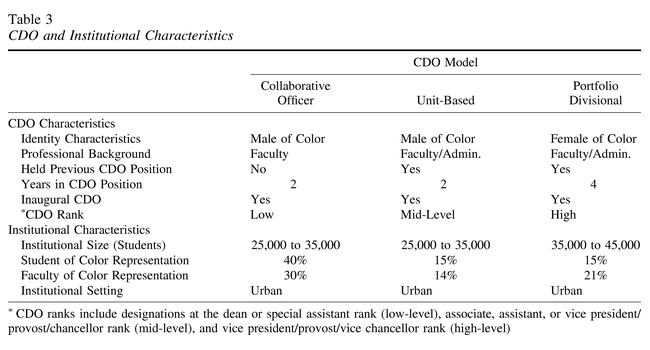
Each selected CDO represents one model out of the three archetypes of vertical authority (i.e., collaborative officer, unit based, and portfolio divisional) that currently serve as templates for colleges and universities to design the CDO role. Using a multiple-case-study methodology, Leon collected data via semistructured interviews with three CDOs and 28 campus administrators and collected documents pertaining to the work of each CDO (e.g., mission statements, strategic diversity plans, position descriptions, and committee reports). Grounded in the literature of diversity management and the nature of the CDO position, Leon analyzed each case, presenting valuable findings examining the configuration of the CDO.
Leon found that the CDO position is highly collaborative and integrative, and these characteristics defined all three CDO models selected. However, when he scrutinized the organizational design of each model, several differences emerged, including not only different configurations but also differences pertaining to ranks in their institutional hierarchies, funding, staffing, power, duties, reporting structure, and strategies implemented.
In this study, Leon brought the voices of administrators as well of CDOs to the forefront of the discussion. Leon demonstrated that although personal characteristics of the CDOs (e.g., charisma, leadership, integrative thinking, and capacity to build relationships) influence how CDOs will approach their tasks, the organizational design of their positions can limit or enhance their capacity to fulfill their responsibilities. As such, it is crucial for institutions to design CDO roles that are equipped to fulfill the demands of diversity work and can position the CDO as a true diversity leader.
Citation:
Leon, R. A. (2014). The chief diversity officer: An examination of CDO models and strategies. Journal of Diversity in Higher Education, 7, 77–91.
Note: This article is in the Educational Psychology topic area. View more articles in the Educational Psychology topic area.