

 When you drop your pencil, how do you know where to look for it? You are easily able to predict where the pencil will land, because you grasp the fundamental physical principles that influence how objects in the world behave, including the influence of gravity, and you know that objects that move out of sight continue to exist. Although we may not realize it, understanding the forces that determine how objects interact is central to how human beings successfully navigate the world.
This nuanced understanding of object physics is not fully present from birth. Until around the age of 3 years, children look for dropped objects directly below where they fell, even if there are other objects or barriers in the way. This search behavior has been termed a gravity bias. While incorrect, it may reflect a strong naïve expectation about how gravity works: Dropped objects fall down.
However, evidence for expectations about gravity in other species, including primates and dogs, has been mixed. In recent years research has demonstrated that dogs share many social skills with humans, such as understanding human pointing gestures—perhaps because they share our social environment. Dogs also share our physical environment, but much less is known about the extent to which they possess a similar understanding of physical properties, such as gravity. A shared gravity bias would provide support for some between-species continuity in physical reasoning skills.
In a paper published in the Journal of Comparative Psychologyopens in new window, Emma Tecwyn and Daphna Buchsbaum reported that domestic dogs do not share a gravity bias with young children. For its investigation of this principle, the paper was the 2019 Journal of Comparative Psychology Best Paper.
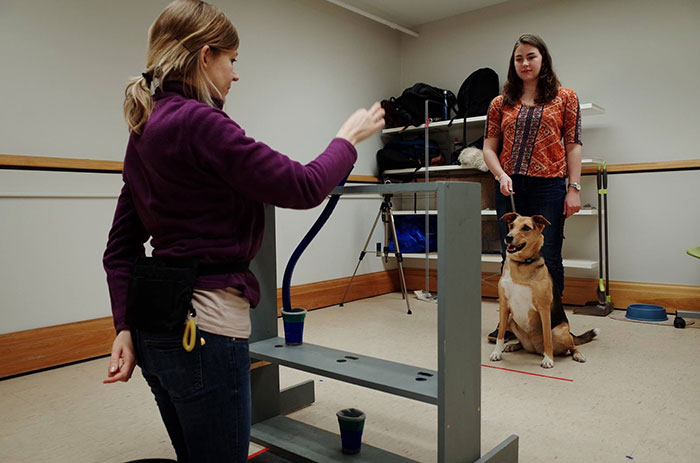
The researchers adapted a puzzle used to study gravity bias in children, known as the tubes task. In the simplest version of the task, a ball is dropped into an apparatus consisting of a single diagonal tube with two or three possible search locations at the bottom, only one of which is attached to the bottom of the tube.
An adult or older child knows that the ball must travel diagonally down the tube and land in the cup attached to the bottom. However, very young children make a predictable error: Rather than looking in the cup attached to the bottom of the tube, they search in the cup directly underneath where the ball was dropped.
Taking advantage of dogs’ motivation to search for treats, the researchers ran a series of experiments where dogs watched a tasty snack being dropped down a tube before being allowed to search for it. The researchers systematically manipulated the features and configuration of the setup to find out the factors on which dogs based their search strategy.
Unlike young children, dogs did not succumb to a gravity bias: They did not systematically search in the cup directly beneath the top of the tube into which the treat was dropped. However, dogs also did not perform like older children or adults. Rather than using fundamental principles about the physical world to search correctly at the end of the tube, they tended to begin by looking in the center of the apparatus, before widening out their search. The only time dogs managed to successfully locate the dropped treats was when the tube was transparent; in that case, it was possible to track the food’s movement through the tube and into the attached cup.
The findings suggest that dogs might not show the same gravity bias as young children due to differing opportunities to learn about the effects of their own actions on the movement of objects. Infants and toddlers frequently drop and throw things onto the floor, including from a height, giving them many opportunities to observe the physical effects of gravity on objects. Dogs’ behavior and anatomy do not afford them these same learning opportunities.
This potentially has important implications regarding the way in which interacting with the world might influence understanding of it. Perhaps, despite sharing humans’ physical environment, dogs’ ability to reason about it differs fundamentally from ours.
Photo of experiment
Note: This article is in the Basic/Experimental Psychology topic area. View more articles in the Basic/Experimental Psychology topic area.