

 More than 330 people have been exonerated by post-conviction DNA testing, unequivocally proving their innocence. False confessions, a narrative admission to a criminal act that one did not commit, have been a contributing factor in approximately 25% of the DNA exoneration cases (The Innocence Projectopens in new window).
For people who are wrongfully accused of a crime, pretrial DNA testing of blood, hair, saliva, semen, and other biological traces can serve as a valuable safeguard against wrongful conviction. Cases like that of Jeffrey Deskovicopens in new window, however, suggest that confession evidence — even when false — may be persuasive enough to overpower exculpatory DNA.
After a lengthy and manipulative interrogation, then-16-year-old Deskovic confessed to the rape and murder of a high school classmate. Prior to trial, DNA testing of the semen recovered from the victim excluded Deskovic as the perpetrator. Yet he was prosecuted and convicted by a jury. At trial, prosecutors theorized that the victim had prior consensual sex with an "unknown and unidentified boyfriend" and that Deskovic, who had confessed to rape and murder, killed her after failing to ejaculate.
Deskovic was convicted in 1991 and released 15 years later when the DNA was matched to a convicted murderer who eventually pled guilty (Santos, 2006opens in new window).
In a legal system that purports to contain numerous safeguards to protect the falsely accused, the foregoing series of events may seem highly atypical. However, in 2010, The Center for Wrongful Convictions identified 19 cases in which confessors to rape and/or murder were tried and convicted despite having been excluded by DNA tests of key biological materials; since that time, additional cases have been reported and critiqued (Drizin & Riley, 2014opens in new window; Goode, 2011opens in new window; Martin, 2011opens in new window).
In arguing each of these cases, the prosecutor proposed a speculative theory to explain away the mismatched confession and exculpatory DNA.
Although these case outcomes are counterintuitive, they are not surprising. Previous research shows that both confessions and DNA are highly persuasive forms of incriminating evidence. Yet, little research has compared contradictory self-report and scientific evidence in the same trial, and, when it has, the results have been mixed.
Thus, in a recently published article in Psychology, Public Policy, and Law, Appleby and Kassin (2016) (PDF, 171KB)opens in new window designed a series of studies to test people's perceptions of guilt in cases in which the scientific evidence (in the form of DNA) and the self-report evidence (in the form of eyewitnesses and confessions) contradict each other, a contradiction sometimes accompanied by a prosecutor's explanatory theory.
Participants read a case summary about the rape and murder of a 16-year-old girl and the resulting police investigation.
Study 1 varied the type of self-report (defendant statement or eyewitness), whether that self-report was incriminating or exculpatory, and DNA that was either incriminating or exculpatory.
Studies 2 and 3 examined how people react to the same evidentiary contradiction (confession vs. exculpatory DNA) when the evidence was accompanied by the prosecutor's argument that the exculpatory DNA evidence merely indicated that the victim had prior consensual sex with an unidentified man.
Participants rendered a verdict, rated their confidence in that verdict, estimated the likelihood that the defendant committed the crime, and rated how convincing of guilt they found each of the pieces of evidence.
In Study 1, participants' perceptions of guilt were overwhelmingly influenced by whether the DNA results were incriminating or exculpatory; this preference was exhibited in verdicts, confidence ratings, and probability-of-commission estimates.
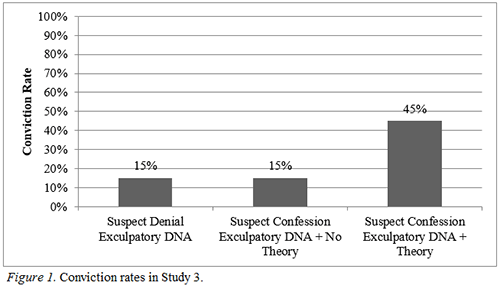
In Studies 2 and 3, the introduction of a prosecutorial theory that sought to reconcile the apparent contradiction in the evidence significantly increased the conviction rate. Using an undergraduate sample, in Study 2, the introduction of a prosecutorial theory increased the conviction rate from 10% to 33%. Using a sample of community adults, Study 3 replicated these findings: a prosecutorial theory increased the conviction rate from 15% to 45%. Study 3 also included a denial condition in which the suspect was interrogated but denied any involvement — a statement that was supported by the DNA.
Importantly, there was no difference in conviction rates between the confession-no theory and denial groups (15%), suggesting that without a prosecutorial theory, a confession with exculpatory DNA may have the same effect on jurors as a case in which the defendant has never confessed (See Figure 1).
Although the conviction rate in response to a confession followed by exculpatory DNA did not constitute a majority of participants, the pattern across three studies was unmistakable: in the case of a defendant who had confessed, the prosecutor's theories significantly attenuated the effect of otherwise compelling exculpatory DNA.
As to why the accompaniment of a prosecutorial theory proved so important, research shows that storytelling in particular presents a potentially important contextual influence on the inferences that people draw from evidence. Successful trial lawyers often stress the value of a causal narrative to help jurors understand complicated trial information. Research on the story model for juror decision-making supports these assertions.
There is also a basic tendency in social perception for people to accept new information at face value. As a result of this tendency, deception detection researchers have observed that people have a "truth bias" when evaluating the veracity of statements.
Bringing together both the preference for stories that provide coherence and the fact that people tend to accept new information as true, it is not terribly surprising that a prosecutorial theory which permits acceptance of all the evidence, including items that are contradictory, will often prove persuasive relative to an alternative in which jurors must make the effortful critical judgment to accept one strong item of evidence and reject another.
Given that DNA evidence has become the new "gold standard" in the forensic sciences, the findings that, in confession cases, laypeople can be persuaded to draw incriminating, non-innocent conclusions from exculpatory DNA have troubling implications for the reliance on it as a safeguard.
These findings reinforce the American Psychology-Law Societyopens in new window White Paper recommendation that the video recording of the processes of interviewing and interrogation in their entirety remains an important mean of protecting innocent suspects in the interrogation room (Kassin et al., 2010) by providing a more accurate factual record for judges and juries needing to assess the voluntariness and credibility of the confession in question.
A second means of countering the inherent power of confession evidence is to admit testimony from experts. At present, U.S. courts differ in their willingness to admit such testimony.
The studies by Appleby and Kassin add to the literature cited by APA in amicus briefs recently submitted to state supreme courts (e.g., Rivera v. Illinois, 2011; Michigan v. Kowalski, 2012; People of New York v. Thomas, 2013) arguing that judges and juries have difficulty assessing confession evidence and that psychological experts would assist the trier of fact.
The authors believe that the present studies contribute to the growing literature on how psychology can be used to recommend evidence-based policies and practices aimed at preventing wrongful convictions.
Citation:
- Appleby, S. C., & Kassin, S. M. (2016). When self-report trumps science: Effects of confessions, DNA, and prosecutorial theories on perceptions of guilt. Psychology, Public Policy, and Law, 22(2), 127–140. https://dx.doi.org/10.1037/law0000080
Note: This article is in the Forensic Psychology topic area. View more articles in the Forensic Psychology topic area.