

 Valence — whether something is positive or negative — is known to broadly influence cognition. For instance, negative items are often remembered better than positive items.
Typically, valence effects are attributed to the greater emotional salience of negative information, and the survival value of devoting more attention to negative information. However, because many of these same processes are also influenced by stimulus similarity, valence differences in cognitive processing could also be explained by valence differences in similarity.
In a paper published in Journal of Experimental Psychology: Learning, Memory, and Cognition, Koch and colleagues (2016) capitalized on the development of a new spatial arrangement method (SpAM) of measuring similarity to test whether there are differences in similarity based on valence in large representative samples of participant-generated stimuli.
In SpAM, participants are instructed to arrange stimuli on a computer screen such that more similar items are closer to each other and more dissimilar items are further away from each other. Pixel proximity between items is then computed as a measure of similarity. Thus, similarity between 20 positive and 20 negative words can be computed from a single trial that takes less than 10 minutes rather than requiring 780 pair-wise similarity judgments.
Participants completed SpAM for 20 positive and 20 negative words that they generated themselves, or that were generated by another participant. Positive words were arranged closer to each other than negative words regardless of whether the words were self-generated or generated by another participant.
This valence asymmetry in similarity was also obtained when participants generated words that were positive and negative idiosyncratically ("for you personally") or consensually ("for all people"), when each participant only contributed two words (one positive and one negative) to the stimulus sets used in SpAM, when participants arranged words representing positive and negative real-life events that they experienced over the course of a week, and when possible confounds (e.g., valence intensity, frequency, familiarity, concreteness) were controlled for.
Finally, Koch et al. reanalyzed data from large word (Warriner, Kuperman, & Brysbaert, 2013; ~14,000 words) and image (International Affective Picture System; Lang et al., 2005; 956 pictures) databases for which valence and similarity ratings are available. Words and pictures from these databases were categorized as positive or negative by a median split based on mean valence ratings. Overall similarity (average absolute rating difference between a word/picture and all other same-valence word/pictures) was greater for positive words/pictures than negative words/pictures.
These results support a general valence asymmetry in similarity whereby positive stimuli (words, events, pictures) are more similar to each other than negative stimuli.
This similarity difference could arise because positive information is encountered more frequently, so positive events or stimuli are more likely to co-occur. Alternatively, because there are more ways for something to be negative (e.g., too hot, too cold) than positive (e.g., just right), negative items are more diverse.
Because both similarity and affective properties are known to influence a variety of cognitive processes including decision-making, categorization, and memory, this robust relationship between similarity and valence may provide a unitary explanation for a wide range of phenomena.
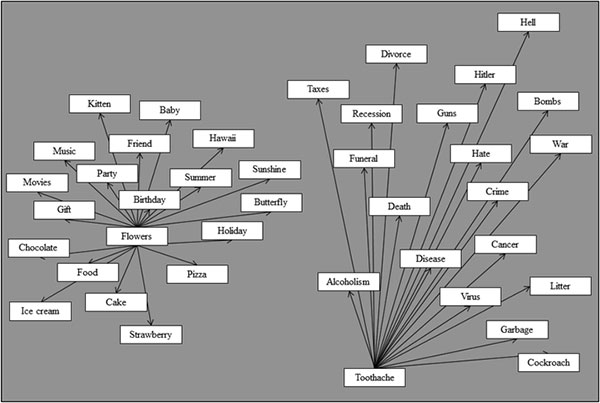
Figure 1 from Koch et al. Example SpAM solution in which positive words (left) are placed spatially closer and thus judged as more similar to each other than negative words (right).
Citation
- Koch, A., Alves, H., Krüger, T., & Unkelbach, C. (2016). A general valence asymmetry in similarity: Good is more alike than bad. Journal of Experimental Psychology: Learning, Memory, and Cognition, 42(8), 1171–1192. https://dx.doi.org/10.1037/xlm0000243
Note: This article is in the Basic / Experimental Psychology topic area. View more articles in the Basic / Experimental Psychology topic area.