Psychological Review

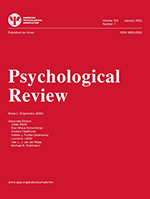
Cover of Psychological Review (medium)
ISSN: 0033-295X
eISSN: 1939-1471
Published: six times, beginning in January
Impact Factor: 5.1
Psychology - Multidisciplinary: 19 of 218
5-Year Impact Factor: 8
Psychology: 8 of 92

Journal scope statement

Psychological Review® publishes articles that make important theoretical contributions to any area of scientific psychology, including systematic evaluation of alternative theories. Papers mainly focused on surveys of the literature, problems of method and design, or reports of empirical findings are not appropriate.

There is no upper bound on the length of Psychological Review articles. However, authors who submit papers with texts longer than 15,000 words will be asked to justify the need for their length.

Psychological Review also publishes Theoretical Notes—commentaries that contribute to progress in a given subfield of scientific psychology. Such notes include, but are not limited to, discussions of previously published articles, comments that apply to a class of theoretical models in a given domain, critiques and discussions of alternative theoretical approaches, and meta-theoretical discourse on theory testing and related topics.


Disclaimer: APA and the editors of Psychological Review assume no responsibility for statements and opinions advanced by the authors of its articles.

Equity, diversity, and inclusion

Psychological Review supports equity, diversity, and inclusion (EDI) in its practices. More information on these initiatives is available under EDI Efforts.

Open science

The APA Journals Program is committed to publishing transparent, rigorous research; improving reproducibility in science; and aiding research discovery. Open science practices vary per editor discretion. View the initiatives implemented by this journal.

Editor's Choice

Each issue of the Psychological Review will honor one accepted manuscript per issue by selecting it as an “Editor’s Choice” paper. Selection is based on the discretion of the editor if the paper offers an unusually large potential impact to the field and/or elevates an important future direction for science.

Author and editor spotlights

Explore journal highlights: free article summaries, editor interviews and editorials, journal awards, mentorship opportunities, and more.


Prior to submission, please carefully read and follow the submission guidelines detailed below. Manuscripts that do not conform to the submission guidelines may be returned without review.

Submission

To submit to the editorial office of Elena L. Grigorenko, PhD, please submit manuscripts electronically through the Manuscript Submission Portal in Microsoft Word or Open Office format.

Prepare manuscripts according to the Publication Manual of the American Psychological Association using the 7th edition. Manuscripts may be copyedited for bias-free language (see Chapter 5 of the Publication Manual). APA Style and Grammar Guidelines for the 7th edition are available.

Submit Manuscript

Elena L. Grigorenko, PhD
Editor, Psychological Review

General correspondence may be directed to the editor's office.

Do not submit manuscripts to the editor’s email address.

All submissions should be clear and readable. An unusual typeface is acceptable only if it is clear and legible.

In addition to addresses and phone numbers, please supply electronic mail addresses and fax numbers, if available, for potential use by the editorial office and later by the production office.

Psychological Review® is now using a software system to screen submitted content for similarity with other published content. The system compares the initial version of each submitted manuscript against a database of 40+ million scholarly documents, as well as content appearing on the open web. This allows APA to check submissions for potential overlap with material previously published in scholarly journals (e.g., lifted or republished material).

Editor's Choice

Each issue of REV will honor one manuscript as the Editor’s Choice.

Selection criteria

The Editor’s Choice article will be selected based on an assessment of the following criteria. In addition to the editor’s own assessment of these criteria, information provided in the peer reviews (numerical ratings and comments) and the AEs’ decision letters will be used as data for selection.

  • Diversity: Does the study advance our understanding of how legal institutions and policy makers should work with and treat diverse groups of people? Does the study contribute to improving services for underserved populations?
  • Innovation: Does the study lead to significantly new knowledge, ask unexamined questions, and/or use highly novel methods to inform policy and legal practice?
  • Methodological rigor: Do the methods meet the highest level of methodological rigor for the particular field of study?
  • Policy significance/impact: Does the study have significant and direct implications that can change/improve/increase practices in the legal or policy areas?

Selection process

When the editor prepares the table of contents each quarter, the editor will identify the article that they believe best meets the criteria in consultation with the associate editors. 

Associate editors will be invited to nominate articles for Editor’s Choice. The editor will consider these nominations in their selection review process.

Masked review policy

Open (i.e., unmasked) review is the default for this journal, though masked review is an option. If you choose masked review, include authors' names and affiliations only in the cover letter for the manuscript.

Authors who choose masked review should make every effort to see that the manuscript itself contains no clues to their identities, including grant numbers, names of institutions providing IRB approval, self-citations, and links to online repositories for data, materials, code, or preregistrations (e.g., Create a View-only Link for a Project).

Length

There is no upper bound on the length of Psychological Review articles.

However, authors who submit papers with texts longer than 15,000 words will be asked to justify the need for their length.

Psychological Review publishes direct replications if they are relevant to and/or embedded in new or enhanced theories. Submissions should include a mention of the replication in the abstract.

Journal Article Reporting Standards

Authors should review the APA Style Journal Article Reporting Standards (JARS) for quantitative and mixed methods. The standards offer ways to improve transparency in reporting to ensure that readers have the information necessary to evaluate the quality of the research and to facilitate collaboration and replication.

Author contribution statements using CRediT

The APA Publication Manual (7th ed.) stipulates that “authorship encompasses…not only persons who do the writing but also those who have made substantial scientific contributions to a study.” In the spirit of transparency and openness, Psychological Review has adopted the Contributor Roles Taxonomy (CRediT) to describe each author's individual contributions to the work. CRediT offers authors the opportunity to share an accurate and detailed description of their diverse contributions to a manuscript.

Submitting authors will be asked to identify the contributions of all authors at initial submission according to this taxonomy. If the manuscript is accepted for publication, the CRediT designations will be published as an Author Contributions Statement in the author note of the final article. All authors should have reviewed and agreed to their individual contribution(s) before submission.

CRediT includes 14 contributor roles, as described below:

  • Conceptualization: Ideas; formulation or evolution of overarching research goals and aims.
  • Data curation: Management activities to annotate (produce metadata), scrub data, and maintain research data (including software code, where it is necessary for interpreting the data itself) for initial use and later reuse.
  • Formal analysis: Application of statistical, mathematical, computational, or other formal techniques to analyze or synthesize study data.
  • Funding acquisition: Acquisition of the financial support for the project leading to this publication.
  • Investigation: Conducting a research and investigation process, specifically performing the experiments, or data/evidence collection.
  • Methodology: Development or design of methodology; creation of models.
  • Project administration: Management and coordination responsibility for the research activity planning and execution.
  • Resources: Provision of study materials, reagents, materials, patients, laboratory samples, animals, instrumentation, computing resources, or other analysis tools.
  • Software: Programming, software development; designing computer programs; implementation of the computer code and supporting algorithms; testing of existing code components.
  • Supervision: Oversight and leadership responsibility for the research activity planning and execution, including mentorship external to the core team.
  • Validation: Verification, whether as a part of the activity or separate, of the overall replication/reproducibility of results/experiments and other research outputs.
  • Visualization: Preparation, creation, and/or presentation of the published work, specifically visualization/data presentation.
  • Writing—original draft: Preparation, creation, and/or presentation of the published work, specifically writing the initial draft (including substantive translation).
  • Writing—review and editing: Preparation, creation and/or presentation of the published work by those from the original research group, specifically critical review, commentary, or revision—including pre- or post-publication stages.

Authors can claim credit for more than one contributor role, and the same role can be attributed to more than one author.

Transparency and openness

APA endorses the Transparency and Openness Promotion (TOP) Guidelines by a community working group in conjunction with the Center for Open Science (Nosek et al. 2015). Empirical research submitted to Psychological Review must at least meet the “disclosure” level for all eight aspects of research planning and reporting. Authors should include a subsection in the method section titled “Transparency and openness.” This subsection should detail the efforts the authors have made to comply with the TOP guidelines. For example:

  • We report how we determined our sample size, all data exclusions (if any), all manipulations, and all measures in the study, and the study follows JARS (Appelbaum et al., 2018). All data, analysis code, and research materials are available at [stable link to permanent repository]. Data were analyzed using R, version 4.0.0 (R Core Team, 2020) and the package ggplot, version 3.2.1 (Wickham, 2016). This study’s design and its analysis were not pre-registered.

Data, materials, and code

Reviews that include quantitative analyses (e.g., meta-analyses) must state whether data and study materials (if these were created for the review, e.g., coding schemes) are posted to a trusted repository and, if how, where to access them. Recommended repositories include APA’s repository on the Open Science Framework (OSF), or authors can access a full list of other recommended repositories. Trusted repositories adhere to policies that make data discoverable, accessible, usable, and preserved for the long term. Trusted repositories also assign unique and persistent identifiers.

In a subsection titled “Transparency and Openness” at the end of the Method section, specify whether and where the data and material will be available or include a statement noting that they are not available. For submissions with quantitative or simulation analytic methods, state whether the study analysis code is posted to a trusted repository, and, if so, how to access it.

For example:

  • All data have been made publicly available at the [trusted repository name] and can be accessed at [persistent URL or DOI].
  • Materials and analysis code for this study are available by emailing the corresponding author.
  • Materials and analysis code for this study are not available.
  • The code behind this analysis/simulation has been made publicly available at the [trusted repository name] and can be accessed at [persistent URL or DOI].

Preregistration of studies and analysis plans

Preregistration of studies and specific hypotheses can be a useful tool for making strong theoretical claims. Likewise, preregistration of analysis plans can be useful for distinguishing confirmatory and exploratory analyses. Investigators are encouraged to preregister their studies and analysis plans prior to conducting the research via a publicly accessible registry system (e.g., OSF, ClinicalTrials.gov, or other trial registries in the WHO Registry Network). There are many available templates; for example, APA, the British Psychological Society, and the German Psychological Society partnered with the Leibniz Institute for Psychology and Center for Open Science to create Preregistration for Quantitative Research in Psychology (Bosnjak et al., 2022). Preregistration Standards for Quantitative Research in Psychology

Articles must state whether or not any work was preregistered and, if so, where to access the preregistration. If reviews were pre-registered as protocols or if quantitative analyses were pre-registered, include the registry links in the Method section.

For example:

  • For a systematic review: This review’s protocol was pre-registered prospectively before data were collected at [stable link to protocol]. We followed the PRISMA-P checklist when preparing the protocol, and we followed PRISMA reporting guidelines for the final report.
  • For an unregistered review: This review was not pre-registered. We followed PRISMA reporting guidelines for the final report.

Manuscript preparation

Prepare manuscripts according to the Publication Manual of the American Psychological Association (7th edition). Manuscripts may be copyedited for bias-free language (see Chapter 3 of the 6th edition or Chapter 5 of the 7th edition).

Review APA's Journal Manuscript Preparation Guidelines before submitting your article.

Double-space all copy. Other formatting instructions, as well as instructions on preparing tables, figures, references, metrics, and abstracts, appear in the Manual. Additional guidance on APA Style is available on the APA Style website.

Below are additional instructions regarding the preparation of display equations, computer code, and tables.

Display equations

We strongly encourage you to use MathType (third-party software) or Equation Editor 3.0 (built into pre-2007 versions of Word) to construct your equations, rather than the equation support that is built into Word 2007 and Word 2010. Equations composed with the built-in Word 2007/Word 2010 equation support are converted to low-resolution graphics when they enter the production process and must be rekeyed by the typesetter, which may introduce errors.

To construct your equations with MathType or Equation Editor 3.0:

  • Go to the Text section of the Insert tab and select Object.
  • Select MathType or Equation Editor 3.0 in the drop-down menu.

If you have an equation that has already been produced using Microsoft Word 2007 or 2010 and you have access to the full version of MathType 6.5 or later, you can convert this equation to MathType by clicking on MathType Insert Equation. Copy the equation from Microsoft Word and paste it into the MathType box. Verify that your equation is correct, click File, and then click Update. Your equation has now been inserted into your Word file as a MathType Equation.

Use Equation Editor 3.0 or MathType only for equations or for formulas that cannot be produced as Word text using the Times or Symbol font.

Computer code

Authors of accepted articles who report new computer simulations of models, or new data-analysis software, are required to provide the code as online supplemental material ("additional content") at the time of final manuscript submission. It is important to include adequate documentation so that the code can be downloaded and used by other researchers.

Because altering computer code in any way (e.g., indents, line spacing, line breaks, page breaks) during the typesetting process could alter its meaning, we treat computer code differently from the rest of your article in our production process. To that end, we request separate files for computer code.

In online supplemental material

We request that runnable source code be included as supplemental material to the article. For more information, visit Supplementing Your Article With Online Material.

In the text of the article

If you would like to include code in the text of your published manuscript, please submit a separate file with your code exactly as you want it to appear, using Courier New font with a type size of 8 points. We will make an image of each segment of code in your article that exceeds 40 characters in length. (Shorter snippets of code that appear in text will be typeset in Courier New and run in with the rest of the text.) If an appendix contains a mix of code and explanatory text, please submit a file that contains the entire appendix, with the code keyed in 8-point Courier New.

Tables

Use Word's insert table function when you create tables. Using spaces or tabs in your table will create problems when the table is typeset and may result in errors.

LaTex files

LaTex files (.tex) should be uploaded with all other files such as BibTeX Generated Bibliography File (.bbl) or Bibliography Document (.bib) together in a compressed ZIP file folder for the manuscript submission process. In addition, a Portable Document Format (.pdf) of the manuscript file must be uploaded for the peer-review process.

Academic writing and English language editing services

Authors who feel that their manuscript may benefit from additional academic writing or language editing support prior to submission are encouraged to seek out such services at their host institutions, engage with colleagues and subject matter experts, and/or consider several vendors that offer discounts to APA authors.

Please note that APA does not endorse or take responsibility for the service providers listed. It is strictly a referral service.

Use of such service is not mandatory for publication in an APA journal. Use of one or more of these services does not guarantee selection for peer review, manuscript acceptance, or preference for publication in any APA journal.

Submitting supplemental materials

APA can place supplemental materials online, available via the published article in the PsycArticles® database. Please see Supplementing Your Article With Online Material for more details.

Abstract and keywords

All manuscripts must include an abstract containing a maximum of 250 words typed on a separate page. After the abstract, please supply up to five keywords or brief phrases.

References

List references in alphabetical order. Each listed reference should be cited in text, and each text citation should be listed in the References section.

Examples of basic reference formats:

Journal article

McCauley, S. M., & Christiansen, M. H. (2019). Language learning as language use: A cross-linguistic model of child language development. Psychological Review, 126(1), 1–51. https://doi.org/10.1037/rev0000126

Authored book

Brown, L. S. (2018). Feminist therapy (2nd ed.). American Psychological Association. https://doi.org/10.1037/0000092-000

Chapter in an edited book

Balsam, K. F., Martell, C. R., Jones. K. P., & Safren, S. A. (2019). Affirmative cognitive behavior therapy with sexual and gender minority people. In G. Y. Iwamasa & P. A. Hays (Eds.), Culturally responsive cognitive behavior therapy: Practice and supervision (2nd ed., pp. 287–314). American Psychological Association. https://doi.org/10.1037/0000119-012

Data set citation

Alegria, M., Jackson, J. S., Kessler, R. C., & Takeuchi, D. (2016). Collaborative Psychiatric Epidemiology Surveys (CPES), 2001–2003 [Data set]. Inter-university Consortium for Political and Social Research. https://doi.org/10.3886/ICPSR20240.v8

Software/Code citation

Viechtbauer, W. (2010). Conducting meta-analyses in R with the metafor package.  Journal of Statistical Software, 36(3), 1–48. https://www.jstatsoft.org/v36/i03/

Wickham, H. et al., (2019). Welcome to the tidyverse. Journal of Open Source Software, 4(43), 1686, https://doi.org/10.21105/joss.01686


All secondary data and program code and other methods from other articles should be cited in the text and listed in the References section.

Figures

Preferred formats for graphics files are TIFF and JPG, and preferred format for vector-based files is EPS. Graphics downloaded or saved from web pages are not acceptable for publication. Multipanel figures (i.e., figures with parts labeled a, b, c, d, etc.) should be assembled into one file. When possible, please place symbol legends below the figure instead of to the side.

Resolution

  • All color line art and halftones: 300 DPI
  • Black and white line tone and gray halftone images: 600 DPI

Line weights

  • Adobe Photoshop images
    • Color (RGB, CMYK) images: 2 pixels
    • Grayscale images: 4 pixels
  • Adobe Illustrator Images
    • Stroke weight: 0.5 points

APA offers authors the option to publish their figures online in color without the costs associated with print publication of color figures.

The same caption will appear on both the online (color) and print (black and white) versions. To ensure that the figure can be understood in both formats, authors should add alternative wording (e.g., “the red (dark gray) bars represent”) as needed.

For authors who prefer their figures to be published in color both in print and online, original color figures can be printed in color at the editor's and publisher's discretion provided the author agrees to pay:

  • $900 for one figure
  • An additional $600 for the second figure
  • An additional $450 for each subsequent figure

Permissions

Authors of accepted papers must obtain and provide to the editor on final acceptance all necessary permissions to reproduce in print and electronic form any copyrighted work, including test materials (or portions thereof), photographs, and other graphic images (including those used as stimuli in experiments).

On advice of counsel, APA may decline to publish any image whose copyright status is unknown.

Publication policies

For full details on publication policies, including use of Artificial Intelligence tools, please see APA Publishing Policies.

APA policy prohibits an author from submitting the same manuscript for concurrent consideration by two or more publications.

See also APA Journals® Internet Posting Guidelines.

APA requires authors to reveal any possible conflict of interest in the conduct and reporting of research (e.g., financial interests in a test or procedure, funding by pharmaceutical companies for drug research).

In light of changing patterns of scientific knowledge dissemination, APA requires authors to provide information on prior dissemination of the data and narrative interpretations of the data/research appearing in the manuscript (e.g., if some or all were presented at a conference or meeting, posted on a listserv, shared on a website, including academic social networks like ResearchGate, etc.). This information (2–4 sentences) must be provided as part of the Author Note.

Authors who have posted their manuscripts to preprint archives prior to submission should include a link to the preprint.

Ethical Principles

It is a violation of APA Ethical Principles to publish "as original data, data that have been previously published" (Standard 8.13).

In addition, APA Ethical Principles specify that "after research results are published, psychologists do not withhold the data on which their conclusions are based from other competent professionals who seek to verify the substantive claims through reanalysis and who intend to use such data only for that purpose, provided that the confidentiality of the participants can be protected and unless legal rights concerning proprietary data preclude their release" (Standard 8.14).

APA expects authors to adhere to these standards. Specifically, APA expects authors to have their data available throughout the editorial review process and for at least 5 years after the date of publication.

Authors are required to state in writing that they have complied with APA ethical standards in the treatment of their sample, human or animal, or to describe the details of treatment.

The APA Ethics Office provides the full Ethical Principles of Psychologists and Code of Conduct electronically on its website in HTML, PDF, and Word format. You may also request a copy by emailing or calling the APA Ethics Office (202-336-5930). You may also read "Ethical Principles," December 1992, American Psychologist, Vol. 47, pp. 1597–1611.

Other information

See APA’s Publishing Policies page for more information on publication policies, including information on author contributorship and responsibilities of authors, author name changes after publication, the use of generative artificial intelligence, funder information and conflict-of-interest disclosures, duplicate publication, data publication and reuse, and preprints.

Visit the Journals Publishing Resource Center for more resources for writing, reviewing, and editing articles for publishing in APA journals.

Editor

Elena L. Grigorenko, PhD
University of Houston, United States

Associate editors

Andrew Bayliss, PhD
University of East Anglia, United Kingdom

Kara J. Blacker, PhD
Naval Medical Research Unit Dayton, United States

Laura Bringmann, PhD
University of Groningen, The Netherlands

Julian Elliott, PhD
Durham University, United Kingdom

Eva Gilboa-Schechtman, PhD
Bar-Ilan University, Israel

Peter Kvam, PhD
Ohio State University, United States

Hongjing Lu, PhD
University of California, Los Angeles, United States

Han L. J. Van der Maas, PhD
University of Amsterdam, Netherlands

Michael R. Waldmann, PhD
University of Göttingen, Germany

Angela Yu, PhD
Technical University of Darmstadt, Germany

Editorial fellows

Lisa Chinn, PhD
University of Oregon, United States

Yujia Peng, PhD
Peking University, China

Brent M. Wilson, PhD
University of California, San Diego, United States

Consulting editors

John R. Anderson, PhD
Carnegie Mellon University, United States

Marjan Bakker, PhD
University of Tilburg, Netherlands

Deanna Barch, PhD
Washington University, United States

Jennifer A. Bartz, PhD
McGIll University, Canada

Denny Borsboom, PhD
University of Amsterdam, Holland

Michelle P. Brown, PhD
University of South Carolina, United States

Nick Chater, PhD
University of Warwick, United Kingdom

Joey T. Cheng, PhD
York University, Canada

Chi-yue Chiu, PhD
The Chinese University of Hong Kong, Hong Kong

Clintin P. Davis-Stober, PhD
University of Missouri, United States

Leonidas Doumas, PhD
University of Edinburgh, United Kingdom

Eli Finkel, PhD
Northwestern University, United States

Cleotilde Gonzalez, PhD
Carnegie Mellon University, United States

Samuel Greiff, PhD
University of Luxembourg, Luxemburg

Tom Griffiths, PhD
Princeton University, United States

Ulrike Hahn, PhD
University of London, United Kingdom

Catherine A. Hartley, PhD
New York University, United States

Steven J. Heine, PhD
University of British Columbia, Canada

Joni Holmes, PhD
Cambridge University, United Kingdom

Jonathan D. Huppert, PhD
The Hebrew University of Jerusalem, Israel

Feng Ji, PhD
University of Toronto, Canada

Michael J. Kahana, PhD
University of Pennsylvania, United States

Tatsuya Kameda, PhD
University of Tokyo, Japan

Katherine H. Karlsgodt, PhD
University of California, Los Angeles, United States

David Kellen, PhD
Syracuse University, United States

Clare Kelly, PhD
University of Dublin, Ireland

Charles Kemp, PhD
University of Melbourne, Australia

Rogier A. Kievit, PhD
Radboud University, Netherlands

Peter D. Kvam, PhD
University of Florida, United States

Michael D. Lee, PhD
University of California, Irvine, United States

Stephan Lewandowsky, PhD
University of Bristol, United Kingdom

Matthew Lieberman, PhD
University of California, Los Angeles, United States

Daniel R. Little, PhD
University of Melbourne, Australia

Gordon Logan, PhD
Vanderbilt University, United States

Tina Malti, PhD
University of Toronto, Canada

Jon Maner, PhD
Florida State University, United States

Andrew J. Martin, PhD
University of New South Wales, Australia

Janet Metcalfe, PhD
Columbia University, United States

Vijay A. Mittal, PhD
Northwestern University, United States

John Opfer, PhD
The Ohio State University, United States

Adam Osth, PhD
The University of Melbourne, Australia

Jörg Rieskamp, PhD
University of Basel, Switzerland

Ajay Bhaskar Satpute, PhD
Northeastern University, United States

Disa Sauter, PhD
University of Amsterdam, Netherlands

Natalie Sebanz, PhD
Central European University, Austria

Philip Smith, PhD
The University of Melbourne, Australia

R. Nathan Spreng, PhD
McGill University, Canada

Mark Steyvers, PhD
University of California, Irvine, United States

Marius Usher, PhD
Tel Aviv University, Israel

Chandan Vaidya, PhD
Georgetown University, United States

Alexander Weigard, PhD
University of Michigan, United States

Daniel T. Willingham, PhD
University of Virginia, United States

Wendy Wood, PhD
University of Southern California, United States

Virgil Zeigler-Hill, PhD
Oakland University, United States

Abstracting and indexing services providing coverage of Psychological Review®

  • Academic OneFile
  • Academic Search Alumni Edition
  • Academic Search Complete
  • Academic Search Elite
  • Academic Search Index
  • Academic Search Premier
  • Advanced Placement Psychology Collection
  • Business & Company Profile ASAP
  • Cabell's Directory of Publishing Opportunities in Psychology
  • Chartered Association of Business Schools (CABS) Academic Journal Guide
  • Current Abstracts
  • Current Contents: Life Sciences
  • Current Contents: Social & Behavioral Sciences
  • EBSCO MegaFILE
  • Education Abstracts
  • Education Full Text
  • Education Research Complete
  • Education Source
  • Educator's Reference Complete
  • Ergonomics Abstracts
  • ERIH (European Reference Index for the Humanities and Social Sciences)
  • Expanded Academic ASAP
  • General OneFile
  • Health & Wellness Resource Center and Alternative Health Module
  • Health Reference Center Academic
  • Humanities and Social Sciences Index Retrospective
  • Humanities Index Retrospective
  • IBZ / IBR (Internationale Bibliographie der Rezensionen Geistes- und Sozialwissenschaftlicher Literatur)
  • InfoTrac Custom
  • International Bibliography of the Social Sciences
  • Journal Citations Report: Social Sciences Edition
  • Linguistics & Language Behavior Abstracts
  • MasterFILE Complete
  • MasterFILE Elite
  • MasterFILE Premier
  • MEDLINE
  • MLA International Bibliography
  • NSA Collection
  • OCLC
  • OmniFile Full Text Mega
  • PASCAL
  • Professional ProQuest Central
  • ProQuest Central
  • ProQuest Discovery
  • ProQuest Platinum Periodicals
  • ProQuest Psychology Journals
  • ProQuest Research Library
  • ProQuest Social Science Journals
  • Psychology Collection
  • PsycInfo
  • PsycLine
  • RILM Abstracts of Music Literature
  • SafetyLit
  • Science Citation Index Expanded
  • SCOPUS
  • Social Sciences Abstracts
  • Social Sciences Citation Index
  • Social Sciences Full Text
  • Social Sciences Index Retrospective
  • TOC Premier

Transparency and Openness Promotion

APA endorses the Transparency and Openness Promotion (TOP) Guidelines by a community working group in conjunction with the Center for Open Science (Nosek et al. 2015). The TOP Guidelines cover eight fundamental aspects of research planning and reporting that can be followed by journals and authors at three levels of compliance.

For example:

  • Level 1: Disclosure—The article must disclose whether or not the materials are posted to a trusted repository.
  • Level 2: Requirement—The article must share materials via a trusted repository when legally and ethically permitted (or disclose the legal and/or ethical restriction when not permitted).
  • Level 3: Verification—A third party must verify that the standard is met.

As of August 1, 2021, empirical research, including meta-analyses, submitted to Psychological Review must, at a minimum, meet Level 1 (Disclosure) for all eight aspects of research planning and reporting. Authors should include a subsection in their methods description titled “Transparency and openness.” This subsection should detail the efforts the authors have made to comply with the TOP guidelines.

The list below summarizes the minimal TOP requirements of the journal. Please refer to the Center for Open Science TOP guidelines for details, and contact the editor (Elena L. Grigorenko, PhD) with any further questions. APA recommends sharing data, materials, and code via trusted repositories (e.g., APA’s repository on the Open Science Framework (OSF)), and we encourage investigators to preregister their studies and analysis plans prior to conducting the research. Trusted repositories adhere to policies that make data discoverable, accessible, usable, and preserved for the long term. Trusted repositories also assign unique and persistent identifiers. There are many available preregistration forms (e.g., the APA Preregistration for Quantitative Research in Psychology template, ClinicalTrials.gov, or other preregistration templates available via OSF). Completed preregistration forms should be posted on a publicly accessible registry system (e.g., OSF, ClinicalTrials.gov, or other trial registries in the WHO Registry Network).

A list of participating journals is also available from APA.

The following list presents seven fundamental aspects of research planning and reporting, the TOP level required by Psychological Review, and a brief description of the journal's policy. (The journal also publishes replications if they are relevant to and/or embedded in new or enhanced theories.)

  • Citation: Level 1, Disclosure—All data, program code, and other methods developed by others should be cited in the text and listed in the references section.
  • Data Transparency: Level 1, Disclosure—Article states whether the raw and/or processed data on which study conclusions are based are posted to a trusted repository and, if so, how to access them.
  • Analytic Methods (Code) Transparency: Level 1, Disclosure—Article states whether computer code or syntax needed to reproduce analyses in an article is posted to a trusted repository and, if so, how to access it.
  • Research Materials Transparency: Level 1, Disclosure—Article states whether materials described in the method section are posted to a trusted repository and, if so, where to access them.
  • Design and Analysis Transparency (Reporting Standards): Level 1, Disclosure—The journal strongly encourages the use of APA Style Journal Article Reporting Standards (JARS-Quant and/or MARS).
  • Study Preregistration: Level 1, Disclosure—Article states whether the study design and (if applicable) hypotheses of any of the work reported was preregistered and, if so, how to access it. Authors may submit a masked copy via stable link or supplemental material or may provide a link after acceptance.
  • Analysis Plan Preregistration: Level 1, Disclosure—Article states whether any of the work reported preregistered an analysis plan and, if so, how to access it. Authors may submit a masked copy via stable link or supplemental material or may provide a link after acceptance.
  • Replication: Level 1, Disclosure—The journal publishes replications.

Inclusive reporting standards

  • Bias-free language and community-driven language guidelines (recommended)
  • Data sharing and data availability statements (required)

More information on this journal’s reporting standards is listed under the submission guidelines tab.

Pathways to authorship and editorship

Editorial fellowships

Editorial fellowships help early-career psychologists gain firsthand experience in scholarly publishing and editorial leadership roles. This journal offers an editorial fellowship program for early-career psychologists from historically excluded communities.

Other EDI offerings

ORCID reviewer recognition

Open Research and Contributor ID (ORCID) Reviewer Recognition provides a visible and verifiable way for journals to publicly credit reviewers without compromising the confidentiality of the peer-review process. This journal has implemented the ORCID Reviewer Recognition feature in Editorial Manager, meaning that reviewers can be recognized for their contributions to the peer-review process.

APA Publishing Insider

APA Publishing Insider is a free monthly newsletter with tips on APA Style, open science initiatives, active calls for papers, research summaries, and more.

Sign up

Social media

Twitter icon     linkedin-icon-black     Facebook icon