


The American workplace is beginning to adjust to new norms after years of disruption, according to APA’s 2024 Work in America™ survey. Workers are contending with the challenges and opportunities brought on by intergenerational workplaces, expectations around remote work, four-day workweeks, and the adoption of artificial intelligence (AI) technologies.
The survey also revealed adverse work experiences reported by those with disabilities and new evidence of the importance of psychological safety in the workplace.
Even with all this upheaval, job satisfaction remains a bright spot for workers, as a majority report satisfaction with key aspects of their employment.
Trending: Intergenerational tension, remote work, four-day workweeks, AI, and economic concerns
Younger Americans are more comfortable working with others their own age
With up to five generations in the American workplace today, there may be significant concerns about their ability to work together.
View a full-size version with detailed description of the younger adults infographic
- Around three in 10 U.S. workers reported that people in their organization who are not close to their age don’t see the value in their ideas (32%) and feel self-conscious about their age at work (29%). A quarter (25%) said they are worried about their job security because of their age.
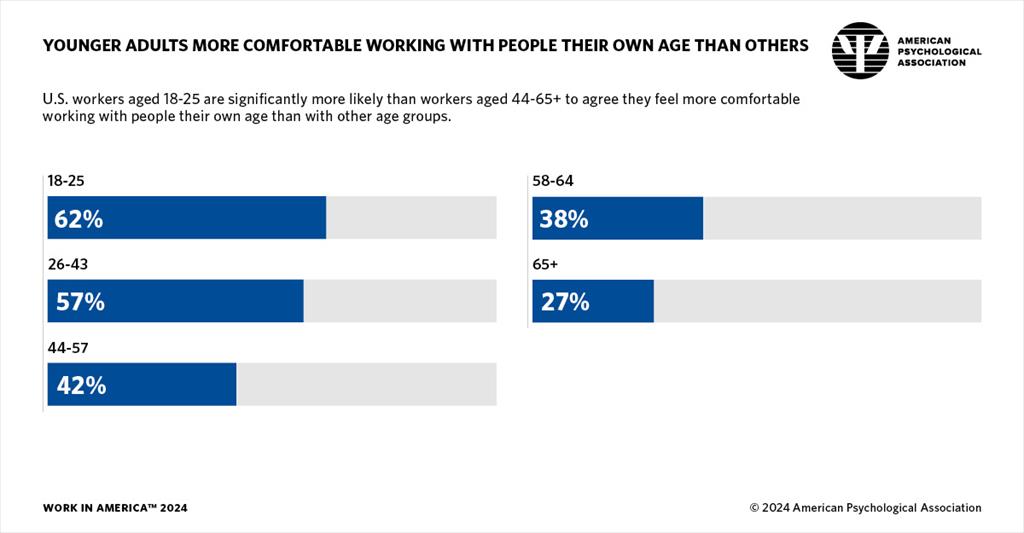
- Around three in five workers (62%) aged 18–25 said they are more comfortable working with people their own age than with other age groups, compared with nearly half (49%) of all workers who said they felt the same.
- Nearly half (48%) of workers aged 18–25 said people in their organization who are not their age don’t see value in their ideas—three times higher than workers aged 65+ (16%).
- Nearly half (45%) of workers aged 18–25 said they feel lonely when they are working, significantly more than workers aged 26–43 (33%), 44–57 (22%), 58–64 (15%) and 65+ (14%).
- Workers aged 57 and younger are more likely than those aged 58 and older to say they typically feel tense or stressed out during the workday (48% aged 18–25, 51% aged 26–43, and 42% aged 44–57 vs. 30% aged 58–64 and 17% aged 65+).
- Overall, however, most working adults reported appreciating the opportunity to work with people of different ages (92%) and said having employees from a range of age groups is an advantage for their workplace (87%).
Even though I’ve been working at my firm for four years, it’s a short span compared with someone else at the workplace. But just because I don’t have years of experience doesn’t mean that what I say isn’t a good idea too.
For the best work experience, employed Americans want to choose where and how they work
American workers want control over where they do their work—whether it is fully in person, fully remote or a hybrid of the two—and they’re more satisfied when they have it. While working adults were divided on whether they would rather work in person, remotely, or hybrid, a third of workers said they are not working in their preferred location. They may also want to work fewer days a week, fully endorsing a move to the four-day workweek.
View a full-size version with detailed description of the preferred location infographic
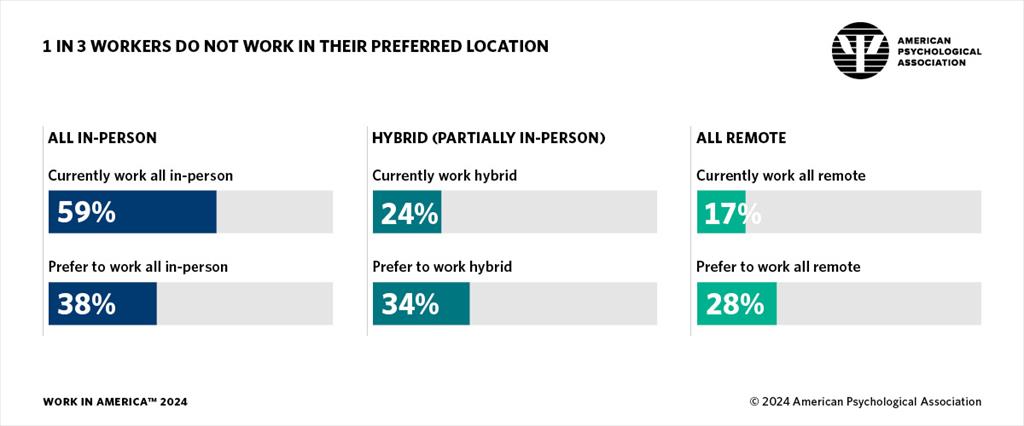
- One in three workers (33%) are not currently working in their preferred location.
- While 59% of U.S. workers reported currently working all in person, 24% reported being hybrid and 17% reported working completely remotely. However, only 38% of workers reported they prefer to work all in person, compared with 34% who reported preferring to work hybrid and 28% preferring to work remotely.
- Regardless of whether they work in person, remotely, or hybrid, the majority of workers agreed that they could be just as effective at work if they only worked four days a week (81%) and would be happier at work if they only worked four days a week (79%).
- In fact, two-thirds of employed adults agreed that the four-day workweek will become the norm in America in their lifetime (67%).
- The percentage of workers reporting that their employer offers four-day workweeks was significantly higher in 2024 than the previous two years (14% in 2022 and 17% in 2023 vs. 22% in 2024).
- One in three workers (33%) said they do not have enough flexibility at work to keep their work life and personal life in balance.
I enjoy working with my immediate coworkers and the hybrid schedule allows me to have more flexibility with home and work.
Employers may be struggling to keep pace with AI adoption
While adoption of AI technology in the workplace may be growing, findings suggest this trend may be employee-driven, with notable gaps in employer guidance.
- More than a third of workers (35%) are intentionally using AI monthly or more often to assist with their work, yet only 18% reported knowing that their employer has an official policy about acceptable uses of AI.
- Half of workers (50%) said their employer has no such policy, and close to one third (32%) were unsure.
- Some employees (41%) worry that AI will eventually make some or all of their job duties obsolete in the future.
I feel my employer should help us to embrace and adopt use of new technology to make us more effective in our roles, such as learning AI and strategizing potential use cases.
Individuals with disabilities have less satisfactory work experiences
Despite many workers reporting satisfaction with their work, individuals with a mental or physical disability were more likely to report experiencing toxic work environments and have more concerns about wages and inflation.
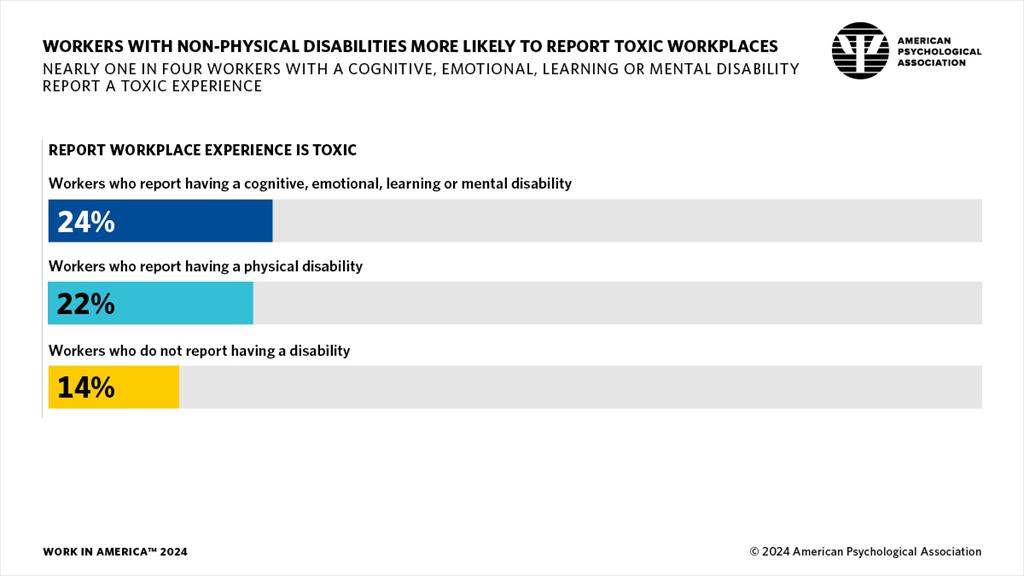
- For those living with a cognitive, emotional, learning, or mental disability, 24% reported a toxic workplace experience, which is significantly higher than those not living with a disability (14%).
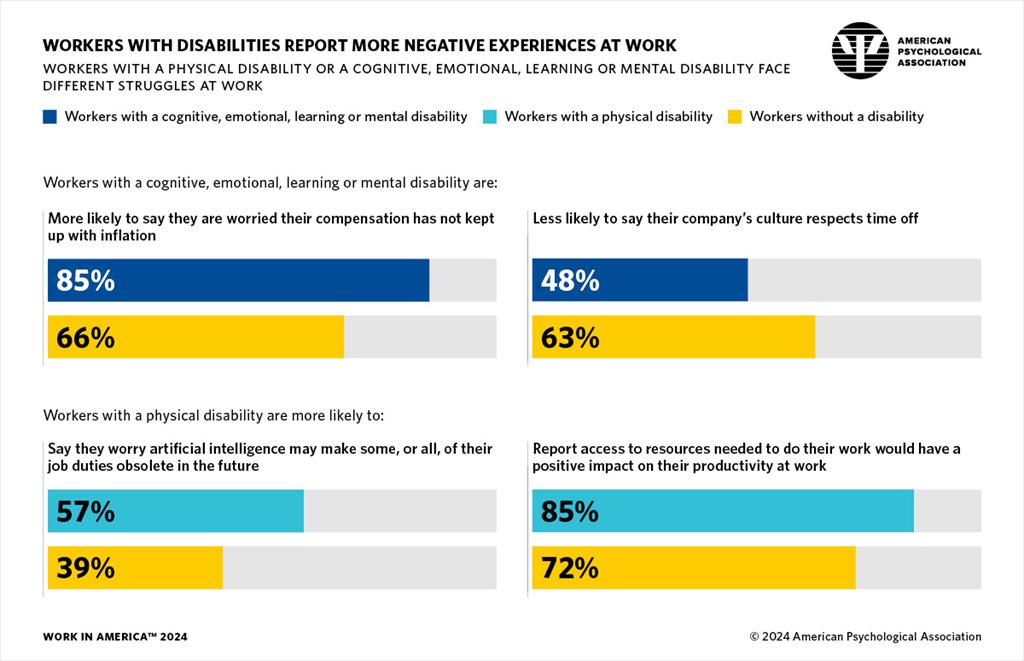
- Those who are living with a cognitive, emotional, learning, or mental disability were also more likely than those not living with a disability to report being worried their compensation has not kept up with inflation (85% vs. 66%).
- Less than half (48%) of individuals living with a cognitive, emotional, learning, or mental disability described their company’s culture as one that respects time off, compared with 63% of those not living with a disability.
- Adults living with a physical disability reported worrying that AI may make some or all of their job duties obsolete (57% vs. 39% of those not living with a disability).
- Workers living with a physical disability (85%) were significantly more likely to say that access to resources needed to do their work would have a positive impact on their productivity, compared with workers with no disability (72%).
A lot of coworkers do not care or understand my difficulties, thus making it even harder. They took away my long-term disability [insurance] when I went part-time.
Inflation weighs on employed adults’ minds
- Two-thirds (67%) of employed adults reported being worried that their compensation has not kept up with inflation, similar to previous years (71% in 2022 and 69% in 2023).
- Women were more likely than men to have expressed this worry (70% vs. 64%).
- Worries about compensation keeping up with inflation may be a factor in job changes—among those workers who plan to look for a new job within the next year, 83% said that they are worried about inflation.
If we got a raise to help keep our wages the same as the price of inflation, then I know I would feel motivated.
Areas for attention: The importance of “psychological safety” and support for workers’ mental health
There are signs that workers perform better in workplaces where they feel comfortable expressing themselves and difficult issues can be raised—what psychologists refer to as “psychologically safe” workplaces. Workers who experience lower levels of psychological safety may struggle with issues important to employers, such as lower productivity and feelings associated with workplace burnout.
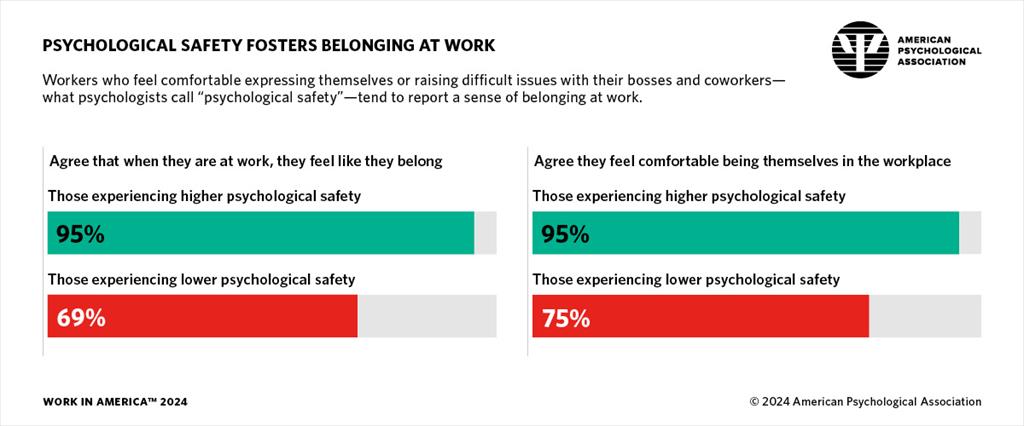
The importance of psychological safety
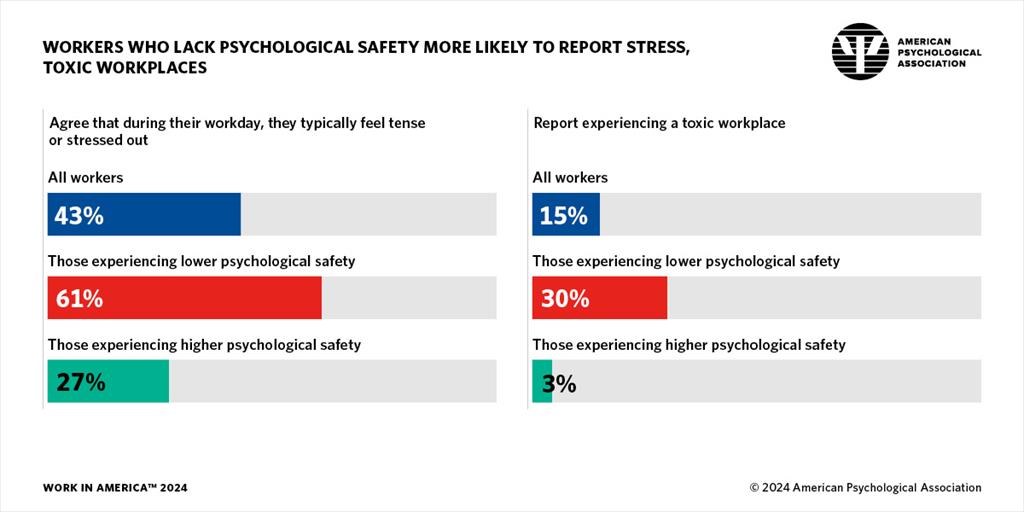
- Around two in five (43%) say that during their workday, they typically feel tense or stressed out. That number rises to more than three in five (61%) among workers who experience lower psychological safety at work.
- More than one in 10 (15%) workers reported experiencing what they characterized as a somewhat or very toxic workplace. Those experiencing higher psychological safety were 10 times less likely than those experiencing lower psychological safety to describe their workplace as toxic (3% vs. 30%).
- Workers with a disability were more likely than those who did not report having a disability to say they experienced lower psychological safety. Two-thirds of workers with a cognitive, emotional, learning, or mental disability (66%) and a similar number of workers with a physical disability (63%) reported experiencing lower levels of psychological safety, compared with 45% of workers who did not report having a disability.
The need for mental health support in the workplace
Despite high satisfaction, many employees worry about reporting mental health concerns at work.
- Nearly three in five said that their employer thinks their work environment is a lot mentally healthier than it actually is (59%), and nearly two in five said they worry that if they told their employer about a mental health condition, it would have a negative impact on them in the workplace (39%).
- More than two in five (45%) employed adults said they have to work more hours per week than they want to.
- A majority (67%) of workers reported experiencing, in the last month, at least one outcome often associated with workplace burnout, such as lack of interest, motivation, or low energy, feeling lonely or isolated, and a lack of effort at work.
Some clients can be very demanding and will call me or text me when they know it’s my day or time off. I feel stressed not to reply, so I end up working often when I’m supposed to be off.
Most working adults report satisfaction in key areas of employment
Did the consistently strong labor market of the past few yearsopens in new window compel employers to look at their job environments? Are we beginning to see the results of years of investment by psychological and leadership professionals dedicated to improving working conditions? Whatever the impetus, employed adults reported high levels of satisfaction related to key aspects of work.

View a full-size version with detailed description of the work satisfaction infographic
- More than four in five employed adults (86%) reported feeling that the work they do has a positive impact on society.
- More than nine in 10 (93%) agreed they are proud of the work they do.
- Eight in 10 (81%) said they would recommend their place of work to others as a good place to work.
- The percentage of people who reported that they intended to look for a new job in the next year was down slightly from APA’s survey in 2022 (34% in 2022, 33% in 2023 and 29% in 2024).
My employer makes sure we have the tools to do our jobs efficiently and productively and trusts us to get the work done. I loathe feeling micromanaged, and I have never felt that way here.
Report notes
Respondents to this survey include full-time, part-time, and self-employed workers. A total of 16% identified as self-employed, and these respondents were given the option of indicating when questions were not applicable to their work environment or experience. Throughout this report, the data reported is based upon only the portion of respondents for which the question was applicable.
Survey methodology
The research was conducted online in the United States by The Harris Poll on behalf of APA among 2,027 employed adults. The survey was conducted March 25–April 3, 2024. Respondents were recontacted and asked an additional question. Fielding for the recontact took place from between April 25–30, 2024. 932 of the 2,027 responded to the recontact.
Data are weighted where necessary by age by gender, race/ethnicity, region, education, marital status, household size, work status, household income, and smoking status to bring them in line with their actual proportions in the population.
Respondents for this survey were selected from among those who have agreed to participate in these surveys. The sampling precision of Harris online polls is measured by using a Bayesian credible interval. For this study, the sample data is accurate to within ±3.1 percentage points using a 95% confidence level. This credible interval will be wider among subsets of the surveyed population of interest.
All sample surveys and polls, whether they use probability sampling or not, are subject to other multiple sources of error, which are most often not possible to quantify or estimate, including, but not limited to coverage error, error associated with nonresponse, error associated with question wording and response options, and postsurvey weighting and adjustments.