

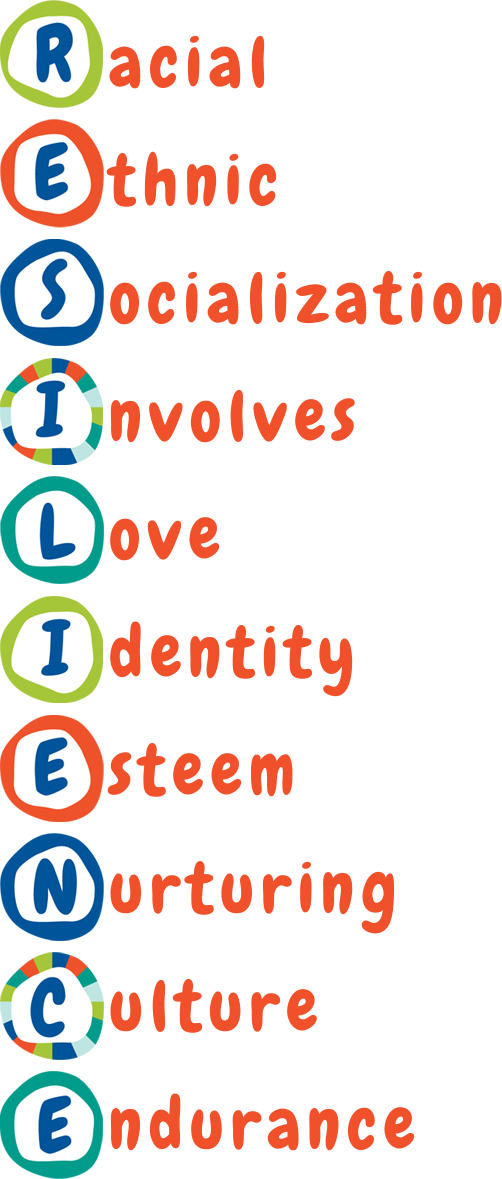
Racial Ethnic Socialization
Racial Ethnic Socialization (RES) is a process through which children learn about race and ethnicity. They learn how to communicate with others about race and ethnicity as well as skills to help them successfully deal with all of the topics that may arise around race and ethnicity. #RES
These messages include:
- Things said and unsaid.
- Things done and not done.
- Emotional reactions.
Stay Ahead of the Game
Children are taught to notice differences between shapes and colors from a young age. Consequently, they also start noticing differences in the people around them.
You are critical in guiding how they handle these differences.
Who participates in RES?
RES messages come from everyone and everywhere.
- Home: Parents, siblings and other family members are the first influence in RES through their conversations, musical preferences, the food they eat and even the art they use to decorate their homes.
- School: Teachers, administrators and peers participate in RES in what they teach and how they treat students.
- Neighborhood: The mix of people that live in your neighborhood, the types of celebrations that are held and the resources available in the neighborhood play a big part in RES.
- Friends: The way friends dress, the languages they speak and the holidays they celebrate open children’s eyes to racial and ethnic differences.
- Media: Through TV shows, movies, music and the news, media is everywhere. It shapes understanding of race and ethnicity in its representations of the different groups in society.
- Society: The way systems, such as education and the justice system, treat the different groups in society plays a major role in RES.

Why You Shouldn’t Avoid the Conversation
When you avoid conversations about race and ethnicity:
- Children are more likely to incorrectly judge other groups.
- Children have little to no connection to their heritage.
- Children are more vulnerable to developing a negative self-concept.
- Children may not know how to respond to racially-charged experiences.
When you address conversations about race and ethnicity:
- Children are more respectful of other groups.
- Children will have a better understanding and appreciation for their own race, ethnicity and overall identity.
- Self-esteem is higher.
- Children can recognize and respond more appropriately to racially-charged situations.


Your 4 year old African-American daughter was bitten by another student because the student wanted to see if she tasted like chocolate. You laugh about the incident and say nothing to your child.

By not addressing the situation, you lose a valuable opportunity to teach your child that because of our different colors, people may make assumptions about who or what they are.

Discuss why the student would think your daughter tasted like chocolate. Explain that despite our different colors, we are all human beings and no person tastes like food. Discuss how best to respond to that situation.
Before You Start RES Ask Yourself

What have I been taught about race and ethnicity?

Do I understand my feelings about my race and ethnicity?

What are the views about race and ethnicity in my home, family, neighborhood, and/or my child’s school?

How have I been addressing race and ethnicity with my child and how does he/she respond?

How have my race-based experiences affected me?

What do I understand about race and ethnicity in my society?

What do I want my child to know about his/her race and ethnicity?

We are united by the reality that all colors and all cultures are distinct & individual.
Suggestions for Engaging in RES

Very Young Children (Ages 3 to 5)
Very young chilren are beginning to recognize the differences between themselves and other people. Caregivers should focus on acknowledging and celebrating differences.
Here are some activities you can do with your children:
- Read books about physical differences in skin, hair, eyes etc.
- Play music from your culture.
- Buy toys that look like your children.
- Watch movies with diverse characters.

Elementary Aged Children (Ages 6 to 11)
Elementary aged children are more in tune to racial and ethnic differences and are more likely to begin noticing differences in how certain racial and ethnic groups are treated.
Here are some activities you can do with your children:
- Read books highlighting the beauty of people who look like them. Also read books with main characters who look like them.
- Take trips to museums and other attractions that celebrate their culture or people of their race.
- Be open to answering questions about racial and ethnic backgrounds.
- Start talking about things going on in the news or at school.

Pre-Teens (Ages 12 to 13)
Pre-teens are beginning to form and express opinions based on various racial and ethnic groups.
Here are some activities you can do with your children:
- Read books about historical figures and events involving people of your racial and ethnic background.
- Spend time teaching more about ethnic traditions such as cooking.
- Attend plays and other performances showcasing your culture.
- Get them involved in groups and activities related to your culture.
- Begin talking about some of the prejudices they may encounter as a result of their race or ethnicity.
- Role play race based scenarios.
- Emphasize respect of all persons regardless of race or ethnicity.
- Share some of your experiences in dealing with racism and discrimination.

Teenagers (Ages 14 to 17)
Teenagers are better able to understand the details of racial and ethnic differences as well as society’s handling of those differences. They struggle with making all of these working parts fit into a solid identity.
- Buy books about coming into your own and charting a path to success for your specific race or ethnic group.
- Have open dialogues about their musical preferences, the company they keep and their attitudes towards other groups.
- Have open dialogues about your experiences.
- Continue conversations about challenges they may face as a result of their race or ethnicity and how to handle them.
Young Adults (Ages 18 +)
- Continue having open conversations to prepare them to deal with any other race and ethnicity experiences they may face as they navigate young adulthood.
- Remain supportive as they learn how best to handle race and ethnicity based situations.

Anticipate Some Barriers