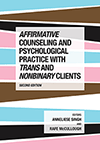
Over the last several years there has been an unprecedented spike in legislation around the country related to LGBTQ+ people. As of November 2023, the ACLU had tracked more than 500 anti-LGBTQ billsopens in new window in the United States for that year alone, with more than 80 of those becoming law. These measures primarily target transgender and nonbinary people for discrimination, such as by barring or criminalizing health care for trans youth, barring access to the use of appropriate facilities like restrooms, restricting trans students’ ability to fully participate in school and sports, allowing religiously motivated discrimination against trans people, or making it more difficult for trans people to get identification documents with their name and gender. In the past few years, there has also been a spike in curricula censorship on matters related to LGBTQ+ people and issues, and also regarding people of color, African Americans in particular. To help psychologists and the public better understand some of these policy issues, APA has compiled resources, discussion points, and references around the biggest topics affecting the LGBTQ+ population.






APA Advocacy Resources
- Psychology and LGBT+ State Legislative Advocacy 2022 (Webinar)
This webinar from March 10, 2022 provides a “lay of the land” summary of what is happening with LGBTQ+ related legislation in 2022, features APA members who have engaged in state level advocacy, provides an overview of advocacy strategies and skills, and introduces participants to the resources found on these webpages. Download presentation slides (PDF, 1MB)opens in new window. - APA Services: LGBTQ+ Health and Civil Rightsopens in new window
Learn more about how APA Services is advocating for the equal treatment of people of all sexual orientations and genders. - Beyond Your Bubble: How to Connect Across the Political Divide, Skills and Strategies for Conversations That Work
This practical, politically neutral book by Tania Israel, PhD, offers concrete skills for holding meaningful conversations that cut across today's intense political divide, showing readers how to connect to the people in their lives. - Speaking of Psychology: How to have meaningful dialogues despite political differences with Tania Israel, PhD
Podcast with the author
Resources from State Psychological Associations
- Advocacy Tip Sheet (PDF, 179KB)opens in new window
Psychologists may be called on to provide testimony before a legislative committee, communicate with their representative or senator on issues, or give a presentation at a town hall. This tip sheet from the Texas Psychological Association is intended to offer some helpful reminders. - State Advocacy: 10 Things to Know about Testifyingopens in new window (Video)
This 14-minute video features Chuck Hollister, PhD, CEO and director of Professional Affairs for the Missouri Psychological Association, sharing tips from his 20+ years of advocacy experience testifying for state legislatures. - Advocacy Toolkit: State Legislator Education and Engagement (PDF, 54KB)opens in new window
This 4-page toolkit, provided by the Texas Psychological Association, is designed to help psychologists capitalize on a visit, meeting, or event with their local lawmakers.
Additional web-based resources
- State, Provincial & Territorial Psychological Association Directory
Contact information for your state psychological association to learn if and how they are engaging in state legislative advocacy. - Freedom for All Americans State by State Legislation Trackeropens in new window
Tracking LGBT-related legislation nationwide. - State Legislature Websitesopens in new window
Learn what is going on in your state legislature. - Equality Federationopens in new window
A national network of state equality organizations. - Movement Advancement Projectopens in new window
See Snapshot: LGBTQ Equality by Stateopens in new window to research the status of equality policies at the state and municipal levels. - Williams Instituteopens in new window
Independent research on sexual orientation and gender identity law and public policy. - Human Rights Campaignopens in new window
See Laws & Legislationopens in new window to research the status of equality policies at the state and municipal levels. - National Center for Transgender Equality (NCTE)opens in new window
See the State Action Centeropens in new window. - Advancing LGBTQ Equality Through Local Executive Actionopens in new window
A resource from the Center for American Progress.
Acknowledgements
APA acknowledges the collaborative relationship between the Div. 44 Public Policy Committee, the APA Advocacy Office, and the Sexual Orientation and Gender Diversity Portfolio in developing the resources on these pages, and in particular the work of the Div. 44 Public Policy Committee in drafting key content for the recommended discussion points for the various issues.
APA also acknowledges the work of Sergio Domínguez Jr.; Department of Counseling Psychology, University of Wisconsin-Madison; in updating key content for 2022.
APA Publications