



Before prescribing psychology came to the Crow and Northern Cheyenne Reservations of Montana, it wasn't always easy for the Native Americans who live there to get the psychotropics they needed.
For one thing, "Montana winters make for difficult transportation," says Earl B.H. Sutherland Jr., PhD, behavioral health director at the Crow/Northern Cheyenne Indian Health Service Hospital. Also, many residents are so poor they often had to choose between buying food or paying for gas to get to an appointment with a psychiatrist. The alternative was to see their primary-care providers, who didn't necessarily have the time or expertise to prescribe psychotropic medication appropriately.
The result? People living with bad side effects or going off their medications altogether. "It was very easy for patients to fall between the cracks," says Sutherland.
Things are different now. Since 2012, Sutherland has been able to prescribe medications himself. He has also recruited two other prescribing psychologists, making the Crow/Northern Cheyenne Hospital unusually well-equipped.
In addition to providing psychotherapy and other traditional psychological services, these psychologists prescribe medications for depression, anxiety and serious mental illness. They also continuously reassess patients to make sure they're not on medications they don't need. And they work with primary-care providers at the hospital — which includes a primary-care clinic, emergency room and inpatient unit — to treat such physical concerns as diabetes, dementia and chronic pain.
The care these psychologists provide has been life changing, says Sutherland. One patient with serious mental illness, for example, used to have a hard time getting his medications despite living just 100 feet or so from one of the hospital's satellite health clinics. "When he gets his meds, he's very stable, but he wasn't able to consistently come in to see the psychiatrist," says Sutherland. "Now, if he misses an appointment, I just walk over and knock on the door."
Prescribing and ‘unprescribing'
Prescribing psychology got its start at the hospital when the child psychiatrist who used to contract with the hospital quit. After six years of trying to find a replacement, Sutherland gave up. "I thought, ‘Well, I'll just do it myself,'" says the child psychologist. He earned a master's degree in clinical psychopharmacology from Alliant International University —– which included didactic training at Alliant sponsored by APA's Div. 18 (Psychologists in Public Service) — and in 2012 received a New Mexico prescribing license, which can also be used in federal facilities.
For Sutherland, part of the appeal of prescription privileges was the ability to "unprescribe." "Working with hundreds of kids over the years, I felt that many were overmedicated, and I wanted to be able to do something to change that," he says.
In many cases, for example, children were being medicated for attention-deficit disorder when their real problems might have been anxiety or learning disabilities. Trauma was also misdiagnosed, adds Sutherland. "Many of the symptoms that would be considered indicative of potentially psychotic processes are more likely due to trauma," he says, noting the extremely high incidence of sexual violence and other trauma in Indian Country. "And there's a very different treatment approach for trauma than medication for psychotic disorders."
Of course, there are patients with chronic and severe mental illness who need medication, too. And while the psychiatrists who used to come to the hospital twice a month were capable and caring, what they were able to offer just wasn't enough, says Sutherland. "We're now able to see people for more than 15 minutes at a time, as often as needed," he says, adding that prescription management services are now available at the two satellite clinics as well as the hospital.
Integrated care
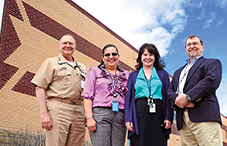 Sutherland and his team don't just focus on psychological problems, however.
"In our psychopharmacology training, they always talked about the bread-and-butter issues of anxiety and depression," says Michael R. Tilus, PsyD, one of the other prescribing psychologists at the hospital. "But in Indian Country, everyone is complex."
In addition to standard psychological problems, he says, Native Americans may face historical trauma, fetal alcohol syndrome, drug and alcohol abuse, domestic violence, child neglect and abuse, high rates of diabetes and other chronic conditions, even malnutrition.
That complexity is why integrating with primary care is so important, says Tilus. If patients with diabetes aren't taking their medication, for example, Tilus and his colleagues offer tips on exercise and diet and cognitive-behavioral therapy, as well as order blood work so that both the providers and patients can monitor the diabetes.
"In Indian Country, we're not auxiliary. All of the medical psychologists have full medical privileges in the hospital and are full members of the medical team," says Tilus. "In the more isolated parts of Indian Country where I've served, it's such frontier medicine that the medical providers have tremendous support for us."
The prescribing psychologists also order EKGs, thyroid tests, metabolic panels and similar tests to check for underlying medical conditions before they prescribe psychotropic medication. For one thing, says Sutherland, they want to make sure the patient doesn't have a previously undiagnosed condition. "We've identified a number of cardiac problems and patients who were undiagnosed diabetics," he says, explaining that prescribing psychologists are trained to interpret lab studies.
The prescribing psychologists also need to make sure the medication they prescribe won't cause any medical problems. "A lot of the medications we prescribe can induce metabolic changes," Tilus points out. For example, mood stabilizers and antipsychotics could raise patients' lipid levels. In some cases, says Tilus, medications could actually push someone from a prediabetic condition to full-fledged diabetes.
Marie Ruth Greenspan, PhD, the third prescribing psychologist at the hospital, spends one day a week in the primary-care clinic, which is just steps away from the behavioral health department. A physician might call her in when a patient with high blood sugar isn't taking his or her medication, for example. "I can help sort out the emotional or psychological aspects of the things standing between the patient and better health," she says.
For some patients with diabetes and other chronic diseases, the problem is depression. In such cases, Greenspan may consult with the physician about the patient's medical co-morbidities and other factors before prescribing an antidepressant and referring the patient to psychotherapy.
Greenspan spends another day each week at the area nursing home, whose residents include both older people and young people who have devastating brain and spinal cord injuries due to substance abuse-related car accidents. Greenspan offers psychotherapy and prescriptions for problems that include dementia and accompanying behavioral issues, anxiety and depression.
She is so integrated into patients' medical care that she even chairs the hospital's controlled substances committee. The committee reviews policies and procedures for prescribing opioids, anxiety medications, psychostimulants and all other controlled substances and ensures that agreements between patients and prescribers — designed to prevent addiction or diversion of medication — are completed. The committee also reviews individual cases. If a patient wants more pain pills, for example, the solution might be to work with the physician to consider more or different medication. But, says Greenspan, it's more likely that the committee will recommend that the patient work with a psychologist to come up with a nonpharmacological way to manage his or her pain.
"There's no problem we try to handle simply with medication," Greenspan says. If she prescribes sleep medication, for instance, she also gives the patient psychoeducation or psychotherapy to encourage a safe, long-term solution.
"We maintain a policy of no pills without skills," says Greenspan. "If we're giving medication, people also need to come in and talk with us and learn nonpharmacological ways of managing their issues as well."
Rebecca A. Clay is a journalist in Washington, D.C.