


In some parts of New Orleans, one of the most inequitable cities in the nation, life expectancy is just 55 — lower than in many developing countries, psychologist Brian Smedley, PhD, told participants in a keynote address to APA's Psychology in the Public Interest Leadership Conference. Just up the highway, white residents can expect to live 25 years longer.
"When it comes to health, often your ZIP code is more important than your genetic code," said Smedley, executive director of the National Collaborative for Health Equity.
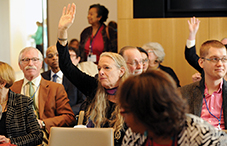
Smedley was just one example of psychologists who spoke at the conference about their work putting psychological science into practice and exposing the structural rather than personal factors behind health disparities and other social problems. Sponsored by APA's Public Interest Directorate and the Board for the Advancement of Psychology in the Public Interest, the first-of-its-kind event brought almost 125 psychologists, students, members of APA governance and others to Washington, D.C., Nov. 15–17.
The directorate invited a broad range of constituencies — APA divisions, ethnic minority psychology associations, Public Interest and other committees, the American Psychological Association of Graduate Students, early career psychologists, Teachers of Psychology in Secondary Schools and APA governance and staff — to send representatives who could carry what they learned back to their groups.

The goal of the conference was to identify the best ways to "give psychology away," as George A. Miller, PhD, put it in his 1969 APA presidential address, said Gwendolyn Puryear Keita, PhD, the directorate's executive director.
Participants heard tips on how to share their scientific findings with policymakers, the media, the public and other audiences. They also heard about what happens when public policy is based on myths rather than sound science, especially the tendency to focus on personal responsibility rather than structural factors in areas as diverse as drug laws and anti-drunk driving campaigns. Participants also spent a day on skills training, learning how to disseminate their science to the public, legislators and the federal executive branch. During the latter workshop, participants met with representatives from the National Institute of Mental Health, The Administration for Children and Families, The Agency for Healthcare Research and Quality, and The Office of the Assistant Secretary for Preparedness and Response, among other executive branch officials.
In addition, participants headed to Capitol Hill to urge Congress to reform the nation's mental health systems. In 40 visits to congressional members and their staffs, participants urged their senators and representatives to support the Mental Health Reform Act of 2015 in the Senate and the Helping Families in Mental Health Crisis Act of 2015 in the House of Representatives. APA President-elect Susan H. McDaniel, PhD, visited the bills' sponsors as well as her own representative.
Outreach to policymakers, the public and other audiences is critical for achieving APA's mission of advancing the creation, communication and application of psychological knowledge to benefit society and improve people's lives, said Keita. "We do a good job of creating knowledge, but we're not as effective in communicating and applying that knowledge," she said. "If we are to fully realize psychology's promise, we'll have to do a better job on those last two pillars of our mission."
More psychologists will need to see the importance of translating their research so it can be put to use for the public good, she said, and psychologists will need to improve their skills at disseminating their work to different audiences.
Escaping killer ZIP codes
Smedley is using psychological science to dispel myths — in his case the myth that choices about eating and exercise, genetics and other individual factors are responsible for racial and ethnic health disparities.
What's far more important is simply where people live, said Smedley, noting that psychologists have been at the forefront of studying how context influences behavior. New Orleans isn't the only example. In Albuquerque, for example, residents of the most marginalized census tracts have a life expectancy of just 66, while residents of more advantaged neighborhoods can expect to live to 94 — a 28-year disparity.


"What's the difference?" he asked. "Some communities have benefited from systematic advantages, often supported by public policies, whereas other communities have been neglected or marginalized, often as a result of conscious policy decisions."
Smedley advocates two kinds of policy strategies to help counter the health-damaging impact of segregation and concentrated poverty. Placed-based investments can help ensure poor neighborhoods enjoy the same amenities, such as grocery stores, as their better-off counterparts. People-based strategies include investment in early childhood education and the promising strategy of "housing mobility."
A randomized controlled trial conducted by the U.S. Department of Housing and Urban Development, for example, found that poor families who got help in moving out of high-poverty neighborhoods were less likely to suffer from obesity, diabetes and other health problems 15 years later. Public policy could also help poor families stay in their own communities as they undergo transformation, added Smedley.
To put that science into practice, Smedley's organization has 19 "Place Matters" teams working around the country to raise awareness of place's impact on health and push for policy and systems changes to improve local conditions.
Reducing racial bias
Patricia G. Devine, PhD, a University of Wisconsin at Madison psychology professor, described how she became committed to the idea of transforming her basic science research into interventions that could improve people's lives.
Early in her career, Devine conducted research proving that even well-intentioned people can still harbor unconscious racial prejudice. Once she discovered that prejudice was a habit, she thought her work was done. It wasn't.


"Reporters came calling, wanting to know how to help people reduce prejudice ... but I realized I didn't have good advice to give them," said Devine. "Like many of my generation, I thought my job was to do the elegant, theoretically driven, carefully conducted empirical science, leaving it to others to do the translational work."
Realizing the hollowness of her responses to those eager to reduce discrimination, Devine had a change of heart. "I started to think, 'Why not me?'" she said. "I might be in the best position to think about how to solve this problem."
In the first stage, Devine conducted the basic research behind her model of prejudice as a habit that can be broken when people feel guilty enough to try to change their unconscious reactions.
The next step was to create an intervention designed to help people break the prejudice habit. Participants get feedback on their scores on a test of implicit bias, learn why bias persists despite good intentions, and are told about the consequences of prejudice in relationships, hiring and even the provision of life-saving treatment in emergencies. Participants also receive a toolkit with strategies for breaking the prejudice habit in everyday life.
Devine found that the intervention has lasting positive effects on people's attitudes, primarily via people's recognition of the connection between their own attitudes and societal discrimination.
It also changes behavior, she has found. In a study aimed at decreasing gender bias in science/technology/engineering/mathematics disciplines, for example, Devine found that departments that participated in a variation of her intervention were more likely to hire women even two to three years later.
She also developed train-the-trainer materials so others could deliver the intervention.
"Social psychology for a long time has been really insular," said Devine, noting that the field has often viewed the media as an enemy. "We need to communicate beyond the walls of our discipline about what it is we do and why it's important."
Overcoming hysteria about drugs
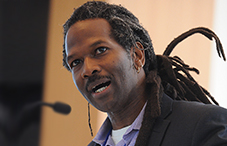
Racial bias also plays out on a national scale, through U.S. drug policies, said Carl Hart, PhD, an associate professor of psychology at Columbia University and author of "High Price: A Neuroscientist's Journey of Self-Discovery that Challenges Everything You Know about Drugs and Society."
Hart described how, as a young man in the 1980s, he believed the conventional wisdom that crack cocaine was responsible for unemployment, violence and other destructive forces within the African-American community. After all, he said, President Reagan said so, and the country had passed legislation that punished users of crack 100 times more than users of powdered cocaine.
 But when Hart began investigating, he made some startling discoveries: Crack and powdered cocaine are the same drug chemically. The overwhelming majority of people who use drugs do so without problems. And perhaps because of scientists' tendency to err on the side of caution, scientists have exaggerated the perils of drugs.
"Drugs are not the problem," said Hart.
The excessive focus on pathology has had devastating, real-life consequences, including mass incarceration of African-Americans. It "has helped to create an unrealistic focus on eliminating certain drugs from our society at all costs, and too often the costs are paid by people I care about — people who are poor, black, shut out," said Hart.
By translating scientific findings into lay language, Hart's book has attracted far more attention than his scientific papers, he said.
"I've had the opportunity to meet with former presidents and current mayors about drug policy," he said. "I'm speaking to Bernie Sanders now about his drug policy."
Communicating for change
But psychologists eager to change the world have to be careful how they frame their messages, warned psychologist Lynn Davey, PhD, whose consulting firm Davey Strategies helps experts and advocates translate their expertise in the service of solving societal problems.
Davey pointed to the "designated driver" campaign as an example of what can go wrong when issues aren't framed properly. "This is always held up as a prototype of a successful campaign," said Davey, noting the campaign's $1.3 billion in donated media, endorsements from presidents and other prominent individuals and polls showing that 84 percent of Americans recall seeing or hearing a public service announcement on the topic.
Yet alcohol-impaired drivers are still responsible for almost a third of all traffic fatalities, with those drivers eight times more likely to have prior driving-under-the-influence violations. "The campaign raised awareness, but to what effect?" said Davey. "It's not keeping the greatest offenders off the road."
What's more, she said, it has been harder to pass legislation for interventions that do work — ignition interlocks and roadside sobriety checks, for example — because the issue has been framed as one of personal responsibility. "It's hard for policymakers to see the structural, systemic, public dimensions of the issue," she said, urging advocates to avoid showcasing individual success stories in their own campaigns.
Instead of focusing on individual solutions to societal problems, said Davey, advocates should explain why the issue matters, what the problem is, how it can be solved and who can solve it. Messages should also be framed around values that help cue how people think about the issue, said Davey, suggesting such values as prosperity, American ingenuity and stewardship.
"It's about appealing to values that structure meaning and then connecting the dots among causes, consequences and solutions," said Davey.