
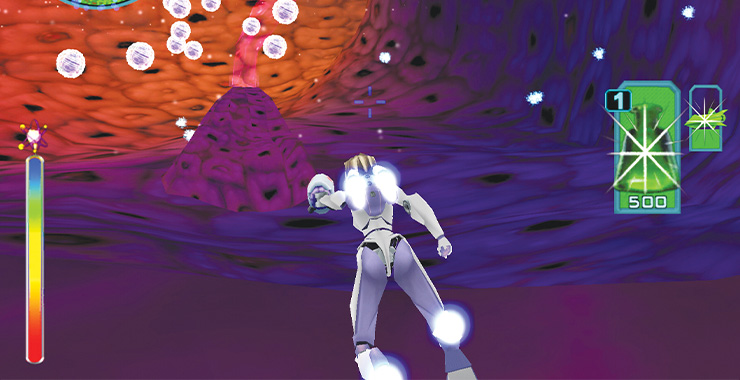
A white-helmeted nanobot swoops across the screen, hurling icy fire toward a stream of blank-eyed, gaping-mouthed villains. Blast! They’ve got their shields up. The nanobot calls in backup, and a white worm rises from beneath, destroying the enemy. More pour in. The bot reaches for another weapon, sending a river of radiation into the baddies below. They fall. Victory!
This could be any shoot-’em-up game about zombies or space invaders—but it’s not. It’s “Re-Mission 2,” an update to the original “Re-Mission” game, which was shown to improve adherence to treatment in young people with cancer. The nanobot’s white fire represents chemotherapy, and the white worm stands in for the patient’s immune system. It may all seem a little like, well, a game, but the “Re-Mission” games teach real lessons. The games are an interactive, nonpreachy way to explain to young people why they must take oral chemotherapy for years, despite unpleasant side effects, says Pam Kato, EdM, PhD, a psychologist and former professor at the Serious Games Institute at Coventry University in the United Kingdom, who helped develop the original game.
“We take them inside the body to help them get this ‘aha’ moment about how their treatments work,” Kato says.
When “Re-Mission” was being developed in the early 2000s, it was in the vanguard of a new class of games: serious games. Today, games designed to have a real-world impact are exceptionally diverse. There are brain-training games that attempt to improve cognitive skills. There are puzzle games in which the players’ efforts advance science and medicine. There is even an annual “game jam” called XR Brain Jamopens in new window that brings together neuroscientists, social scientists and game developers to explore the intersections of their fields.
But the ultimate goal of many serious games is simply to educate. This can mean a focus on traditional subjects like science, history or politics. Or it can encompass games about health or ones that teach social-emotional skills such as empathy, perspective-taking and conflict resolution. As games become more widespread, researchers say, they may change how students prove their mastery over topics and how they learn complex subjects. And they can do so in an accessible, enjoyable way.
“Games are super-engaging and popular for everybody, across all gender, ethnic and socioeconomic lines,” says Val Shute, PhD, a professor in the educational psychology and learning department at Florida State University and a pioneer in assessment within educational games.
Playing to learn
According to a 2008 report from the Pew Internet & American Life Project, 97% of American teens play video games at least sometimes, and half had played within a day of being surveyed (Pew/Internet, Reportopens in new window 202-415-4500, 2008). And there is good evidence that games can both trigger serious emotions and improve learning. Nicholas Bowman, PhD, a professor of media and communication at Texas Tech University, has found that as many as 75% of gamers surveyed have feelings of introspection and self-reflection during gameplay, even in games geared only for entertainment (Psychology of Popular Media Cultureopens in new window, Vol. 5, No. 4, 2016). “World of Warcraft” players, Bowman has found, often feel responsibility for their avatars as distinct social actors (New Media & Societyopens in new window, Vol. 18, No. 7, 2016).
These experiences aren’t confined to the game. In a study led by Matthew Grizzard, PhD, a communications researcher at the State University of New York at Buffalo, college students were assigned to play a first-person shooter game either as a terrorist or a U.N. soldier or to do nongaming writing assignments. The students who played the shooter game reported greater guilt afterward than those in the nongaming conditions, and those assigned to play as the terrorists felt guiltiest of all. Intriguingly, in-game guilt was associated with the increased salience of the moral domains of care and fairness outside of the game (Cyberpsychology, Behavior, and Social Networking, Vol. 17, No. 8, 2014).
These results suggest that even just-for-fun games can be powerful. Serious games, designed with a purpose in mind, have been shown to make an impact, too.
“Re-Mission” is one of the earliest and most striking examples. In a randomized controlled trial of the first version of the game, teens and young adults who played showed increased cancer knowledge over those who played a control game not related to cancer (Journal of Adolescent Healthopens in new window, Vol. 41, No. 3, 2007). The same trial found that players took 16% more of their prescribed antibiotics and had 40% more oral chemotherapy metabolites in their blood than young adults in the nongaming control group (Pediatricsopens in new window, Vol. 122, No. 2, 2008). The game quite literally helped save lives.
Another early pioneer in serious gaming was “PeaceMaker,” created at Carnegie Mellon University’s Entertainment Technology Center in 2005. This turn-based game asks players to take on the weighty task of establishing peace between Israel and Palestine. Users can choose between playing the Palestinian president or the Israeli prime minister and must navigate both internal approval ratings and international opinion as they make political choices.
The aim of the game is to improve conflict resolution and perspective-taking, says Eric Brown, one of the game’s co-developers, who now directs a computer-science learning platform at Carnegie Mellon. Especially important, Brown says, is having users play the side they don’t support. “We would have people who were more sympathetic to the Palestinian perspective playing the Israeli side, and they’d keep having negative things happen and they would catch themselves using military options,” says Brown.
Similarly, someone sympathetic to Israel playing as the Palestinian president might find themselves chafing against Israeli policy. “It starts to build the understanding of why these actions are taken,” Brown says.
Ronit Kampf, PhD, a lecturer in the department of communication at Tel Aviv University, has found that players of the game become more knowledgeable about the Israeli-Palestinian conflict (Information, Communication & Societyopens in new window, Vol. 18, No. 6, 2015). Kampf has also found that the game is capable of changing player attitudes about the conflict (Computers in Human Behavioropens in new window, Vol. 52, 2015).
Games’ unique ability to put the player in control of a separate character has also opened up new ways to build empathy. “Auti-Sim,” created by independent developers Taylan Kadayifcioglu, Matt Marshall and Krista Howarth, attempts to create empathy for people with autism by putting the player in the shoes of a child with auditory hypersensitivity on a busy playground. The closer the player gets to other children, the more distorted the sound and picture become. Another lush, empathy-focused gaming experience is “Never Alone,” a game developed in collaboration with Alaska Native elders to continue the storytelling tradition of those cultures.
But empathy-building games need to be designed carefully; otherwise, they can have unintended effects. The 2011 game “SPENT,” developed on behalf of a homeless shelter, asked players to make financial choices on a shoestring budget to avoid ending up on the street. Unfortunately, many players became less sympathetic to those in poverty after playing the game, according to research by Gina Roussos, then a graduate student in social psychology at Yale University. The act of making choices within the game seemed to boost players’ belief in meritocracy, causing the lesson to backfire (Cyberpsychologyopens in new window, Vol. 10, No. 2, 2016).

Making school a game
Careful design can be the difference between a good game and a poor one, says Shute, an educational psychologist and a keynote speaker at APA’s Technology, Mind & Society Conference, Oct. 3–5. A crucial component of good games, Shute says, is that the actions within the game reflect what the game designer wants players to learn.
An example is “Physics Playground,” a game designed by Shute and her team that teaches middle and high school students Newtonian physics concepts through game actions. A player might have to build a lever to move an obstacle, for example, or tinker with gravity and resistance to move a ball toward a target.
The key, Shute says, is that students experience the physics through gameplay. This not only promotes learning, she says, but also allows educators to track a student’s progress in fine-grained detail.
In the game’s log, Shute and her team have access to every move the students make throughout the process: every failure, every aborted attempt, every solution. The team has used game logs to study when and why students succeed at or quit “Physics Playground,” identifying signs, for example, of when a student might need learning support to prevent him or her from giving up (11th International Conference on Educational Data Miningopens in new window, 2018).
Game-based assessment has great potential to make learning less stressful for students, says Alan Lesgold, PhD, a psychologist and professor of education at the University of Pittsburgh who studies technology and learning. “We really have to learn what folks know without forcing them into psychologically brutal situations because that’s the only way we know how to do it,” Lesgold says. “There may be even more potential in using games for assessment than using games for teaching.”
The paper-and-pencil tests that dominate schools today don’t reflect real-world problem-solving well, says Yoon Jeon Kim, PhD, the executive director of the Playful Journey Lab at MIT, who completed her doctoral training with Shute. They can also be culturally biased. Games, on the other hand, can test as they’re played, a feature Shute has dubbed “stealth assessment.” If researchers can show that skills in games transfer to the real world, stealth assessment could one day replace fill-in-the-bubble exams.
“I really think that assessment is the key to changing the educational system,” Kim says.

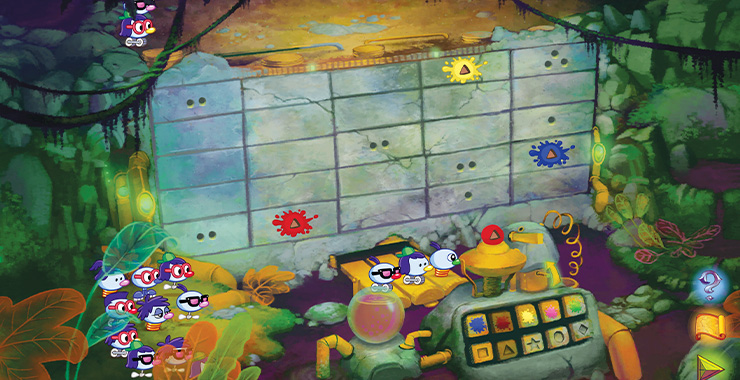
Researchers also hope that games will reach populations who have historically been disengaged from STEM (science, technology, engineering and math) topics. Shute has found that despite stereotypes about games and gender, “Physics Playground” is rated equally highly for enjoyment and learning by boys and girls (“Learning Science: Theory, Research and Practice,”opens in new window McGraw-Hill, 2019). That’s a promising finding, Shute says, given persistent gender disparities in participation in STEM fields. Games may also provide a route for testing knowledge in non-neurotypical students, says Jodi Asbell-Clarke, PhD, the director of the Educational Gaming Environments group at the technology of education research organization TERC (formerly the Technical Education Research Centers) in Massachusetts. Asbell-Clarke and her colleagues are researching the puzzle game “Zoombinis,” originally developed by TERC to teach computational thinking, or how to solve open-ended problems with logic and organized steps. During studies of “Zoombinis” in schools, the team has observed that teachers often report that hard-to-reach kids, such as kids with Individualized Education Programs (IEPs) for autism or attention-deficit hyperactivity disorder, respond even better to the game than their peers, Asbell-Clarke says.
“Our hypothesis is that many of the observed strengths of neurodiverse learners, such as systematic thinking and pattern recognition and detail observation, lend themselves very well to computational thinking,” Asbell-Clarke says. She and her team are currently analyzing their computational-thinking game data based on player IEP status to test this hypothesis.
One of the most widespread game platforms in classrooms today is iCivics, a suite of games and curricula designed to teach civics that was developed by a nonprofit organization founded by retired Supreme Court justice Sandra Day O’Connor. The iCivics games teach civics concepts to middle and high schoolers in an experiential way, says Matthew Farber, EdD, a professor of technology, innovation and pedagogy at the University of Northern Colorado. In “Do I Have a Right?” students run a virtual law firm to learn about the Bill of Rights. In “Win the White House,” they run a presidential campaign to learn about the electoral college. Pre- and post-test studies of iCivics find that it improves civics knowledge among elementary, middle and high school students (Lecompte, K., et al., Research in the Schools,opens in new window Vol. 18, No. 2, 2011).
The platform is used by more than 170,000 teachers across the United States. Its success, Farber says, is partially due to the fact that social studies teachers are typically comfortable with role-play in the classroom. Even in the 1950s, he says, students ran class elections and participated in political skits. “To do the same thing digitally seems natural,” says Farber, who is in the iCivics Educator Network.

As technology advances, educational games have the potential to become ever more immersive. At the University of Connecticut, researchers are using virtual reality to simultaneously teach issues of justice, memory and history. The university houses the Thomas J. Dodd Research Center, a collection of the files of one of the lead lawyers who prosecuted the war crimes of Nazi leadership in the Nuremberg trials. Players of the game, called “Courtroom 600,” leaf through digital versions of Dodd’s files, accumulating evidence and then interrogating Nazi ideologue Alfred Rosenberg in an immersive virtual version of the courtroom where the trials took place. Players use the experience to explore the logical fallacies of Rosenberg and other trial defendants and to understand how the stage was set for genocide during the Nazi regime. (In real life, Rosenberg was found guilty and executed.)
“We saw the Nuremberg trials as a really interesting opportunity to explore the nature of justice and value of critical discernment, especially during a global rise in digital disinformation and anti-Semitism,” says Stephen Slota, PhD, an educational psychologist at the university.
A looming challenge, Farber says, is to move richer gaming experiences into school classrooms. Serious games could enrich history and English classes just as documentaries and Hollywood adaptations of novels do, he says. The key is integrating them into the curriculum.
“Games are the storytelling medium of the 21st century,” Farber says. “In my mind, why wouldn’t we teach with them?”