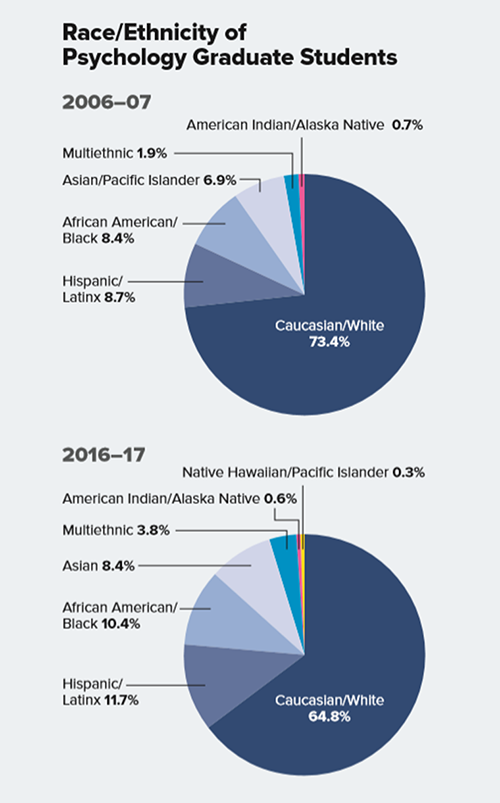
Efforts to recruit diverse students into psychology look promising: The percentage of racial- and ethnic minority psychology graduate students grew from 27% in the 2006–07 academic year to 35% in 2016–17, with increases for every ethnic-minority category tracked, according to a new analysis of data from APA’s annual Graduate Study in Psychology survey of psychology graduate programs.
The largest increases were for students who identified as Hispanic or multiethnic, and master’s students were slightly more diverse than doctoral students. Moreover, about 40% of first-year psychology students identified as a racial or ethnic minority.
“Greater diversity in the field translates into more perspectives informing our research and clinical work,” says Zewelanji Serpell, PhD, director of graduate studies in psychology at Virginia Commonwealth University.
But while diversity is increasing overall, the APA data also reveal some gaps. For example, although blacks make up 13% of the U.S. population, they account for only about 5% of the psychology workforce and 10% of psychology students. The ratio of psychologists and Hispanics is even more uneven: While Hispanics make up 18% of the population, they represent only 4% of the psychology workforce and 12% of psychology students.
Among the factors driving the increased diversity are the diversity competency adopted in 2002 by the National Council of Schools and Programs of Professional Psychology (NCSPP) and APA’s adoption of diversity as a guiding principle for programs starting in 2009. “They help programs to be intentional and explicit in their strategies to recruit and support diverse students,” says Amy Mezulis, PhD, chair of Seattle Pacific University’s clinical psychology department.
Individual programs and faculty are also working to bring in more diverse students. “If we say that diversity and inclusion are important and we want to increase diversity, we have to really be intentional about it,” says Enrica Ruggs, PhD, an assistant professor of management and the director of the Center for Workplace Diversity and Inclusion at the University of Memphis. “That means going to places and trying to recruit students that may not otherwise know about psychology.”
Some program directors are reaching out to historically black colleges and universities, Hispanic-serving institutions and other diverse undergraduate programs. Also key is ensuring that undergraduate students get the mentoring and advice they need to apply for graduate school.
Other efforts include holistic admission procedures that use multiple indicators rather than focusing on just GRE scores, hiring faculty who are diverse themselves or otherwise invested in diversity and staying connected with diverse alumni after they graduate. “They can help recruit new applicants, offer insights for current students and build connections to support each other as they grow in their careers,” says Georita Marie Frierson, PhD, dean of the D’Youville College School of Arts, Sciences and Education in Buffalo, New York.
Indeed, these new psychologists are changing the field’s makeup. Between 2007 and 2016, the percentage of psychologists who were racial or ethnic minorities almost doubled—from 9% to 16%, according to APA’s Center for Workforce Studies.
More competition
A surprising finding of the APA survey analysis is that it’s become harder to get accepted into a psychology doctoral program: Acceptance rates dropped between the 2003–04 and 2015–16 academic years in most psychology subfields.
Those rates reflect a larger trend in the social and behavioral sciences, which is the second most selectiveopens in new window field of doctoral study, trailing only business, according to the Council of Graduate Schools.
Cognitive psychology saw the biggest increase in competitiveness, going from a 20% to a 13% acceptance rate for doctoral programs, while clinical psychology doctoral acceptance rates dropped from 16% to 13%, likely driven by a 20% increase in applications.
But not all subfields followed this pattern. The acceptance rate to clinical PsyD programs has been level since 2004–05. During this time, the median number of applications to clinical PsyD programs decreased. “While it’s not unusual for applications to decline during a strong economy, possible causes include student concerns about financing their education, since PsyD candidates do not have the same funding opportunities available to PhD candidates,” says NCSPP President Francine Conway, PhD.
More recently, the median number of enrolled students has also decreased for clinical PsyD programs, which could indicate that programs are choosing to have smaller class sizes to preserve the high quality of their training, says Conway, who is also dean of the Rutgers Graduate School of Applied and Professional Psychology.
Master's I/O degrees in demand
Applications to master’s-level industrial-organizational (I/O) psychology programs have increased, while the median number of master’s program applications for most other subfields has been flat or declined.
For the 2016–17 academic year, master’s I/O programs had more applications than any other subfield and the acceptance rate (39%) was the second most selective, after clinical psychology master’s programs (38%). The I/O acceptance rate has held steady for at least four years, but it is notably more competitive than in 2008–09, when the acceptance rate was 50%.
Meanwhile, the number of I/O programs and enrollments have grown to meet the demand. There are 28% more master’s and doctoral programs listed in the APA Div. 14 (Society for Industrial and Organizational Psychology) program directoryopens in new window than 10 years ago.
Ruggs credits the increased interest in master’s-level I/O degrees to the doors the degree can open, including the ability to find a job and interesting work, as well as good pay: The median annual salary for I/O psychologists in management is $111,270, according to May 2018 estimatesopens in new window from the Bureau of Labor Statistics, which includes both master’s- and doctoral-level workers in this category.
“It’s an area of psychology that has immediate application to business,” says I/O psychologist Joe Allen, PhD, of the University of Utah. “That’s resulted in a growing awareness, where organizations that previously didn’t know about I/O are now actively recruiting I/O psychologists.”