How much nicotine is in an electronic cigarette? That depends on your address. In the European Union, regulations require e-cigarette liquids to contain no more than 20 mg per mL. In the United States, the liquid might contain two or even three times as much nicotine. Now, American legislators are considering similar regulations limiting the nicotine in vaping liquid in an effort to protect public health.
That would be a big mistake, says Tom Eissenberg, PhD, a professor of psychology at Virginia Commonwealth University (VCU) and co-principal investigator at VCU’s Center for the Study of Tobacco Products (CSTP). “On its surface, it makes sense. But such regulation won’t achieve its intended goal, and will probably harm people,” he says.
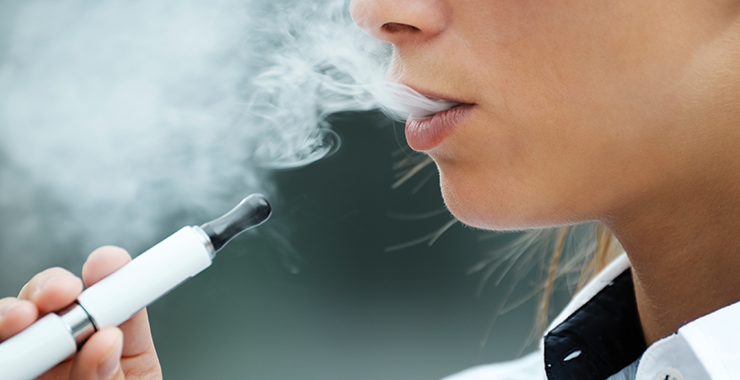
The reasons have to do with the way e-cigarettes are designed. The devices use a heating element to aerosolize an inhalable liquid containing nicotine, solvents and, often, flavorings. But the devices are available in different wattages, and some devices allow users to turn up the power settings, which results in more vapor and a bigger hit of nicotine. “Users can get around the restrictions on nicotine by increasing the power,” explains Alison Breland, PhD, an assistant research professor of health psychology at VCU and co-principal investigator at the CSTP.
Research from the CSTP team suggests that when nicotine levels in e-cigarette liquid are low, users are likely to ramp up a device’s power to compensate. In the process, the overheated liquids break down into harmful by-products such as the carcinogen formaldehyde. In other words, limiting nicotine levels without understanding how that might affect user behavior could backfire in a dangerous way.
“Limiting nicotine drives addicted people to use high-powered vaping devices, which emit more nicotine and more toxicants,” Eissenberg says. “It’s an example of a regulation that should have been tested in a laboratory first.”
That’s where the CSTP comes in. The multidisciplinary center’s central mission: to test the likely outcomes of potential regulations and provide the U.S. Food and Drug Administration (FDA) with data to inform future regulatory action. It’s a collaborative effort, with more than three dozen faculty and staff from psychology, engineering, chemistry, public health and other fields.
“We want to understand what these products do, how much nicotine and other toxicants they deliver, and how users’ behavior influences what they’re exposed to,” Breland says. “The FDA can put regulations in place to protect public health, but they’re looking for scientific evidence to back them up. Our goal is to give the FDA information to help them make the right regulations.”
Threading the needle
The popularity of e-cigarettes in the U.S. marketplace is soaring—especially among young people. The number of high school students who reported vaping nicotine in the past month rose sharply between 2017 and 2019, according to preliminary data from the University of Michigan’s long-running Monitoring the Future survey (Miech, R., et al., The New England Journal of Medicineopens in new window, Vol. 381, No. 15, 2019). That report found, for instance, that more than a quarter of 12th graders reported past-month vaping in 2019, compared with 11% two years earlier. Another 2019 study found 27.5% of high school students and 10.5% of middle schoolers reported they had used e-cigarettes (Cullen, K.A., et al., JAMAopens in new window, Vol. 322, No. 21, 2019).
At the same time, a spate of lung injuries and deaths associated with vaping has brought increased public attention to these products and highlighted how little researchers still know about their potential impact on users’ health, and how they should be regulated.
Proponents maintain that e-cigarettes are a less harmful alternative to traditional cigarettes since they can contain fewer dangerous contaminants than tobacco smoke and may serve as a transitional product to help smokers eventually quit nicotine altogether. But others raise concerns that e-cigarettes could be harmful if they undermine people’s attempts to quit smoking, or encourage nonsmokers to start using nicotine.
“We are all trying to thread this needle of having products on the market that are hopefully lower harm than combustible cigarettes, [but not] enticing to naive users,” says Andrew Barnes, PhD, an associate professor of health behavior and policy at VCU and a member of the research team.
Hoping to help regulators strike that balance, the team is tackling a broad set of questions about how e-cigarettes work, how much nicotine and toxicants they deliver, and how people are using them. To answer those questions, the VCU team has partnered with researchers at institutions including the American University of Beirut in Lebanon, Johns Hopkins University, the University of Arkansas for Medical Sciences, the University of Southern California and the University of Oklahoma Health Sciences Center.
The collaboration developed in the aftermath of a 2009 law granting the FDA authority to regulate tobacco. Realizing the agency needed science to guide its regulatory efforts, the FDA joined with the National Institutes of Health (NIH) to create the Tobacco Centers of Regulatory Science (TCORS) at research institutions throughout the country. Eissenberg had been studying tobacco products since 1999, and he jumped at the chance to get involved. In 2013, the CSTP was launched with a five-year, $18.3 million TCORS grant.
In its first five years, the center focused on studying how e-cigarettes and tobacco products function and how people use them. With its second round of funding—a five-year, $19.7 million TCORS grant awarded in 2018—the researchers are building on that earlier work to predict the effects of potential regulations, such as those limiting e-cigarette nicotine levels or power settings.
Predicting the outcomes of e-cigarette regulations is tricky, because the devices and their users vary so much. The amount of nicotine and toxicants that an e-cigarette delivers depends on a combination of the device design, the content of the liquid, and user behaviors such as the rate at which users puff and how long they inhale. Putting together all of those pieces requires a transdisciplinary effort, and the CSTP has embraced the team approach. In 2018, the center won the APA Prize for Interdisciplinary Team Research, which included $5,000 to put toward their continuing research efforts.
While engineers and analytical chemists have examined the designs of different kinds of e-cigarettes and developed specialized equipment to measure the exact length, volume and rate of people’s puffs, psychologists focus on factors that influence individual behavior, as Breland, Eissenberg and colleagues described in a 2019 article about their multidisciplinary model (Breland, A., et al., American Psychologistopens in new window, Vol. 74, No. 3, 2019).
Psychology is no more important than other disciplines in the partnership, Eissenberg stresses, but it does bring an essential perspective to the research. “Addiction is a disease of behavior, and psychologists should be on any team that is involved with trying to understand and regulate an addictive behavior,” he says.
Potential for abuse
In one key example of the importance of behavioral research, the team found that experienced e-cigarette users are able to get more nicotine from a puff of an advanced-generation e-cigarette than they’d typically get from a tobacco cigarette (Hiler, M., et al., Experimental and Clinical Psychopharmacologyopens in new window, Vol. 25, No. 5, 2017). The earliest e-cigarettes had previously been found to emit little if any nicotine, Breland says, but this study showed that newer devices are a different story. “That was a key finding, showing that these later-generation devices have the ability to deliver quite a lot of nicotine.”
The nicotine delivery rate is known as “nicotine flux,” and it’s something the research team is very interested in, Breland says. As far as public health is concerned, it’s what ends up in a user’s body that counts. For that reason, regulating nicotine flux could be more effective than regulating the amount of nicotine that can go into the device, as the European Union has done.
The team is now undertaking lab studies to see what happens when nicotine flux is limited. They’re studying physical responses, such as the frequency and volume of puffs and how much nicotine is delivered to the bloodstream, as well as emotional and behavioral factors, such as how well different products relieve cravings and how pleasant they are to use.
“Those things end up being more important than you might imagine. If a product doesn’t reduce cravings, people won’t use it. On the other hand, if you have a product people love, you’re looking at the potential for abuse,” Breland says.
Some team members are taking other approaches to studying “abuse liability,” or the potential for people to become dependent on e-cigarettes. In one study, Barnes and Caroline Cobb, PhD, an assistant professor of psychology at VCU, have recruited smokers and e-cigarette users to vape various products in their lab. As one indicator of abuse liability, the researchers will measure how hard participants are willing to work—by pressing a space bar key—to earn puffs from a given e-cigarette condition. The premise is that participants will work harder (press the key more often) to access more desirable conditions.
“Our preliminary data show people are working harder for the low-nicotine and high-watt condition,” Barnes says, suggesting that such a combination—in which higher wattage results in higher nicotine flux—may present a greater risk of addiction.
Ultimately, the researchers hope to identify a nicotine flux range that would deliver nicotine fast enough to satisfy smokers (so that they would be more inclined to switch from tobacco to less harmful e-cigarettes), but not so satisfying that it would increase their nicotine cravings or hook new users. The goal, Eissenberg adds, is that the FDA could require e-cigarettes to operate within that range. “We’re trying to find the sweet spot for nicotine delivery,” he says.
Another CSTP team member, Joanna Cohen, PhD, of the Bloomberg School of Public Health at Johns Hopkins University, has launched a survey of 1,200 e-cigarette users. Participants will be surveyed every three months about their use of e-cigarettes and other tobacco products to understand how their behaviors are changing as regulatory changes occur.
The survey will ask how users are reacting to the federal ban on fruit and mint flavors in e-cigarettes that use cartridges (like the JUUL vaping device). Will users vape less? Or will they switch to potentially more harm-ful combustible cigarettes or open-system e-cigarettes that allow them to add their own flavors?
Understanding such responses is critical for ensuring regulations benefit public health without creating unintended consequences, Cohen says. “That allows regulators to close policy loopholes, maximize the individual and public health benefits from their policies and minimize the harms.”
The CSTP researchers aren’t privy to the FDA’s future regulatory plans, Breland says, but the team has made some recommendations based on their findings so far. One is the recommendation to restrict open-system vaping devices. In open systems, people can pour in any liquid they like, meaning it can contain any amount of nicotine, additives or flavor compounds. The power settings in such devices also vary widely, some reaching as high as 200 watts. Closed systems use premeasured pods of nicotine liquid, and operate at about 8 watts—meaning users can’t turn up the power to levels that will overheat the liquid and produce dangerous by-products.
“In closed systems, users pop in a pod of liquid that ideally has some quality control and could be regulated in a way that users know what’s going into it. People can’t modify the liquid, and their ability to modify the power settings is very limited,” Breland says. Those limits mean it’s much more practical to regulate nicotine flux within a closed system.
For now, though, e-cigarettes and their nicotine liquids vary dramatically in design, power and nicotine flux, making the industry a bit like the Wild West, Eissenberg says. “I see that continuing unless someone gets ahold of it and reins it in.” But he’s buoyed by the fact that the FDA is looking to the research to guide its decisions. “Data will drive effective regulation,” he adds.