When are we susceptible to misinformation?
Starting in the 1970s, psychologists showed that even after misinformation is corrected, false beliefs can still persist (Anderson, C. A., et al., Journal of Personality and Social Psychologyopens in new window, Vol. 39, No. 6, 1980).
“When we hear new information, we often think about what it may mean,” says Norbert Schwarz, PhD, a professor of psychology and marketing at the University of Southern California. “If we later hear a correction, it doesn’t invalidate our thoughts—and it’s our own thoughts that can maintain a bias, even when we accept that the original information was false.”
Schwarz identified five criteria that people use to decide whether information is true: compatibility with other known information, credibility of the source, whether others believe it, whether the information is internally consistent, and whether there is supporting evidence (“Metacognition,” in APA Handbook of Personality and Social Psychology, 2015). His studies also show that people are more likely to accept misinformation as fact if it’s easy to hear or read (Consciousness and Cognitionopens in new window, Vol. 8, No. 3, 1999).
Since the 2016 U.S. presidential election, when misinformation spread widely on Facebook and other social media platforms, psychological research on the topic has accelerated. Studies of motivated reasoning by psychologist Peter Ditto, PhD, of the University of California, Irvine, show that people deploy skepticism selectively—for instance, when they’re less critical of ideas that align with their political beliefs (Gampa, A., et al., Social Psychological and Personality Scienceopens in new window, Vol. 10, No. 8, 2019).
Others have built on Schwarz’s early findings, showing that people are more likely to fall for misinformation when they fail to carefully deliberate the material, whether or not it’s aligned with their political views (Bago, B., et al., Journal of Experimental Psychology: Generalopens in new window, Vol. 149, No. 8, 2020). The lead author of one such analysis, Gordon Pennycook, PhD, an assistant professor of psychology at the University of Regina in Saskatchewan, Canada, says this suggests that passive sharers, rather than malicious actors, may be the bigger problem in the fake news phenomenon (Cognitionopens in new window, Vol. 188, 2019).
Six “degrees of manipulation”—impersonation, conspiracy, emotion, polarization, discrediting, and trolling—are used to spread misinformation and disinformation, according to Sander van der Linden, PhD, a professor of social psychology in society at the University of Cambridge in the United Kingdom and director of the Cambridge Social Decision-Making Labopens in new window, and his colleagues. For instance, a false news story may quote a fake expert, use emotional language, or propose a conspiracy theory in order to manipulate readers.
Research also reveals individual differences in susceptibility to misinformation. For one, people who use an intuitive reasoning style tend to believe fake news more often than those who rely primarily on analytical reasoning (Journal of Personalityopens in new window, Vol. 88, No. 2, 2020). Political ideology also appears to play a role, with those holding extreme beliefs—particularly on the far right—being most susceptible to misinformation (Baptista, J. P., & Gradim, A., Social Sciencesopens in new window, Vol. 9, No. 10, 2020).
Further research is needed to understand the complex interactions between demographic factors such as age and misinformation. Early data indicate that older adults—who are more affected by COVID-19—are sharing more news in general about the virus, including fake news (The State of the Nation: A 50-State COVID-19 Survey, Report #18opens in new window, October 2020), but they may be less likely to believe it (Royal Society Open Scienceopens in new window, Vol. 7, No. 10, 2020). In fact, research has shown that younger people, regardless of political group, are more likely to believe COVID-19 misinformation than older people (The State of the Nation, 2020opens in new window).
COVID-19 and the infodemic
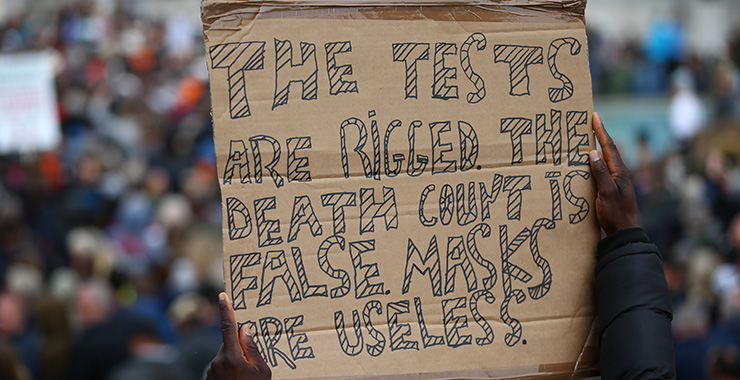
Regardless of why it’s shared, misinformation surrounding COVID-19 has been so rampant that the World Health Organization (WHO) declared a parallel “infodemic”opens in new window to describe the scale of fake news and its potential impact on efforts to limit the virus’s spread.
“There’s often a lot of uncertainty in crisis situations, so people come together and start sharing information in a sort of collective sense-making process,” says Kate Starbird, PhD, an associate professor of human-centered design and engineering at the University of Washington, who studies how information travels during crises. “That process can get things right, but it can also get things wrong, producing rumors that turn out to be false.”
For example, when stay-at-home orders first went into effect in March 2020, Starbird and her colleagues tracked how one Medium article, which misrepresented the scientific evidence on social distancing, went viral after several Fox News personalities shared it (Washington Postopens in new window, May 8, 2020).
Researchers have also started to document the scope of the infodemic. A study that surveyed more than 1,000 U.S. adults in March and July 2020, led by psychologist Daniel Romer, PhD, research director of the University of Pennsylvania’s Annenberg Public Policy Centeropens in new window, found that about 15% believed the pharmaceutical industry created the coronavirus and more than 28% thought it was a bioweapon made by the Chinese government. Those beliefs predicted a subsequent decrease in willingness to wear a mask or take a vaccine (Social Science & Medicine, Vol. 263, 2020).
That pattern also holds in other countries. An analysis of misinformation from five samples across the United States, Europe, and Mexico showed that substantial portions of each population—anywhere from 15% to 37%—believed misinformation about COVID-19 in April and May 2020, representing what the authors call a “major threat to public health.” People who were more susceptible to misinformation were less likely to report complying with public health recommendations and less likely to say they’d get vaccinated (Royal Society Open Scienceopens in new window, Vol. 7, No. 10, 2020).
Though research directly tying misinformation to behavior is still limited, exposure to fake news does have real-world consequences. In the political domain, it is correlated with declining trust in mainstream media organizations (Ognyanova, K., et al., The Harvard Kennedy School Misinformation Reviewopens in new window, 2020) and likely impacts voting behavior, though more research is needed on the nuances of that relationship (Lazer, D. M. J., et al., Scienceopens in new window, Vol. 359, No. 6380, 2018). Misinformation has even spurred violence, for instance when a conspiracy theorist fired a gun inside Washington, D.C.-based pizzeria Comet Ping Pong in 2016.
And on the coronavirus front, “the causal link between misinformation and behavior is actually quite direct and visible,” van der Linden says.
He points to attacks on 5G cellular towersopens in new window in the United Kingdom after an online conspiracy theory linked 5G technology to the virus’s spread, and methanol poisonings in Iran following false claims that alcohol cures COVID-19 (Shokoohi, M., Alcoholopens in new window, Vol. 87, 2020 ). One study documents hundreds of deaths and thousands of hospitalizations around the world associated with COVID-19 misinformation, including rumors, conspiracy theories, and stigmas (Islam, M. S., et al., The American Journal of Tropical Medicine and Hygieneopens in new window, Vol. 103, No. 4, 2020 ).
Cognitive psychologist Briony Swire-Thompson, PhD, a senior research scientist at the Network Science Instituteopens in new window at Northeastern University, cautions that data collected early in the pandemic may not reflect current beliefs. For example, some people who indicated in the spring or summer of 2020 that they were not willing to take a vaccine may have adjusted their stance as the pandemic has progressed. And misinformation isn’t the only factor in hesitancy toward COVID-19 vaccines. Their speedy development, in addition to well-grounded skepticism of the medical establishment among minority groups, also contribute to public uncertainty.
Still, 21% of U.S. adults said in November 2020 that they don’t plan to get vaccinated, even if more information becomes available (Pew Research Centeropens in new window, 2020)—and psychologists say that countering coronavirus misinformation is necessary for breaking the virus’s grip on society.
Efforts to stop the spread
Psychological research backs several methods of countering misinformation. One is to debunk incorrect information after it has spread. Much more effective, though, is inoculating people against fake news before they’re exposed—a strategy known as “prebunking.”
“Like a vaccine, we expose people to a small dose of misinformation and explain to them how they might be misled,” says Lewandowsky. “If they then encounter that misinformation later, it no longer sticks.”
That’s best achieved by warning people that a specific piece of information is false and explaining why a source might lie or be misinformed about it before they encounter the information organically, says Schwarz. Lewandowsky, Schwarz, van der Linden, and others have shown that prebunking can neutralize misinformation on climate change, vaccines, and other issues (Global Challengesopens in new window, Vol. 1, No. 2, 2017; Jolley, D., & Douglas, K. M., Journal of Applied Social Psychologyopens in new window, Vol. 47, No. 8, 2017).
Van der Linden and Jon Roozenbeek, PhD, a postdoctoral researcher at the University of Cambridge, developed and tested this technique using “Bad Newsopens in new window,” a gamified intervention that simulates a social media feed to teach participants how to distinguish between real and fake news headlines on politicized topics such as climate change or the European refugee crisis. Tests of the game—which more than a million people have played—show that playing it once can boost participants’ ability to identify misinformation, but that the inoculation effect decays after about two months (Maertens, R., et al., Journal of Experimental Psychology: Appliedopens in new window, 2020).
“We also found that if we reengage people following the initial intervention, we can boost their response so that the inoculation lasts longer,” van der Linden says.
When the infodemic struck, van der Linden and Roozenbeek built a new online game, “Go Viral!opens in new window,” which aims to prebunk common misinformation surrounding COVID-19. Players assume the role of a manipulator and practice interacting with others in a social media simulation. The game draws on van der Linden’s six degrees of manipulation (describing the six common ways misinformation is produced), teaching players how emotional language, fake experts, and conspiracy theories can be used to mislead. Through partnerships with the U.K. Cabinet Office, the WHO, and the United Nations, the game has already reached thousands of people. For example, the WHO lists “Go Viral!” as a resource for tackling online misinformationopens in new window and has featured the game in its newsletters.
Initial results may be promising, but van der Linden says his team hasn’t yet tested their interventions on more skeptical groups, such as people who intentionally spread disinformation. He says his team hopes to reach those groups through its partnerships with organizations like the WHO, which can market the game on Facebook, Twitter, and other social media platforms.
Another way to address misinformation is to encourage people to reflect on the veracity of claims they encounter. A test of COVID-19 misinformation led by Pennycook and his colleagues found that a simple accuracy nudge increased participants’ ability to discern between real and fake news. Participants saw a series of headlines—some true, some false—and rated whether they would share each item. Those in the experimental condition, who were also asked to rate the accuracy of each headline, shared more accurate news content compared with participants in the control group (Psychological Scienceopens in new window, Vol. 31, No. 7, 2020).
“We tripled the difference in the probability of sharing true versus false information when we drew people’s attention toward accuracy,” Pennycook says.
Media literacy organizations such as the News Literacy Projectopens in new window (NLP) and First Draftopens in new window are applying such strategies in an effort to dispel misinformation and disinformation on COVID-19 and other issues. NLP’s virtual classroom offers 14 lessons on topics such as conspiracy theories and misinformation, drawing on psychological insights on motivated reasoning, confirmation bias, and cognitive dissonance. Nearly 200,000 middle- and high-school students have completed those courses and the organization’s newsletters reach about 40,000 people each week.
Other groups have created media literacy resources geared toward older adults, who are just as capable of spotting hoaxes but have been disproportionally targeted by disinformation sources (Brashier, N. M., & Schacter, D. L., Current Directions in Psychological Scienceopens in new window, Vol. 29, No. 3, 2020). These resources include the Poynter Institute’s MediaWise for Seniors programopens in new window and AARP’s Fact Trackeropens in new window interactive videos.
“We want people to understand that disinformation is fundamentally exploitative—that it tries to use our religion, our patriotism, and our desire for justice to outrage us and to dupe us into faulty reasoning,” says Peter Adams, NLP’s senior vice president of education. “Much of that is a psychological phenomenon.”
What’s next in misinformation research
One key to stanching the deluge of misinformation is to halt its spread on social media platforms, but that requires industry buy-in, which has been slow. During the 2020 presidential election, Twitter flagged tweets that contained misleading information about election results—a form of prebunking—and in December, Facebook announced that it would begin removing posts with false claims about COVID-19 vaccines. In a reversal from previous stances, multiple social media companies suspended or banned President Trump from their platforms for inciting violence at the U.S. Capitol in January, while Congress was certifying the electoral vote of the 2020 presidential election.
“This has made an impact, but the problem has certainly grown faster than the solutions,” Starbird says.
Psychologists say that countering misinformation will ultimately require stronger partnerships with social media platforms, which can help disseminate tools such as “Go Viral!” and provide internal data to researchers studying fake news.
“We need to figure out what’s actually happening on these platforms—how often people see false content, for instance—and that’s very hard to do without buy-in,” says Pennycook.
Meanwhile, research is underway to further characterize the spread of misinformation and its effects on behavior. For example, Chrysalis Wright, PhD, an associate lecturer and director of the Media and Migration Labopens in new window at the University of Central Florida, is studying how misinformation on COVID-19 affects anti-Asian sentiment. And Starbird is analyzing discourse on mask-wearing on Twitter to understand how people invoke science to prove a point.
What’s most needed, though, is research that shows whether media literacy efforts are effective outside of the context in which they’re taught, says Schwarz. Just because people know how to fact-check doesn’t guarantee they’ll do it in the right context.
“So far, the studies are basically like school tests,” he says. “Developing that skill is a start—but do I recognize when I need to use it?”