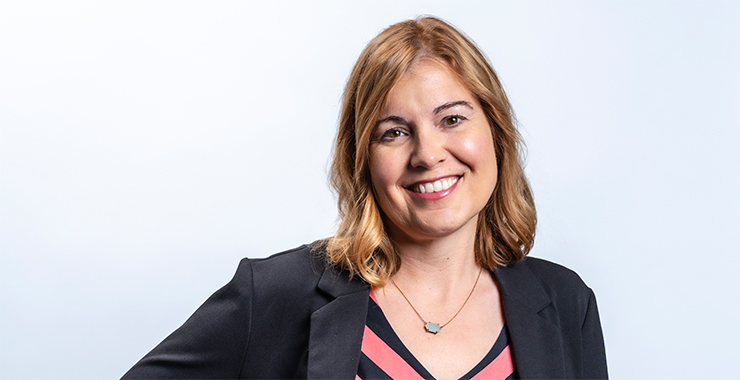
When she chose a career in clinical psychology, Andrea Bonior, PhD, didn’t expect to find herself discussing a tweet from Sesame Street character Elmo on CNN. But in the 2 decades since she completed her degree, Bonior built a media presence that has carried her work far beyond the clinic and the classroom. After 15 years of writing The Washington Post’s Baggage Check advice column, she is now a widely featured expert on mental health, relationships, current events, and more.
Bonior appears regularly on local and national TV, radio, and podcasts; is often featured in The New York Times, USA Today, Vox, and dozens of other outlets; and has authored three popular press books. She also runs a private psychotherapy practice in Bethesda, Maryland, and is a teaching professor in the psychology department at Georgetown University.
She uses her public moments to share insights that can improve people’s lives or change how they see things. That could be a simple tip for dealing with a difficult colleague, a road map to authentic adult friendships, or warning signs of suicide risk in a loved one.
We spoke with Bonior about her work as a science communicator and the joys and challenges of appearing in the public eye.
How did your media work begin and evolve?
During my doctoral studies at American University, I wanted to engage a part of myself that didn’t fit into my coursework, so I started writing an advice column in a web magazine for congressional staffers on Capitol Hill. That led to a very exciting opportunity: I was asked to write the Baggage Check mental health advice column when The Washington Post launched its free commuter newspaper, Express. At the time, I was completing my postdoc, so I assured my training program that my words were my own and the advice wasn’t a substitute for one-on-one care.
At one point, a literary agent contacted me about writing my first book. A few years later, one of my first national TV appearances came through a former student who was a producer on The Lead with Jake Tapper. Things kind of snowballed from there. Media begets media once you’ve shown you can go on set, speak clearly, and connect with an audience.
Your media work spans a broad range of messages, tones, and formats. How do you shift between those while maintaining credibility?
It helps to have a clear guiding principle across everything I do: How can I give people a new insight in a scientifically sound way?
From there, I tailor my message to the audience and the moment, adjusting tone and level of detail as needed. A 2-minute CNN segment, a wellness podcast, and a keynote speech to an industry group each call for a different balance of depth and accessibility.
Another important boundary: I don’t speak outside of my expertise, which means I turn down a lot of opportunities. Once people know you as a psychologist, there’s a tendency to assume you can comment on anything related to mental or behavioral health. But just like in my clinical practice, I have to work within my expertise. Having taught students about psychological disorders for almost 2 decades, I can explain the basics of DSM [Diagnostic and Statistical Manual of Mental Disorders] diagnoses in a television segment, but that doesn’t mean I’d position myself as an expert witness on psychosis.
It also means holding firm ethical boundaries—for example, I won’t speculate on a diagnosis of a public figure, even though that’s a request I get all the time. It can be tempting, especially because you develop relationships with producers and journalists who trust your opinion and want you to go that little bit further.
What challenges can come with increased public visibility?
Our words can sometimes be used against us. Last year, I gave a print interview about how the cuts to the federal workforce were affecting people in the Washington, D.C., area from a mental health standpoint. I talked about how it was—and still is—a devastating and uncertain time for those who have dedicated their lives to government, humanitarian work, and the sciences. I used a particular phrase: “people whose way of life feels under attack.” To me, “way of life” meant values and sense of purpose. But a conservative news outlet homed in on that phrase and turned it into a story about Democrats getting booted off the government’s gravy train. That’s not what I meant or said, but it served that news outlet’s purpose.
You do need a thick skin—and sometimes I struggle with that. Years of writing an advice column helped me learn to handle dissenting opinions. When given respectfully, I welcome critical responses, because I’ve learned a lot from them. But there’s a difference between constructive criticism and hate mail. A few years ago, I wrote an article about helping parents raise children with healthy attitudes toward consent. I got some disturbing hate mail about it, which I always file away in a special folder in case it’s ever needed.
Any therapist has to think about their own boundaries, physical safety, and privacy. But when you’re in the public eye, that turns up the volume immensely—especially at a moment when it somehow feels political to be promoting human values like kindness, empathy, and curiosity.
What lessons and advice about media work would you offer to others who are getting started?
Many of the skills I’ve developed as a clinician and as a teacher have translated into my media work. I learned a lot about my speaking patterns while training to become a therapist when my supervisor reviewed recordings of my sessions. I still find it difficult to watch myself, but being curious about your strengths and deficits can help a lot. For example, if you’ve been invited to appear on a podcast, try recording yourself and listening for verbal tics, like repeating the word “um.” Years and years of teaching 20-year-olds have also helped me see that I can share as many journal articles as I want, but I need to occasionally use humor and real-world examples to make my points hit home.
There are some basics I’ve learned: Wear solid colors on TV, avoid jangly necklaces around the microphone, and stand when recording audio so your voice projects. That’s the simple stuff. The harder work is getting comfortable with yourself and loosening the grip of perfectionism. A lot of times when people get nervous, it’s because they’ve set such high expectations for themselves.
If you’re starting to do media work, think about how you can incorporate your personality. We do need to maintain some boundaries, but letting your own strengths shine through can really enhance this work. Ultimately, you’re making a human connection with the audience—and in this age of uncertainty about AI, those organic, human strengths matter more than ever.