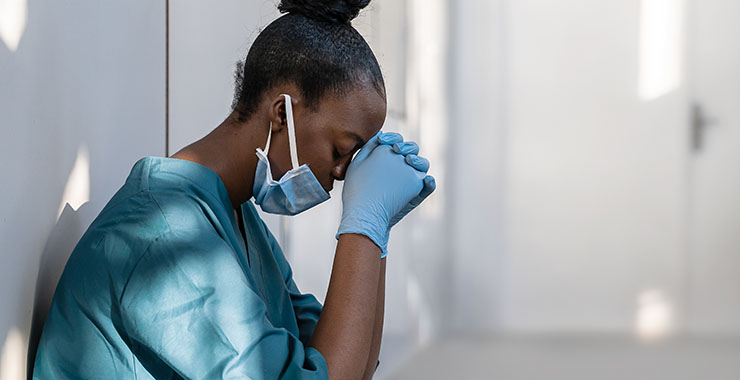
Occupational burnout, a psychological syndromeopens in new window consisting of emotional exhaustion, feelings of cynicism, and reduced personal accomplishment, is especially prevalent in high-pressure, demanding fields like health care. Researchopens in new window suggests around 1 in 3 physicians are experiencing burnout at any given time, which not only puts their well-being on the line, but also compromises patient care.
Health care workers who were already vulnerable to burnout faced an even higher risk during the COVID-19 pandemic, which introduced longer hours and a higher risk of infection to their workplace. And as COVID-19 took its toll, health care providers who worked directly with COVID patients also became second victimsopens in new window as they reckoned with ongoing loss. These combined stressors, experts sayopens in new window, put clinicians at heightened risk for mental health problems, along with increasing their preexisting vulnerabilityopens in new window to suicidal ideation. Now, health care workers are facing the stress of rising cases and more hospitalizations as the Delta variant spreads.
At the front lines of ensuring these providers’ well-being is counseling psychologist Craig Rooney, PhD, program director of The Office of Clinician Well-Beingopens in new window at the University of Missouri Medical School.
His office supports about 1,200 faculty, fellows, residents, and advanced practice clinicians, including those who may be struggling with burnout or mental illness. During the pandemic, he and his team introduced new ways to support these staff, addressing the effects of the pandemic’s trauma and re-introducing the importance of managing burnout.
Rooney says the pandemic opened his eyes to the need for a multi-pronged, multi-intervention approach to best support these front-line workers. He also saw the need to address some of the structural and systemic variables that contribute to burnout. “If we learned anything during the pandemic, it’s that there’s no single way to help clinicians with burnout,” he says.
APA spoke to Rooney about why addressing burnout is so important and what his team is doing to help.
How does physician and nurse burnout affect patient care?
When I give talks to clinicians about burnout, I provide three main arguments about why it’s important. First, we have the moral ground: Physicians and nurses who are burned out are more likely to develop alcohol and drug use disorders, more likely to be depressed, and are at higher risk for suicide, so it’s our job to help protect their well-being.
Then, there’s the care argument. We know physician and nurse burnout scores correlate with higher medical error, more malpractice litigation, lower patient satisfaction, higher turnover, higher patient mortality in intensive-care units, higher absenteeism, and more hospital-based infection. This is reason enough to support clinicians with burnout, but patient outcomes also trickle into the moral and business arguments. It can be a vicious cycle.
Third, there’s the business argument. Simply put, replacing burned-out physicians is very expensive.
What did you and your team learn about burnout in health care settings during COVID?
We learned that for many, COVID-19 had a multiplier effect on the issues of burnout that existed in health care settings prior to the pandemic. It exposed the fissures that already existed.
Most people can identify with how disruptive COVID has been in general—but now imagine your job involves repeated exposure to the virus and its death toll. You’re concerned about transmitting the virus to your family, plus you’re working long hours.
During the pandemic, we did what we could to help our clinicians be resilient. We offered free, formal mental health treatment via telehealth alongside a well-trained peer support team called forYOU, which provides resources that help clinicians cope with work-related stressors.
The leadership of our medical school and academic health center also arranged for onsite child care and alternative housing for people who tested positive or had a significant exposure. We provided meals, a rolling tea cart, massage therapy on site, encouraging chalk messages on the sidewalks, meditation, and quiet rooms. We also used an app called Kudos to foster the expression of appreciation and gratitude across the organization. Within the app, administrators can gift points redeemable for gift cards.
On the other side of the pandemic, we want to ask the broader questions about what kinds of features in the environment continue to burn them out in large numbers so can we attempt to fix those.
One fissure we noticed is the increasing administrative burden on clinicians, who have had to spend more time than ever working on patient charts and dealing with paperwork, forms, and pay structure issues. There are a lot of potential workflow interruptions, like inadequate technology and staffing and productivity requirements, that don’t allow clinicians a reasonable amount of time for their personal lives.
What interventions are helping clinicians recover from COVID-19 stress and trauma?
Our short-term counseling program increased in use 175% during the pandemic, and I think that’s an indication that it’s helping.
It’s tough for busy clinicians to plug into a community therapist, whose hours might be limited. We lowered as many barriers as possible. I’m on site where they work, the services are free, and I can meet via telehealth with flexible hours.
We also focused on letting clinicians know they had our support with whatever they may be struggling with. We held training about trauma and the delayed mental health effects of natural disaster events, which prepared leaders in our organization to respond to team members struggling post-pandemic.
We also thought it was important to offer points to stop and reflect on the loss of the pandemic. Clinicians may have functioned in survival mode [during the height of the pandemic]. Now, many of them are beginning to process the trauma.
To help with that, in May 2021 we conducted a COVID-19 commemoration ceremony to honor those patients we’d lost to COVID-19. We live-streamed it so clinicians could be part of it and coordinated a moment of silence throughout the hospitals.
What role does prevention play in managing burnout?
My training as a psychologist leaves me with a bias that prevention is always better. It’s better to prevent deterioration than to patch things up after injury. Of course, prevention always presents a measurement challenge in terms of effectiveness—it’s easier to measure outcomes after the fact. But we’re doing our best to equip our doctors, nurses, residents, and trainees with a variety of tools they need to stay well.
People are barraged by emails, so I show up in person as much as I can. It’s better to get their attention by attending faculty meetings and staff retreats where I can talk about the issue of burnout before it becomes a major issue.
Earlier in the pandemic, we began going into the COVID-19 units and touching base with people on a regular basis to check in on how they were doing and making a support person available in all units. Our goal was to prevent them from feeling isolated and alone during a really challenging, traumatic time.
We’re also developing a physician leadership development program we hope to launch this year. We think if we give doctors better leadership tools, we can prevent some of the downstream effects of burnout that can stem from poor leadership.
How can psychologists help spot the signs of burnout in fellow providers?
Psychologists have been working harder over the last year than ever before. They’re experiencing similar stressors as their clients, which is unique in our work—plus, with repeated exposure.
Bringing a psychology-minded lens to behavior is helpful. Christina Maslach’s work offers a clear picture of what burnout looks like: emotional and physical exhaustion; depersonalization that shows up as cynicism, sarcasm, or compassion fatigue; and a lack of efficacy—not doing a good job or doubting your ability to do a good job. If you see these things in a fellow psychologist or health care provider, it’s worth considering they are burning out.
If that’s the case, I think it’s always helpful to remind people how common burnout is in our profession, and just as important, that it’s never been easier to get support. Thanks to fewer regulatory hurdles we saw in the pandemic, psychologists who may be hesitant about seeking psychotherapy locally can simply find a telehealth clinician in another city.