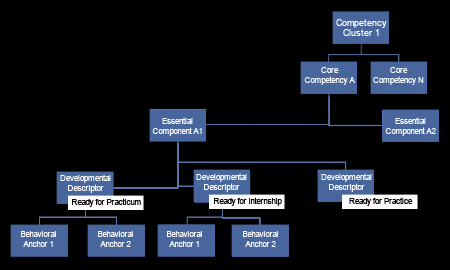
The Benchmarks Evaluation System sought to transform the content of the Benchmarks document into a useable instrument for assessing and tracking students’ competence during their training in professional psychology. It is generally recognized that the original Benchmarks document itself is too large and extensive for use as a tool to rate student competence. For example, it is broadly inclusive of the full range of professional competencies, some of which may not be relevant to a particular graduate or internship program. In its focus on the evaluation of student competencies, the Benchmarks Evaluation System fulfills a need that most programs have to evaluate and document student progress toward program goals. The system provides an immediately accessible approach for examining your program’s current training goals, and mapping them onto the Benchmarks evaluation forms. These forms can then be used to evaluate students’ progress toward your program’s goals. We believe that this approach can also help programs gauge their interest and readiness for a broader implementation of the competency-based approach, which is discussed in the second section of the guidebook.
The Benchmarks is not intended to be implemented as a fixed model, and accordingly the Benchmarks Evaluation System is designed to be used in a flexible way to tailor a set of competency expectations and rating forms that represent the goals and learning outcomes of a particular training program.
Adapting the benchmarks evaluation system for your program
Modifying the Benchmarks to a particular program involves the following process.
- First, program faculty or staff should examine the revised competency benchmarks document and review the 6 clusters to determine which of the clusters are areas of focus in their own training program.
- Second, after choosing overall clusters, look at the core competencies within and decide which ones match your program’s goals and mission.
- Next, within each core competency, choose which of the several essential components that you want trainees to develop. Additional essential components may be added to match the goals of your program. Each essential component has three developmental descriptors, which indicate the developmental progression of the essential component at the readiness for practicum, readiness for internship, and readiness for practice levels. These descriptors may be modified if needed to fit your program and its goals.
- Finally, refer to the Appendix on the webpage and select or modify behavioral anchors (examples) relevant to your program that help clarify the essential components and their developmental descriptors.
We stress again that programs are free to develop additional individualized essential components and behavioral anchors that characterize the program’s curriculum and identity.
Example: Consider an internship program in a large Children’s Hospital in an urban setting. The program chooses the clusters of professionalism, relational, application, science, education and systems.They choose all of the competencies under each cluster, except for teaching in the education cluster, and the management and advocacy competencies under systems. Further, they choose all of the essential components except for scientific approach to knowledge generation under science. They had considerable discussion about whether or not expecting students to develop competencies in producing research, but came to consensus that with the time limits and expectations of clinical hours at the hospital, they cannot expect interns to develop that competency.
The faculty then develops a set of behavioral anchors for each essential component at the readiness for entry to practice level that is particularly geared to working with children and their families. In addition, the faculty identified particular competency areas that they wanted students to end the year with very high levels of demonstrated competence that corresponded to their work in an urban academic hospital: individual and cultural diversity, evidence-based practices and interdisciplinary systems. To that end, they identified behavioral descriptors that conveyed that high level of competence in those competence areas.
Choosing the evaluation form
. For ease of use, the Benchmarks Evaluation System offers the option of an overall form that applies to all levels of training, and as a set of three forms, one for each developmental level. The overall form takes a wide developmental perspective, assuming the possibility that a given individual may be considerably above or below the level generally expected at their level of training. The overall form offers an unconstrained range of rating levels, allowing description of competence at levels below and above those assigned to the student’s level of training. For example, a practicum student who has exceptional competence in individual and cultural diversity may be better described using the “readiness for practice” level than the “readiness for internship level.” The disadvantage of the overall form is that it has three times as many developmental descriptors for each essential component, and is therefore longer and harder to use by supervisors or instructors. Since a key goal of the Evaluation System is to make competency rating feasible, it also offers three additional forms, each corresponding to the one of the three training levels. These forms are easier to use, and we recommend them for regular application. In this case use of the overall form may be indicated for initial competence assessment prior to entering a new training level, or in cases where particular strengths or weaknesses are detected and need to be tracked.
Using the rating scale
. Examining the overall evaluation form, note that qualitative differences in competency standards are suggested at each of the three levels (increasing competence across levels moving left to right). Within each level, using either the full form or the level-specific form, the rating scale is used to indicate how characteristic the competency description is of the trainee’s behavior. The rating scale is a 5–point Likert scale ranging from “0” (“Not at All/Slightly”) to “4” (“Very”). The scale requires that raters judge the match between the competency description and the trainee’s behavior; thus, raters are not asked to make an additional quality or preparedness judgment. This approach is intended to help raters maintain focus on observed behaviors, and to reduce the inflationary influence induced by making broader or more critical judgments (e.g., “meets expectations,” “excellent/outstanding” vs. “average,” etc.).
For each item, raters should select the number corresponding to how characteristic the competency description is of the trainee’s behavior. If the individual being rated is best described by a “0” or “4” on any individual item (indicating that the individual has not yet demonstrated the behavior or always demonstrates the behavior reflected in the item, respectively), the rater using the full form has the option of rating that item at the level below or above the individual’s training level in order to provide the individual with additional information regarding their achievement of each competency. Otherwise, the rater should request a full form, or use the narrative section at the end to detail the issues involved. At the end of each evaluation form, raters have the opportunity to write a qualitative narrative summarizing the trainee’s current level of competence and describing the trainee’s strengths and areas for further work.
Setting competence expectations
. The minimal expected competence rating for each competency is the program’s decision, rather than that of an individual rater (e.g., a supervisor). The supervisor is not asked to determine whether or not a trainee showing the specified level of competence meets competence criteria. For example, a program with a strong emphasis on multicultural counseling might expect the essential ICD component “Monitors and applies knowledge of self as a cultural being in assessment, treatment, and consultation” (2A) to be evident in the first two years of training, and to expect the behavior to be “very” characteristic of trainees. Trainees meeting a program’s criteria for competence should progress to the next level (e.g., “readiness for internship”), whereas those who do not, should participate in a remediation program (see section below on Remediation Plans for guidance on developing an effective plan for trainees with competency problems).
Familiarizing faculty and supervisors with the evaluation forms
. Although it is optimal for the faculty and supervisors who will use the rating forms to participate in developing them, it is often the case that, for example, supervisors who have no prior acquaintance with the competencies approach or with using a competencies rating form will be asked to complete a form. If it is possible to gather the supervisors together for an introductory meeting, it is a good idea to present the rationale for the approach and to describe how their work with evaluating trainees plays a crucial role in the operation of the program. Using real (and disguised) or hypothetical examples, the group can work to transform a narrative assessment of a trainee into ratings on the scale. A meeting of this sort should also allow supervisors to raise questions and concerns about the competencies approach, about the scale, and about the practical issues involved in using it. If a meeting is not possible, then a letter, a phone call, and/or referring them to this website may help in orienting the supervisors. We have found that supervisors unfamiliar with this process may be helped by a phone call from a knowledgeable faculty or staff member, in which they are walked through the process of applying the form for a particular trainee they are working with.
Orienting trainees to benchmarks and methods of evaluation
. Trainees should be oriented to the program’s competencies, means of evaluation, and competency expectations at the start of their training, and at relevant transitions (e.g., before starting practicum). At the inception of an evaluation period for a benchmark (e.g. introduction to assessment), the instructor and/or training director should introduce the trainee to the Benchmarks, the relevant essential components, the developmental descriptors, and their behavioral anchors. This orientation prepares the trainees to be focused on the learning objectives for the experience and to be self reflective about development of the skills involved.
Objections to the evaluation system
. In the course of orienting faculty or supervisors with the competencies benchmarks rating forms, a number of objections to them have arisen. We will briefly discuss these objections to assist in the orientation process.
- The rating form takes evaluation out of the ongoing relationship with the supervisee, and introduces a judgmental and critical component into a supportive relationship.
We have found that this can be true if the form, and the valuable role is serves in the student’s training, is not discussed with the supervisee at the very start of the supervision. If the supervisor regards the competencies approach and the form as an intrusion, of course this will affect how she presents it to the trainee. However, if the supervisor goes over the form and uses it as a way to talk about what she and the trainee will be working on during their time together, and if the supervisor uses the form regularly to praise the trainee for areas of growth, and to work with the trainee on areas that need more attention, then the trainee will generally find a good deal of comfort in the clear expectations voiced by the supervisor and the ongoing sense of the progress she is making toward the goals of the supervision. Of course, in these discussions, the supervisee’s own input is key – what does she want to gain from the supervision? Where does she think she is in terms of the goals at this point in time? In other words, if the rating form can become a part of the collaborative relationship, then it will be much less likely to be experienced as an intrusion by the supervisee. We have found that it is easy to overlook how concerned trainees are about their supervisor’s expectations, and how worried they are about critical evaluation of their work. Rating forms, and a good discussion of the competencies they are meant to assess, can help by making these expectations explicit, and by voicing the supervisor’s evaluation. This evaluation so often remains implicit, to be filled in by the trainee’s own overly-active sense of deficiency as a novice in a complicated field.
The rating form, by itself, is not warm and engaging, and does not offer a coherent summary narrative of the supervisor’s evaluation of the trainee. The forms have a narrative section at the end, where the supervisor can enter an evaluation for the trainee that summarizes the observations on the form. But beyond that, the crucial element is that the rating form is the basis of an ongoing discussion with the trainee about her progress and the challenges to be addressed.
- Faculty or supervisors are too busy to complete the form, especially considering that it is 7 or 8 pages long.|
In addition to finding a way to explain the overall idea of the competency-based approach, and how important the forms are to the trainee and the program, we have mentioned that going over the form with the supervisor in relation to the trainee she supervises is a useful way to help the supervisor both understand that it is important to the program (because the faculty member is taking time to go over the form in detail with the supervisor), but also it helps the supervisor realize that it’s not as difficult as it seems. Despite the fact that the newly revised forms help condense the original Benchmarks, there is inevitably still some redundancy in the form, so that the number of judgments that go into it is not as daunting as may first appear.
- Supervisors and other evaluators tend to use the high end of competency rating scales. This causes problems with validity and reliability. What can be done about this?
Here again it is important to assist supervisors and other evaluators in understanding the larger picture of the developmental nature of growing competence. To use a developmental analogy, a parent does not fault a toddler for walking awkwardly, but hovers nearby to ensure her safety, and praises her increasing mastery. We expect all trainees to achieve the levels of competence that we all aim for, but expect that at any given time, there will be room for growth. The goal of the competence approach is to foster this growth optimally, and to help the trainee and the program to understand where they are in their growth so as to be of greatest assistance. It does not help anyone in this task if the ratings are unrealistic or inaccurate. At the same time, we have worked to stress the developmental features of the benchmarks in our version of the rating scale, and to eliminate as much evaluative language as possible. For example, we do not use “meets expectations” or “satisfactory progress;” we simply ask how characteristic a given descriptor of competence is of the trainee involved.
Communicating competency evaluation results to trainees.
Competencies that have been assessed with the Benchmarks Evaluation System may be utilized for formative or summative evaluations or both.
Formative evaluation. Formative evaluation is offered regularly during the ongoing training process, and is intended to help the trainee understand where she is in the process of developing professional competencies – to understand how and where she is gaining competence, and to locate areas that may need more attention. Trainees may be encouraged to self monitor during the learning experience and to be aware and document their observations of their own learning experience. Trainees may meet with the faculty instructor or supervisor periodically to discuss self evaluation of their competency development and to receive feedback from the faculty instructor. The formative approach allows trainees to make corrective adaptations while still within the learning experience rather than possibly spend weeks in a semester before corrective action. The disadvantage of ongoing evaluation is the time demand for the faculty or supervisors and trainees. The ongoing self monitoring aspect for trainees, even though time consuming, is especially beneficial to the incremental development of skills.
Summative evaluation. As its name implies, summative evaluation provides an integrative overview of the trainee’s skills at the conclusion of a period of training. The Benchmarks Evaluation System tends to blur the distinction between formative and summative evaluation, because it does not ask the evaluator to determine whether the trainee’s performance meets predetermined criteria for adequacy, which is a common feature of summative evaluations. A full summative evaluation would be the result of comparing the evaluator’s ratings with the criteria for adequate performance established by the training program. Thus a faculty member or supervisor may offer a final formative evaluation, and the program director may offer a final summative evaluation after matching the faculty or supervisor’s ratings with the program’s criteria for adequate performance. This task may be assigned to the faculty or supervisor, however, in which case the final evaluation will be summative. As noted above, however, this dual task may reduce the validity of the faculty or supervisor’s ratings of the trainee’s performance.
At the start of the training experience, the program director is encouraged to review the evaluation form that will be used for the final evaluation with the trainee, who should also be informed of the expected levels of competence for acceptable performance. Having clear expectations for what is to be accomplished during the training period is very important.
The value of evaluation is enhanced when trainees are asked to rate themselves on the evaluation form at the start of the training experience. Reviewing these self-evaluations with the faculty or supervisor at the start of training can also help both trainee and supervisor develop more focused goals for the training experience. Comparison of these self-evaluations with a repeat of them, and with faculty/supervisor evaluations, can help trainees see the progress they have made, identify areas in need of further work, and enhance their own self-reflective skills through comparison with supervisor ratings.
Remediation plans for competence problems
One of the benefits of the Benchmarks Evaluation System is that its focus on competencies can help quickly to identify competency problems. It is extremely important that a program have a documented plan for addressing competence issues, rather than making up a plan at the time that a trainee shows evidence of a competence problem. As part of this plan, the competencies rating forms can help pinpoint and document a trainee’s competence problem, and may point to steps for remediation. Continued evaluation using the forms during remediation help document the trainee’s progress (or lack thereof), and support further administrative action should it be needed. To aid this process further, a model Competency Remediation Plan and other resources are available.
Ethical guidelines require that efforts to resolve conflicts and problems must first be made informally, so it is critical that any competency concerns are first discussed with the trainee. Once a competency problem is identified, it is recommended that all relevant parties come together in a remediation meeting. The plan includes noting the date and names of the trainee, faculty, and supervisors. The competency domains of concern are noted (identifying one or more of the 16 competency areas), in which the trainee’s performance does not meet the benchmark required by the program. The plan then documents the description of the problem(s) in each competency domain with as much specificity as possible, the date it was brought to the trainee’s attention, and steps already taken to address the problem by both the trainee and the faculty/supervisor. The plan then documents the specific expectations for acceptable performance, noting the trainee’s responsibilities and the supervisor or faculty’s responsibilities for action. The timeframe for acceptable performance is specified, as is how and when the performance will be assessed. Finally, the plan documents the consequences for unsatisfactory remediation, if the trainee is unable to change his or her behavior.
Example: As an example, consider a student who is a 1st year doctoral trainee in a practicum class. His first journal entry notes his fear of African-American clients. His responses to ethics vignettes in class indicate lack of knowledge about the ethics code and poor ethical decision-making. His instructor is concerned, talks to him about it, but notes that the student has made no effort to focus on increasing his cultural competence or learning more about ethical decision-making. She brings her concern to the faculty for help to develop a remediation plan. The faculty identify the competency areas as ethics and individual and cultural diversity. The remediation plan included discussions with the trainee about concerns and potential harm to clients. The faculty determined that they expected him to be able to articulate appropriate responses to new ethics vignettes and to demonstrate self knowledge of what led to unconscious biases against African-Americans. The faculty decided that they would work with him in an independent study on ethical decision making and on categorization theory and knowledge of self and others. They would evaluate him at the end of the semester, and the consequences of failing to demonstrate competence were determined to be probation or expulsion.
Evaluating the relationship competency
As part of the work of the benchmarks workgroup, an evaluation form focusing on the relationship competency was developed that gathers and organizes all references to relationship competencies in the benchmarks document, yielding a more specific and expansive set of essential components than those found in the relationships competency in the benchmarks rating forms. Faculty instructors or directors of training may consider utilizing the more expansive version of this competency if (1) the program values greater or more specific relational development or (2) the program encounters trainees who are having particular difficulties in relational skills with faculty, peers, supervisors, or clients. Trainees with competence difficulties are often reported to have particular problems with relationships. The more detailed Relationships Competency Rating Form can help specify and document these difficulties, and can help in monitoring the effectiveness of remediation plans for these trainees. If the more expansive form is used for routine assessment of competence, it is recommended that the formative approach be utilized with this competency given the difficulty of teaching relational competency and the importance of specificity, examples, and direct guidance for trainees.