

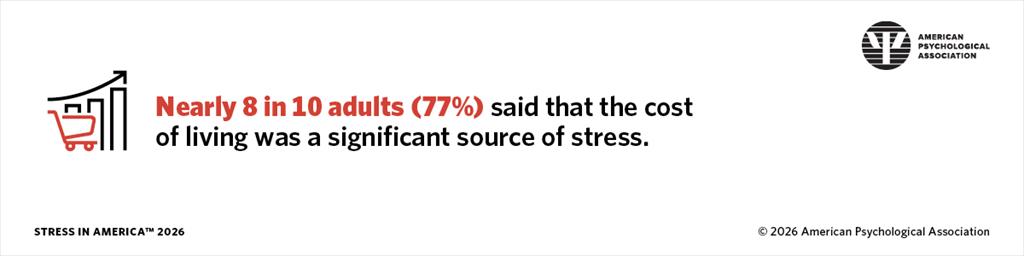
Highlights from the 2026 Stress in America™ report reveal that stress remains a constant in daily life as people across the United States navigate another year marked by economic pressures, political tension, and global uncertainty. Nearly 8 in 10 adults (77%) said that the cost of living—the necessary costs of day-to-day life such as rent, mortgage, groceries, child or family care, and transportation—is a significant source of stress in their lives, making it the most frequently cited source of stress.

American Psychological Association. (2026, October 22). Stress in America™ 2026: The stress of uncertainty. https://www.apa.org/pubs/reports/stress-in-america/2026
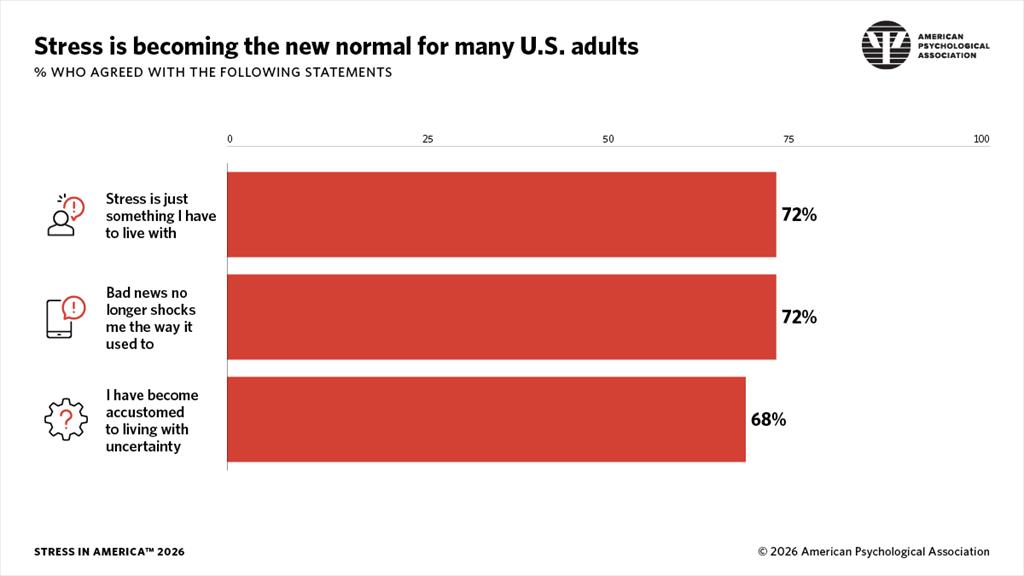
Against a backdrop of persistent uncertainty and ongoing societal challenges, many adults appear to view chronic stress as something to be managed rather than overcome. In response, many seem to be recalibrating their expectations, shifting from hopes of returning to stability toward learning how to live amid ongoing uncertainty. Stress is no longer being experienced as an interruption to everyday life. For many U.S. adults, it has become part of the baseline.
What’s stressing out U.S. adults most—and why it matters ahead of Election Day 2026
Financial pressures and concerns about the future of the nation continue to dominate the stress landscape, highlighting the extent to which questions about affordability, financial security, and the country’s direction are weighing on people’s minds. Ahead of the 2026 midterm elections, these findings offer important context on the concerns U.S. adults are carrying with them into the broader political environment.
The economy in general remains a top-cited source of significant stress. After climbing sharply from 64% in 2023 to 73% in 2024, the economy has remained a significant source of stress among three-quarters of the population, reaching 75% in 2025 and 74% in 2026. More than seven in 10 adults (71%) reported that money is a significant source of stress, an increase from 63% saying the same in 2023.
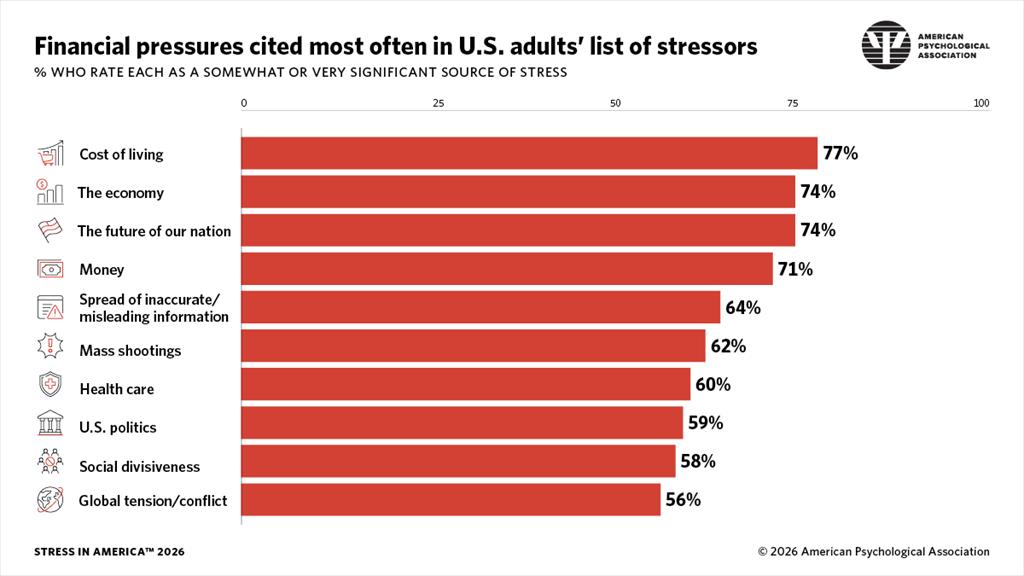
The pressures U.S. adults face are not solely financial. Health care (e.g., access, affordability, finding time for appointments, etc.) remains a prominent stressor; six in 10 adults (60%) identified it as a significant source of stress in their lives.
Many adults also reported stress tied to the nation’s political and social climate, which is important context before Election Day. Concerns about the future of the nation (74%) rank alongside economic issues as one of the most often cited sources of stress facing adults across the nation, reflecting uncertainty about the forces shaping both individual lives and the broader national landscape.
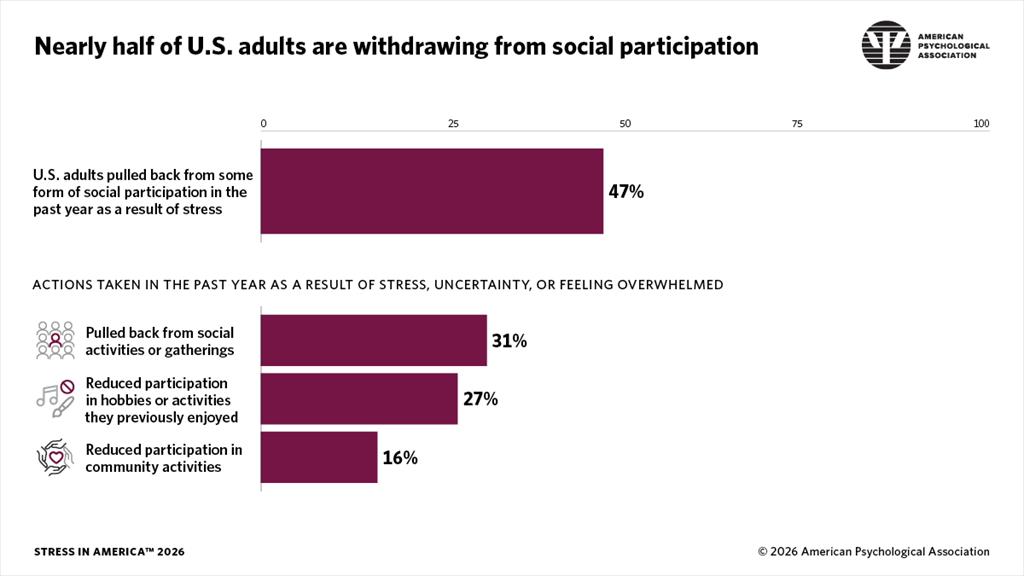
The effects of chronic stress extend well beyond how people feel. For many adults, stress has begun to shape how they spend their time, engage with their communities, and participate in daily life. While most have not given up on relationships, civic involvement, or the issues they care about, many feel increasingly stretched for the emotional and mental bandwidth needed to stay fully engaged.
As stress accumulated, many adults reported pulling back from activities that once provided enjoyment, connection, or support. Nearly half (47%) said they had pulled back from at least one form of social participation over the past year as a result of stress, uncertainty, or feeling overwhelmed.
The pull to withdraw extended beyond social activities. More than one-third of adults (37%) reported disengaging from the broader world around them. Nearly three in 10 (28%) said they had avoided watching or reading the news, while about one in five (21%) reported avoiding engagement with political or societal issues altogether.
Yet these behaviors did not necessarily signal apathy. In many cases, adults appeared caught between a desire to stay engaged and a struggle to manage the emotional toll of doing so. Half of adults (51%) reported feeling too emotionally drained to stay engaged with everything happening in the world. At the same time, nearly two-thirds (63%) believe that getting involved in their community, social issues, or politics could make a meaningful difference in their future.
The tension between wanting to remain engaged and having the capacity to do so may be particularly consequential for social connection. About half of adults reported at least sometimes feeling isolated from others (51%), left out (49%), or lacking companionship (48%).
As some U.S. adults retreat from social interaction, a similar proportion report regularly turning to AI for connection and guidance
As social withdrawal and emotional exhaustion became more common, many U.S. adults reported turning instead to AI for support. What began as a tool for answering questions and improving productivity appeared to be taking on a much broader role in people’s lives, with adults relying on it to navigate decisions, process emotions, manage stress, and even address needs traditionally met by friends, family members, or health professionals.
AI use increased significantly in 2026. Seven in 10 adults (70%) reported intentionally using AI, up from 62% in 2025.
Many adults reported using AI to help navigate everyday decisions and challenges. Among those who had used AI, nearly two-thirds reported they had used it to help make day-to-day decisions (65%) or organize their thoughts (63%). Others reported having turned to AI for health information and guidance, including getting input on treatments (62%), self-diagnosing (60%), and for discussing their physical health (59%).
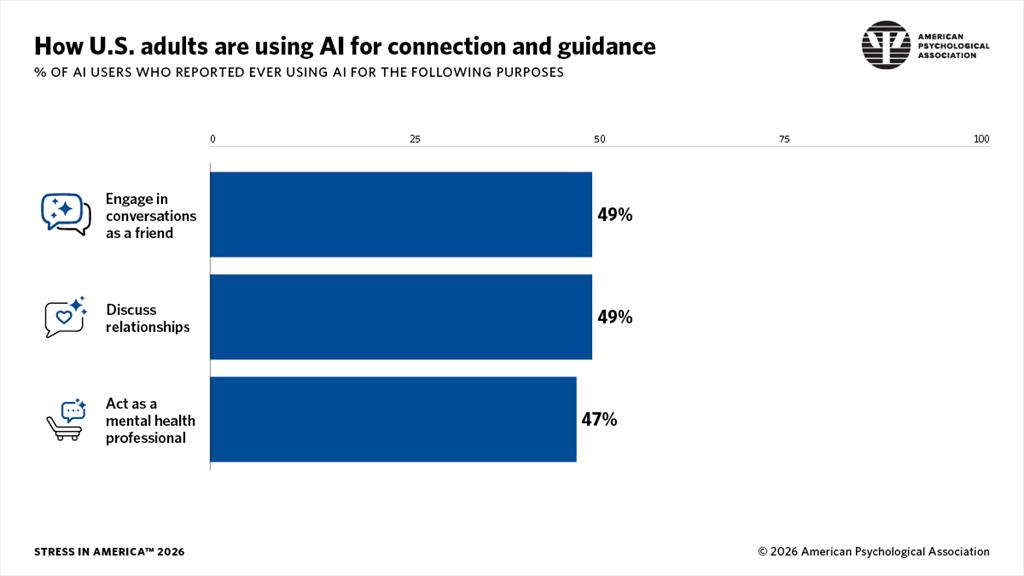
AI also appeared to be serving social and emotional functions for some adults. Nearly half of AI users reported that they had engaged in conversations with AI as a friend (49%) or discussed their relationships with it (49%). A similar proportion (47%) reported using AI in a role comparable to a mental health professional, such as obtaining a second opinion on suggestions by a therapist or practicing therapeutic exercises. One in 10 AI users reported that they rely on AI more than they rely on friends and family for advice.
Together, these findings suggest that many adults were using AI not only to answer questions or complete tasks, but also to organize thoughts around experiences and seek emotional support.
These emerging uses of AI reflect a broader shift in how some adults are responding to ongoing stress, uncertainty, and social isolation. For some, AI appears to supplement sources of advice, connection, and support that have traditionally come from friends, family members, or professionals. For others, its growing role raises questions about dependence, disconnection, and the place technology may increasingly occupy in meeting emotional and social needs, as well as safety concerns about whether AI is offering the right advice in place of professionals.
What are the obstacles U.S. adults believe are preventing them from achieving their dreams?
As stress and uncertainty become increasingly embedded in daily life, many U.S. adults reported feeling less certain about their ability to shape their future. More than one in four adults (28%) said they had little to no control over their future, up from 23% in 2025. For some, that uncertainty appeared to be influencing not only how they viewed the future, but whether they planned for it at all.
Over the past year, one in four adults (26%) have put their futures on hold, with 17% reporting they stopped planning for the future and 16% reporting delaying major life decisions, such as changing careers, purchasing a home, or having a child, because of stress, uncertainty, or feeling overwhelmed. These behaviors were particularly common among younger adults. About one-third of adults ages 18–29 (34%) and ages 30–45 (34%) reported delaying future planning, compared with 24% of adults ages 46–61 and 13% of adults ages 62–80.
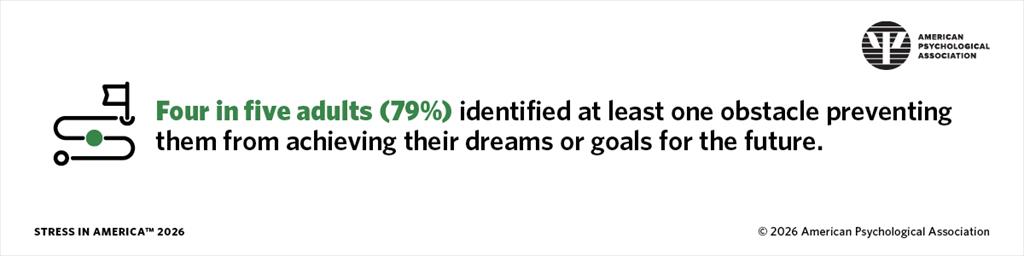
For many adults, these decisions appeared connected to a broader perception that significant barriers stand between them and their goals. Four in five adults (79%) identified at least one obstacle preventing them from achieving their dreams or goals for the future. Economic challenges emerged as the most common barriers, reported by more than half of adults (53%). Two in five adults also reported some type of health barrier standing in the way of their goals, such as physical or mental health concerns (both 23%, respectively) and accessing necessary health care for themselves or their families (13%).
These findings suggest that many adults are navigating a future that feels increasingly uncertain. Financial pressures, health care challenges, anxiety, and broader societal concerns continue to stand in the way of long-term goals and future planning. Yet despite reporting significant obstacles and lowering expectations, most adults (72%) still feel they have at least some control over their future. In that sense, many people appeared to be adapting to stress, even as they questioned what may be possible for themselves and future generations.
Methodology
The research was conducted online in the United States by The Harris Poll on behalf of APA among 3,132 adults ages 18+ who reside in the U.S. (“national sample”). In addition, oversamples allowed for increased totals by race/ethnicity: 801 Black, 803 Latino/a/e, and 827 Asian. The total sample also included 72 individuals who identified as only Native American or Alaskan Native/Native Hawaiian or Pacific Islander, which falls below the standard threshold for reporting (n≥100). For Latino/a/e adults, interviews were conducted in English and Spanish.
The survey was conducted July 29–August 24, 2026.
Data is weighted where necessary to reflect its proportions in the population based on the March 2025 Current Population Survey by the U.S. Census Bureau, PEW NPORS 2025 (for frequency of internet use and political party affiliation) and PEW 2023 (for language use). Weighting variables included age by gender, race/ethnicity, education, region, household income, frequency of internet use, and political party affiliation to bring them in line with their actual proportions in the population.
Latino/a/e adults also were weighted for acculturation, taking into account respondents’ household language as well as their ability to read and speak in English and Spanish. Country of origin (U.S./non-U.S.) also was included for Latino/a/e and Asian subgroups.
Respondents for this survey were selected from among those who have agreed to participate in our surveys.
The sampling precision of Harris online polls is measured by using a Bayesian credible interval. For this study, the general population sample data is accurate to within ± 2.5 percentage points using a 95% confidence level. This credible interval will be wider among subsets of the surveyed population of interest.
- The sample data for the Black sample is accurate to within ± 4.4 percentage points using a 95% confidence level.
- The sample data for the Latino/a/e sample is accurate to within ± 5.0 percentage points using a 95% confidence level.
- The sample data for the Asian sample is accurate to within ± 4.6 percentage points using a 95% confidence level.
- The sample data for the young adult (age 18–29) sample is accurate to within ± 5.7 percentage points using a 95% confidence level.
All sample surveys and polls, whether or not they use probability sampling, are subject to other multiple sources of error which are most often not possible to quantify or estimate, including, but not limited to, coverage error, error associated with nonresponse, error associated with question wording and response options, and postsurvey weighting and adjustments.
Date created: October 2026