Author: Sebastian Junger
Publisher: Twelve
Copyright year: 2016
ISBN: 978-1-4555-6638-9
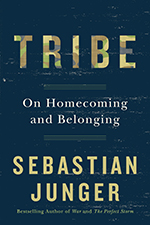 Sebastian Junger’s “Tribe” presents a compelling message of solidarity at a time when divisiveness has run rampant in society. As in “The Perfect Storm,” Junger’s engaging true story of fishermen confronting a maritime disaster, people who face tragedy must often come together in furtherance of a common cause. However, the message in “Tribe” is occasionally clouded by Junger’s promoting the benefits of war, rampage shooting and disasters (man-made and natural) as a means for justifying a more united society. Because of this, readers of “Tribe” could gain the impression that the best way to bring the country back together, reduce depression and suicide rates, and create a more close-knit community would be to perpetrate an event like 9/11. Thus, while “Tribe” may point to the benefits of community unity, readers should also reflect on what the costs might be to achieve such solidarity.
“Tribe” begins with discussion of the loyalty and communal nature of Native Americans, noting that colonists abandoned settlements to live among the Native Americans, but the reverse never occurred. In these simpler times, as Junger’s story goes, people did not have time to be depressed because they were too busy scrounging for resources. Even when Junger states the “impulse [to romanticize Native Americans] should be guarded against” due to regularly used torture and warfare, he quickly qualifies those concerns in the same paragraph, noting that “cruelty… was very much the norm for that era” (p. 13). He then immediately returns to the appeals of Native life and later discusses the solidarity benefits of warfare. His idolizing Native life soon leads to his thesis that increases in wealth and urbanization correspond with increases in depression, suicidality and loneliness. According to Junger, society would be better off with small, close-knit tribal communities of limited resources, dependent on each other for survival.
Research consistently finds that a sense of unity and belonging bring about other psychological benefits and, in this manner, Junger correctly showcases the advantages. However, Junger shows a worrying support for violence as a panacea for society’s ills. For example, Junger relies on studies that the aerial bombardment of London at wartime resulted in fewer psychiatric admissions to (perhaps inappropriately) conclude that bombing an area causally reduces mental illness. He then doubles down on this claim, citing research that war inspires people to be happier and laugh more (p.70) and gain courage, loyalty and selflessness (p. 77). In fact, Junger even says, “deployment … actually lowers the risk of suicide...” (p. 84). Junger even reframes the events of 9/11 as a temporary cure-all for violent crime, rampage shootings, suicide and post-traumatic stress disorder (PTSD) symptoms. While elements of these studies are all likely true, it is troublesome to discuss such negative events as almost exclusively positive ones.
That is not to say positive things cannot come from tragedy. When Junger notes how high unit cohesion for soldiers or high community unity can reduce psychological symptoms, or how soldiers returning from war might miss the war because of the camaraderie they felt in the trenches, he is latching onto an important concept — the human need to belong and be part of something. But the book’s most powerful statements come not from Junger but through quotes from Sharon Abramowitz, who spent time in Africa in the Peace Corps. Abramowitz reminds us that Americans are prone to express support for the military through posters and words, but our society does not effectively give returning troops what is most prized: jobs. In this manner, Abramowitz clarifies that it not just being a member of a tribal community that promotes psychological well-being. Instead, recognizing people for their achievements and assuring that people hold a meaningful role in society could offer innumerable benefits, and not require any bloodshed to achieve them. That would indeed create a tribe people would seek to join.
About the reviewer
Jason A. Cantone, JD, PhD, focuses his research on legal decision making within the federal court system. His current research explores unlawful discrimination, cooperation between federal and state court systems, and how the intersection of social psychology and law can inform decision-making processes. Before his current employment at the Federal Judicial Center, Cantone was employed as an analyst for the United States Air Force at United States Strategic Command. Cantone served on APA’s Committee on Legal Issues (as co-chair in 2016) and currently serves on the APA Conflict of Interest Task Force. The views expressed in all reviews are the author's own and not necessarily those of any employer, past or present. Cantone's reviews are completed outside the scope of his current employment.