Getting into graduate school might seem like a daunting journey, but with the right preparation and resources, you can navigate the process with confidence. In this article, I’ll guide you through the essential steps to help you feel ready to apply for the graduate program of your dreams.
Step 1: Assess your research interests and goals
Before diving into program applications, it’s crucial to understand the direction you want to take with your research. Ask yourself: Do your previous research experiences align with what you want to explore in graduate school? If not, don’t worry! Many undergraduates take on lab manager or project coordinator roles upon graduating to gain more relevant experience in their desired field. Alternatively, brainstorm ways to connect your past research experiences to create a compelling narrative that brands you as a competitive candidate.
Your answer to this question can also help determine the type of graduate program that’s right for you. If you’re looking for more classroom exposure and introductory or intermediate research opportunities, a master’s program might be a great fit. On the other hand, if you’re aiming for expert knowledge and a deep dive into a specific topic, pursuing a PhD or PsyD could be the way to go.
Step 2: Look into research programs
Summer is a great time to start exploring potential graduate programs. Consider the following factors when researching:
- Location: Is it an area you’re familiar with or would like to live long-term? Is it accessible via public transportation or will you need a car?
- Faculty: Are there faculty members whose research interests align with yours? Does the program encourage collaboration beyond your advisor?
- Resources: Does the school invite guest lecturers and scholars? Are there support systems for applying for fellowships and grants? Does the program have a clinical center for hands-on experience? Are there professional development opportunities to prepare you for post-graduate employment?
- Type of program: Is the program clinical, counseling, developmental, social, or organizational psychology? What stands out about the program and how does it align with your research interests and career goals?
Step 3: Start crafting your application
If you’re interested in learning more about applying to graduate school, APA has created a free video seriesopens in new window to provide more information about becoming a psychological scientist. Most programs require a personal statement, CV, letters of recommendation, and sometimes a research statement, writing sample, and/or GRE scores. Here are some tips for each component.
Personal statement
A common mistake that applicants make is restating every experience on their CV in their personal statement. Instead, discuss what your research experience taught you, the skills you developed, and how your experiences shaped your approach to working with certain populations. Focus on delineating rather than listing. Consider also addressing:
- Why this specific program and school?
- Your goals while in the program and upon completion of your degree
- Volunteer, leadership, or work experiences that have influenced how you will engage as a graduate student
- Why you are a good fit for your faculty of interest and the overall school climate
- Faculty members with overlapping interests you can see yourself collaborating with outside of your advisor
Curriculum vitae (CV)
Include core components like your education background, manuscripts, conferences, research, and clinical experiences. Also consider adding professional affiliations, scholarships/fellowships, and awards/honors that you’ve applied for and won.
Research statements and writing samples
Submit statements relevant to your intended research in graduate school. This shows both breadth and depth in your proposed area of study. Cite faculty you’re applying to work with, demonstrating that you’ve read their work and know how to integrate it into a cohesive research plan.
Tip: Tailor a paragraph in your personal statement specifically to each school you’re applying to, showing that you’ve researched the program and understand how it can benefit you and vice versa.
Step 4: Craft an application timeline
It’s not uncommon for undergraduate students to juggle multiple responsibilities while applying for graduate school. A well-planned timeline can help manage the process. Some things to consider applying for as you prepare your application are fellowships such as the National Science Foundation Graduate Research Fellowship Project (NSF-GRFP)opens in new window or APAGS/Psi Chi Junior Scientist Fellowship. In addition, consider inquiring about application fee waivers to alleviate costs, especially if schools have resources to help minoritized students. Applying to graduate school can be a challenging process, but with careful planning, dedication, and the right resources, you can make it a rewarding journey. Remember to stay organized, seek support when needed, and most importantly, believe in your potential to succeed.
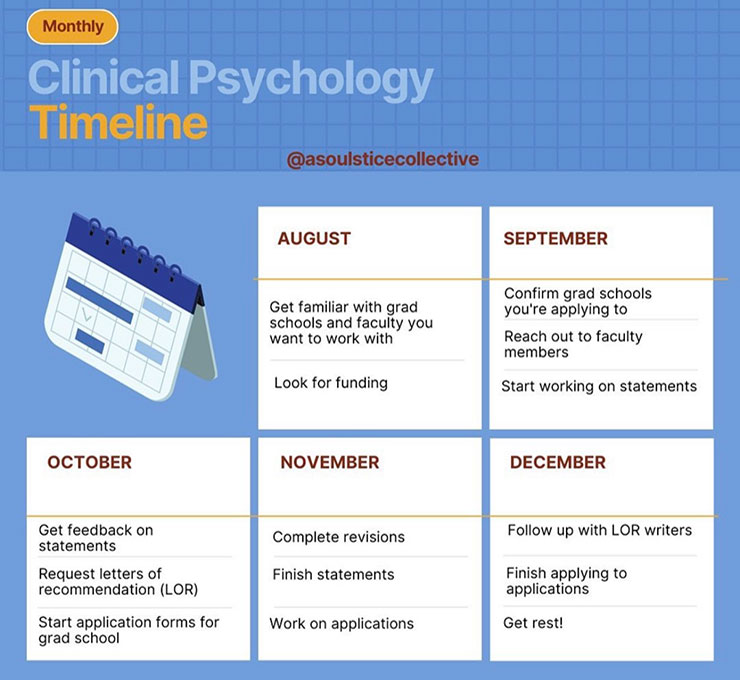
View full-sized infographic with full text description
Good luck, and may you find the perfect program that will propel you towards your academic and professional dreams.
 Lauryn Hoard is a second-year clinical psychology graduate student at George Washington University and is an intern for the American Psychological Association of Graduate Students (APAGS). Her current research interests pertain to examining the effects of offline and online racial discrimination and protective factors in Black Americans. When she is not working, she is either running, doing pilates, trying new foods, creating content (